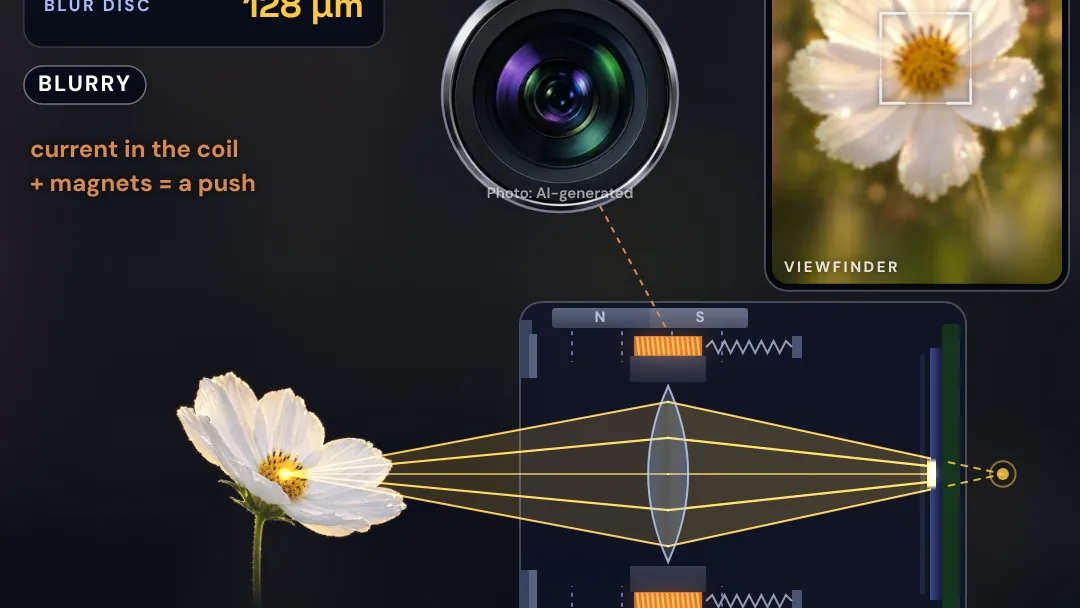
Point your phone at a flower, and the picture snaps from soft to sharp. Nothing in the camera seems to move. Something does. A small lens slides forward, less than a millimeter, so the light lands on the sensor.
Try it yourself in Focus Lab: drag the flower toward the phone and watch the lens slide until it runs out of travel.
Why does one spot make a point sharp?
Light from each point in the scene bends through the lens and meets again at one spot. If that spot lands on the sensor, the point is sharp. If not, it smears into a blurry disc.
The model uses a thin lens with a focal length of 6.0 millimeters, typical of a phone’s main camera, which ranges from about 5 to 7 millimeters. A point at distance d in front of the lens is imaged at v behind it, from 1/f = 1/d + 1/v.
How far does the lens have to move?
A spring holds the lens focused at infinity when it is at rest. A point comes into focus when the lens is pushed forward by s = f²/(d − f). For a flower 50 centimeters away, that is 0.073 millimeters. At 12 centimeters it is 0.32 millimeters, and at 10 centimeters it is 0.38 millimeters.
Real voice-coil actuators typically travel about 0.25 to 0.4 millimeters, so the model’s motor stroke of 0.383 millimeters is in range.
The closer the flower, the faster the required lens movement grows. The lens has to move about 4.4 times farther to focus on the flower at 12 centimeters than on the flower at 50 centimeters, because the light from close objects meets much farther behind the lens.
Why does the flower stop focusing at 10 centimeters?
The motor’s stroke sets the closest distance. In the model it is exactly 10 centimeters, measured from the lens. Phones’ main cameras typically focus no closer than about 10 to 20 centimeters, which is why a phone switches to its ultrawide camera for macro shots. Closer than that, the lens runs out of travel, and the picture stays soft.
What does the model leave out?
The model’s tag reads “thin lens, diagram not to scale.” The diagram draws the lens movement about seven times larger, relative to the lens, than the lens-to-sensor distance, and the flower distances are compressed. The real camera module is only about 6 millimeters deep. Other simplifications:
- Real lenses. A phone lens is a stack of 5 to 8 plastic elements, not one thin lens. Diffraction and aberrations are not modeled.
- How the phone decides. Phones use phase-detection pixels or contrast hunting to pick a distance. The model does not show that choice.
- Stabilization. Optical image stabilization uses similar coils sideways, and it is not modeled.
Predict first, then try
Before you look, predict the lens movement for a flower at 12 centimeters, compared with one at 50 centimeters. Will it be twice as far, four times, or ten times? Then check it in Focus Lab by dragging the flower toward the phone.
Watch the blur disc shrink as the lens slides, and notice where it stops. Drag the flower to 6 centimeters and see the motor run out of travel. Explain to yourself why the picture stays soft after that point.
The photos are AI-generated illustrations. The blur in the viewfinder is computed by the model, and every number comes from it.
Sources: Analog Devices, Lens driver focus in camera modules, Analog Dialogue; Lux, iPhone Macro: A Big Day for Small Things; Wikipedia, Thin lens; Wikipedia, Circle of confusion; Wikipedia, Voice coil.
Sources & further reading
Make the next question an experiment.
Browse independent creators who make big ideas visible.
Find an explainer