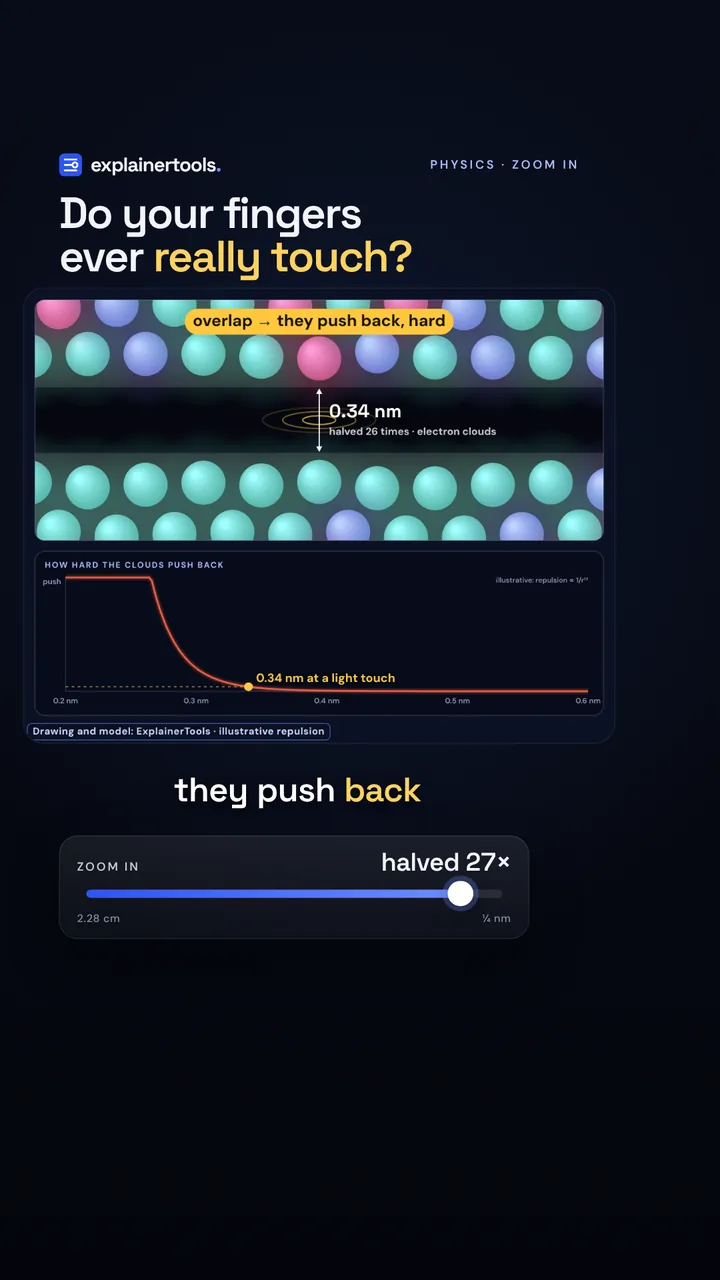
A viral 3D film halves the gap between two fingertips 26 times, past fingerprint ridges, skin cells, keratin and atoms, and stops at about a third of a nanometer. It mixes two ideas. Halving forever is Zeno’s paradox, but ½ + ¼ + ⅛ + … adds up to exactly 1, so infinitely many steps can take a finite time. What really stops the gap is the electrons: every atom wears a cloud of them, and overlapping clouds push back steeply. Press harder and the gap barely shrinks. That last third of a nanometer is what touching is.
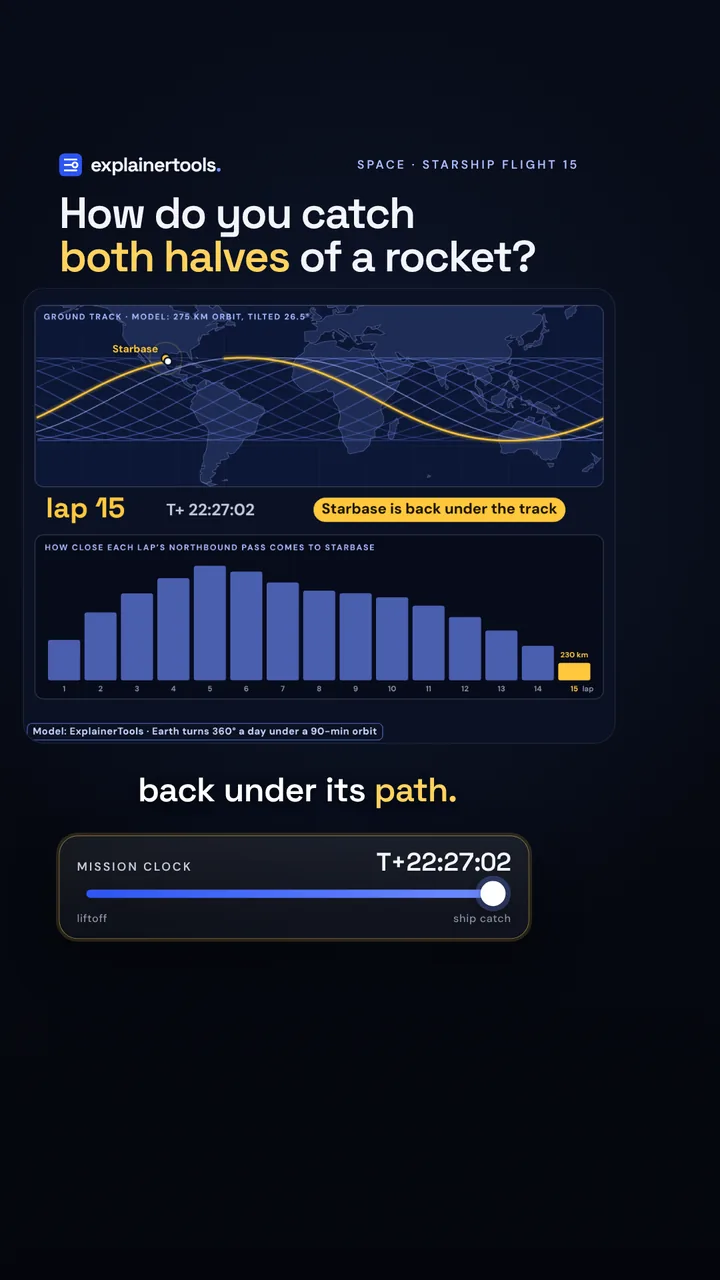
On its next flight, Starship Flight 15 (NET Fri Nov 13, 4:45 PM CT, pending regulatory approval), SpaceX plans to catch the Super Heavy booster with the tower’s arms about 6½ minutes after liftoff, then catch the ship too, about 22½ hours later. The booster has been caught three times before; no ship ever has. The ship reaches orbit at about 17,500 mph, drops off 26 Starlink V3 satellites, and waits: each 90-minute lap ends about 23° farther west as Earth turns underneath, so it takes about 14 laps before Starbase is back under its path. Then it reenters, banks over Mexico and Texas, falls belly first, flips upright on three engines and is caught by two fittings under its forward flaps.
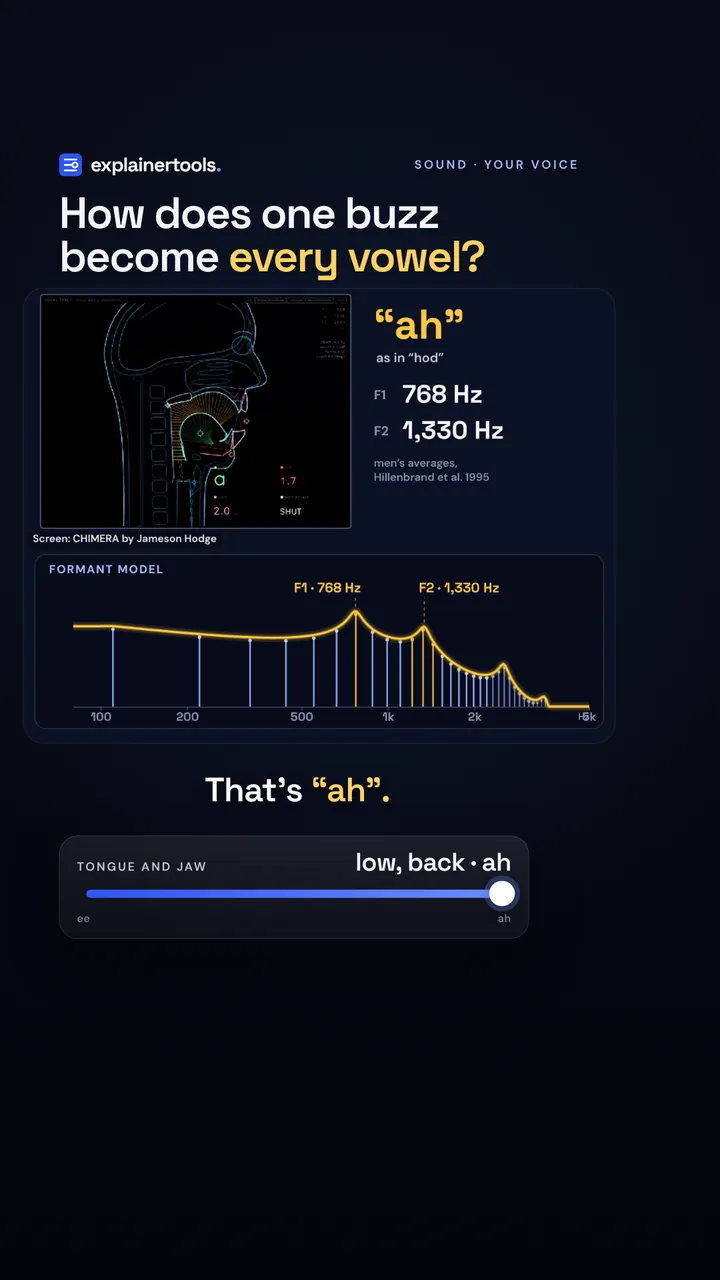
Your vocal folds make the same buzz for every vowel: about a hundred puffs of air a second, a row of harmonics at 110, 220, 330 Hz and up. The throat and mouth above them are a tube that rings at its own resonances, the formants. Tongue high and forward, it rings at about 340 and 2,300 Hz: “ee”. Jaw down and tongue back, about 770 and 1,330 Hz: “ah”. The first two formants are enough to tell most vowels apart. Featuring CHIMERA, Jameson Hodge’s free browser synth that simulates the airway itself: its vowel shapes land within about 2% of measured voices, though speech recognition still gets about 37% of its words wrong.
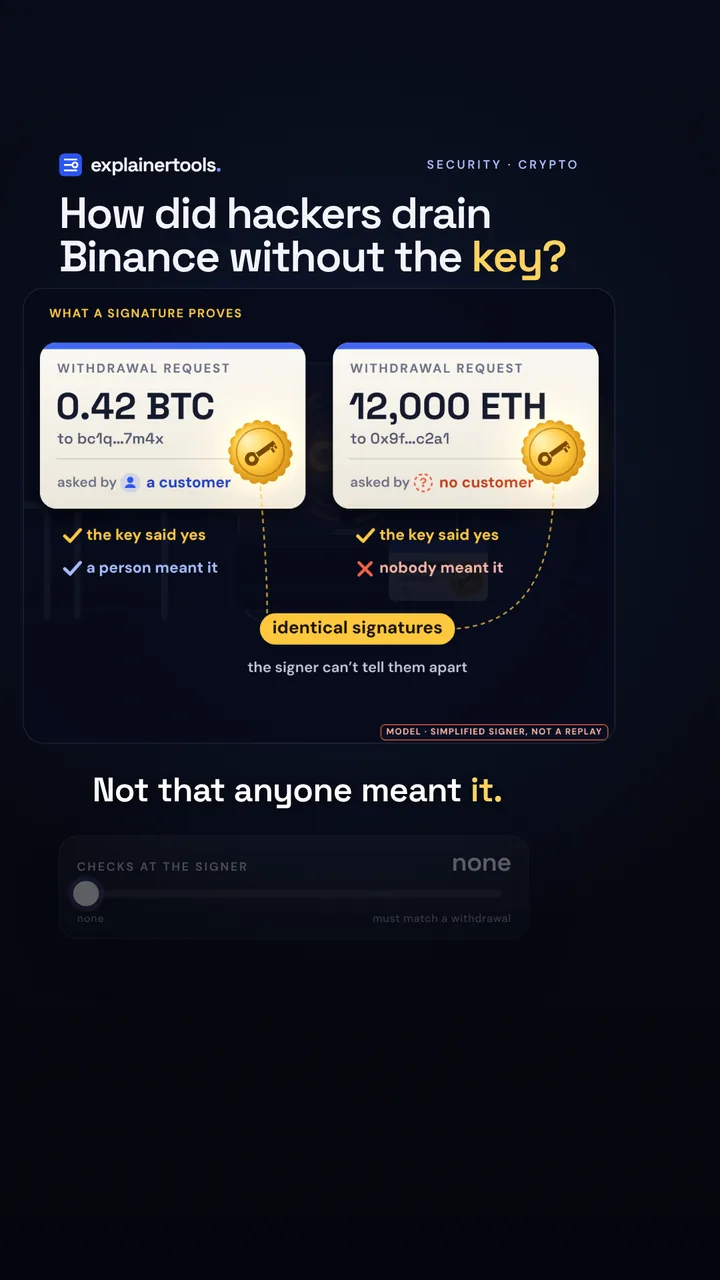
Binance says hackers moved about $6.34 billion out of its hot wallets on October 29, and that it found no sign a private key leaked. A hot wallet stays online, and its key is kept inside a service that signs requests all day. A signature only proves the key said yes, not that anyone meant it. Binance says hacked engineer computers led, in steps, to that signing service, so unauthorized requests got genuine signatures, and the drain took under four hours. In the model, a check at the signer fixes it: a request with no matching customer withdrawal gets no signature.
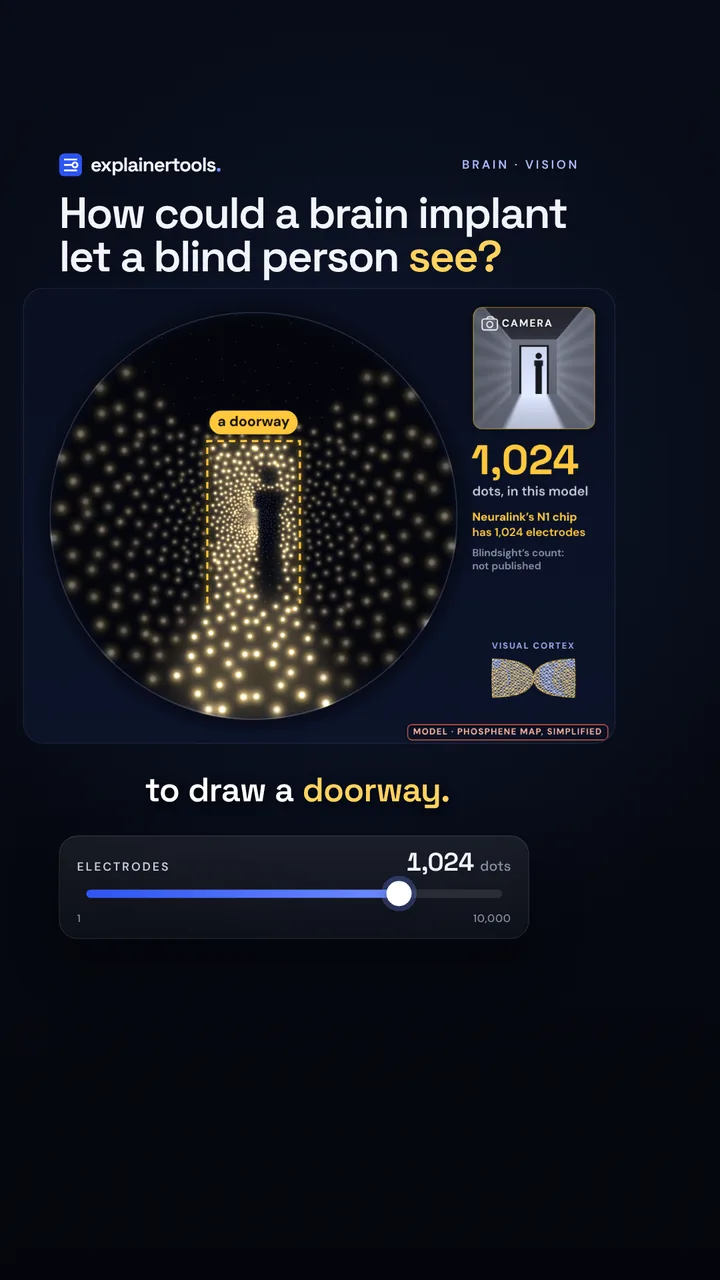
Elon Musk says Neuralink’s Blindsight implant is ready and just waiting on regulators. Sight happens in the brain, not the eye: stimulate one spot of the visual cortex and a person sees a dot of light, a phosphene, always at the same place in view. The cortex is a map of the view with the center stretched big, so a camera turns each frame into dots, one per electrode. In this model, 60 dots read as a scatter of stars and about 1,000 start to draw a doorway; Musk says the first images will look like Atari graphics.
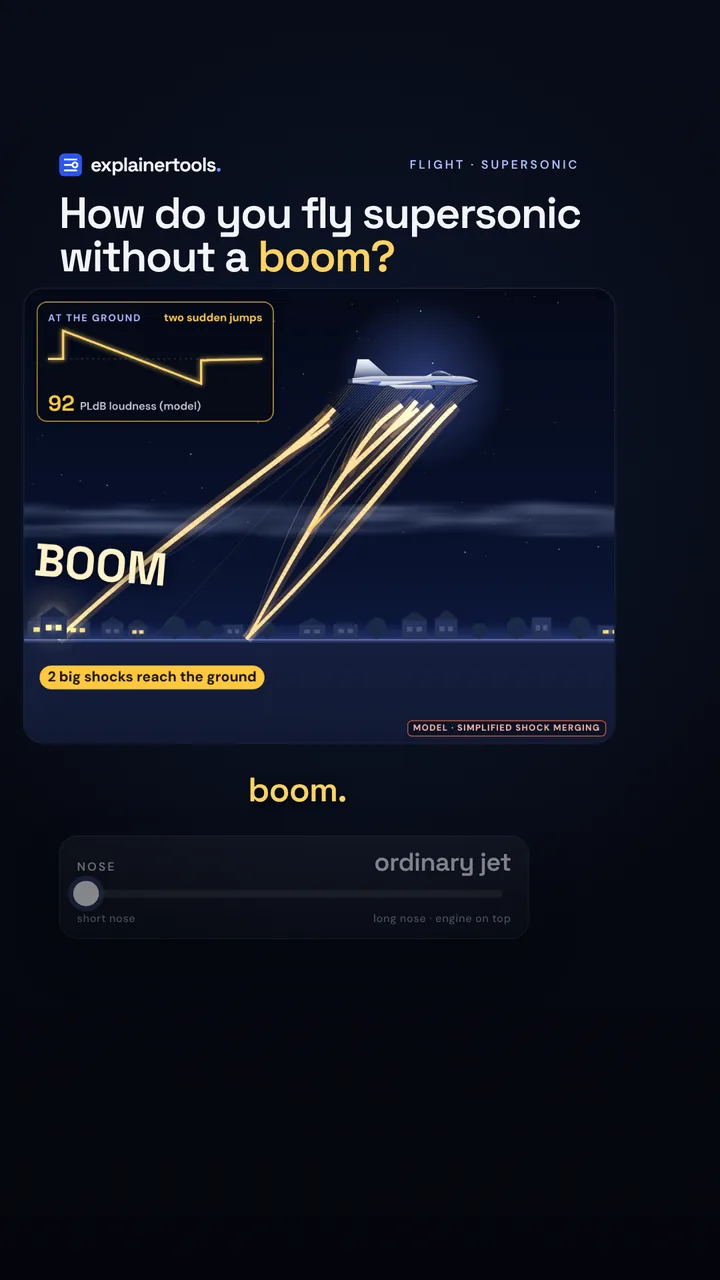
Every supersonic jet makes shock waves, one from each bump: the nose, the canopy, the wings, the tail. On an ordinary jet they catch up on the long way down and merge into two big ones, the N-wave you hear as a sharp double boom. NASA’s X-59 has a very long nose and its engine on top, so its small shocks stay apart and arrive one by one: a soft thump. NASA aims for about 75 perceived decibels on the ground; Concorde’s boom was about 105. Supersonic airliners have been banned over US land since 1973, and next NASA will fly the X-59 over towns and ask people what they hear.
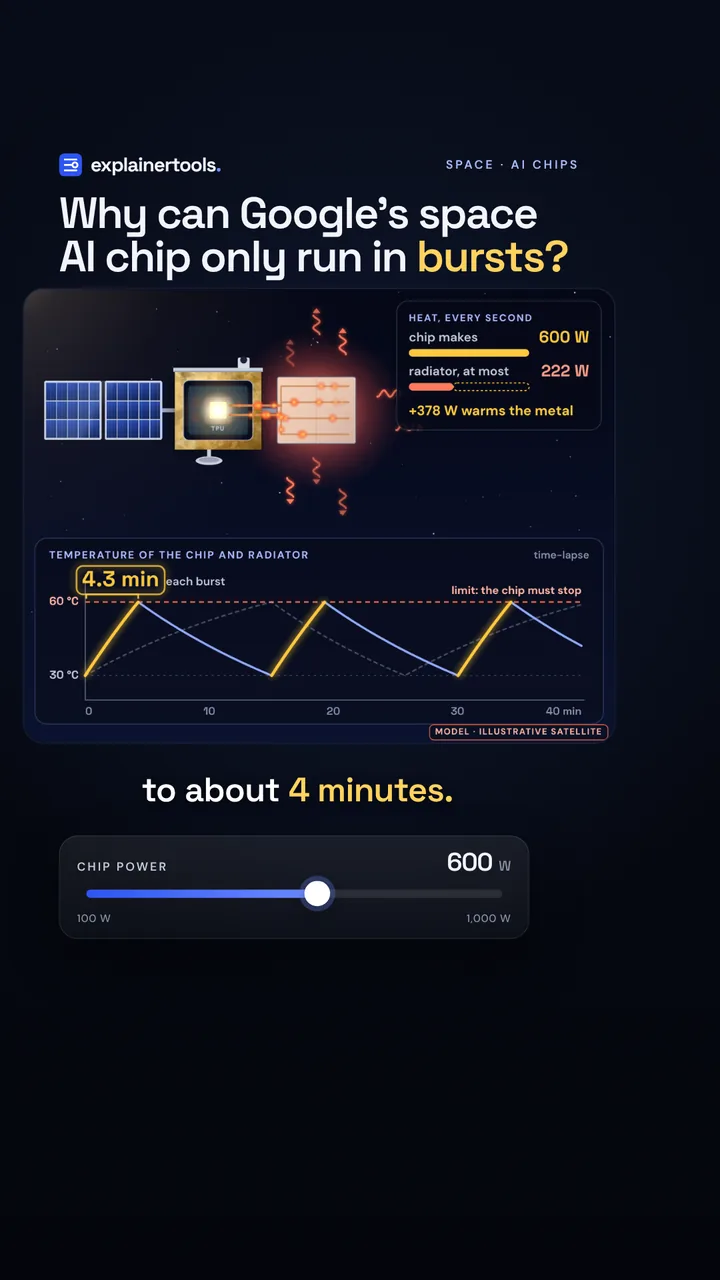
Google ran Gemma 4 on a TPU in orbit, and it wrote a haiku. But its chips reportedly run only about 15 minutes at a time, and one reason is heat. Space is cold but empty: there’s no air for a fan to push, so heat can only leave as an infrared glow from a radiator. When a small radiator can’t keep up, the extra heat soaks into the metal until the chip hits its limit and must stop and cool. In this model, twice the power shrinks each burst from 15 to about 4 minutes; a radiator four times bigger lets it run nonstop, but radiators are heavy.
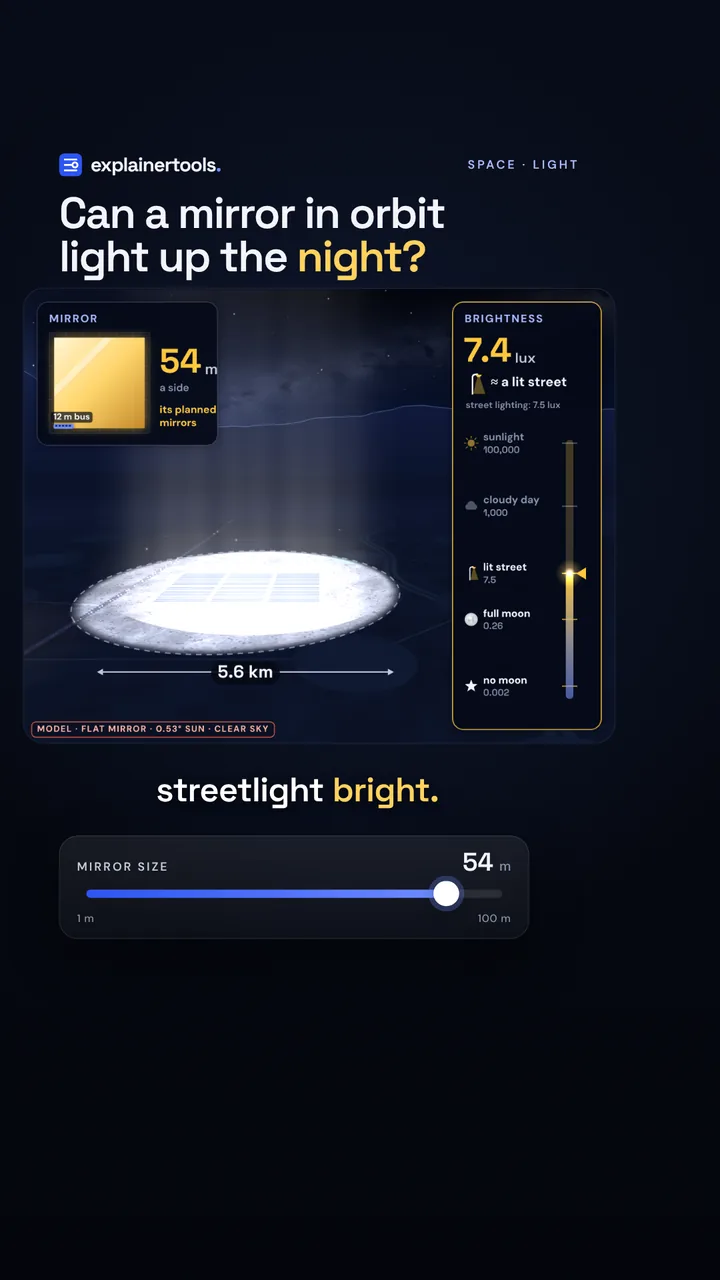
A startup, Reflect Orbital, wants to sell sunlight after dark: after sunset, a satellite 600 km up is still in sunshine, and a tilted mirror can bounce that light down. But the Sun is a disc 0.53° wide, so the beam spreads into a spot nearly 6 km across, whatever the mirror’s size. A bigger mirror only makes the spot brighter: about 3 full moons for Reflect’s 18 m test mirror in this model, about a lit street for its planned 54 m mirrors. The catch: each mirror races past in about 4 minutes, so a spot needs a stream of them, and astronomers warn the glow would spread for kilometres.
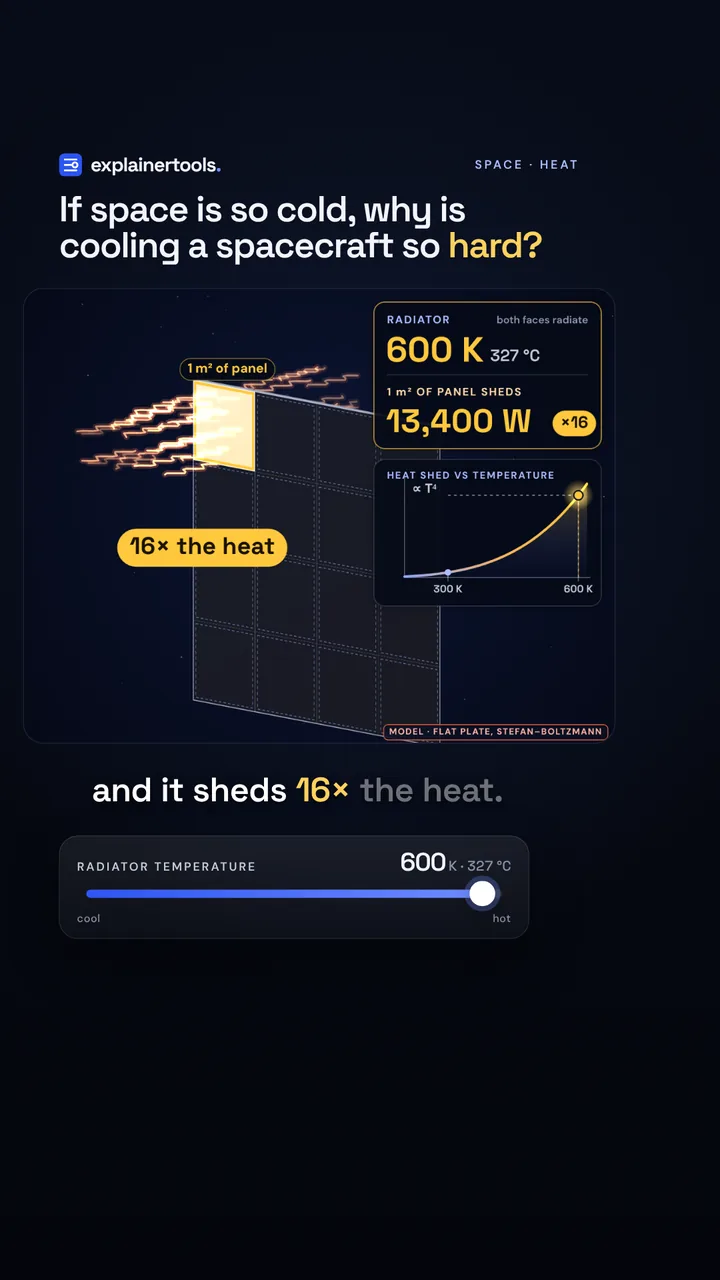
Deep space is about −270 °C, yet a spacecraft overheats without big radiators. With no air, heat can’t be carried away; it can only leave as infrared light. Double a radiator’s temperature above absolute zero and it sheds 16 times the heat: a square metre of white panel sheds about 840 W at 27 °C and 13,400 W at 327 °C. But electronics would cook, so radiators run cool, and big: the space station has six, each as long as a tennis court. A 1 GW data center in orbit would need over a square kilometer.
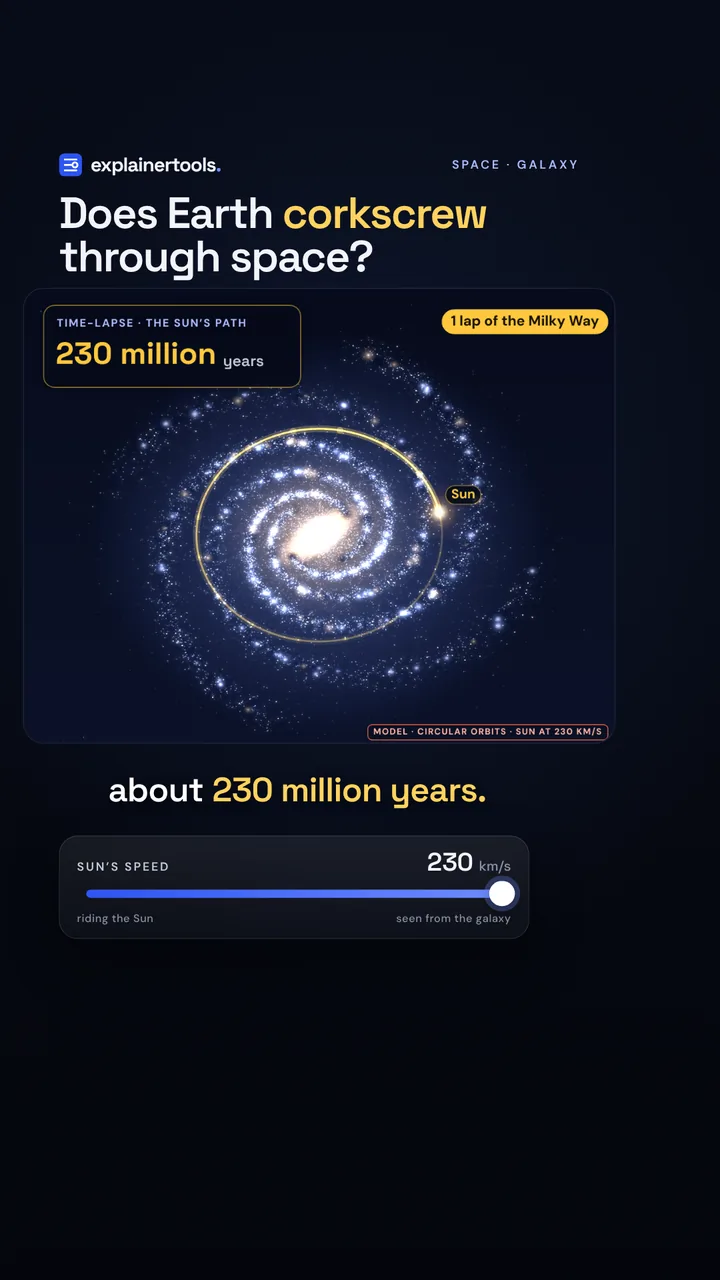
Ride along with the Sun and the planets go round in circles. But the Sun orbits the Milky Way at about 230 km/s, so seen from the galaxy each orbit stretches into a coil, so long it’s nearly straight: in one year Earth goes round the Sun once, 940 million km, while the Sun carries it about 7.3 billion km. The orbits are tilted about 60° to the path, so Earth doesn’t trail behind the Sun in a vortex; half the year it’s out in front. One lap of the galaxy takes about 230 million years.
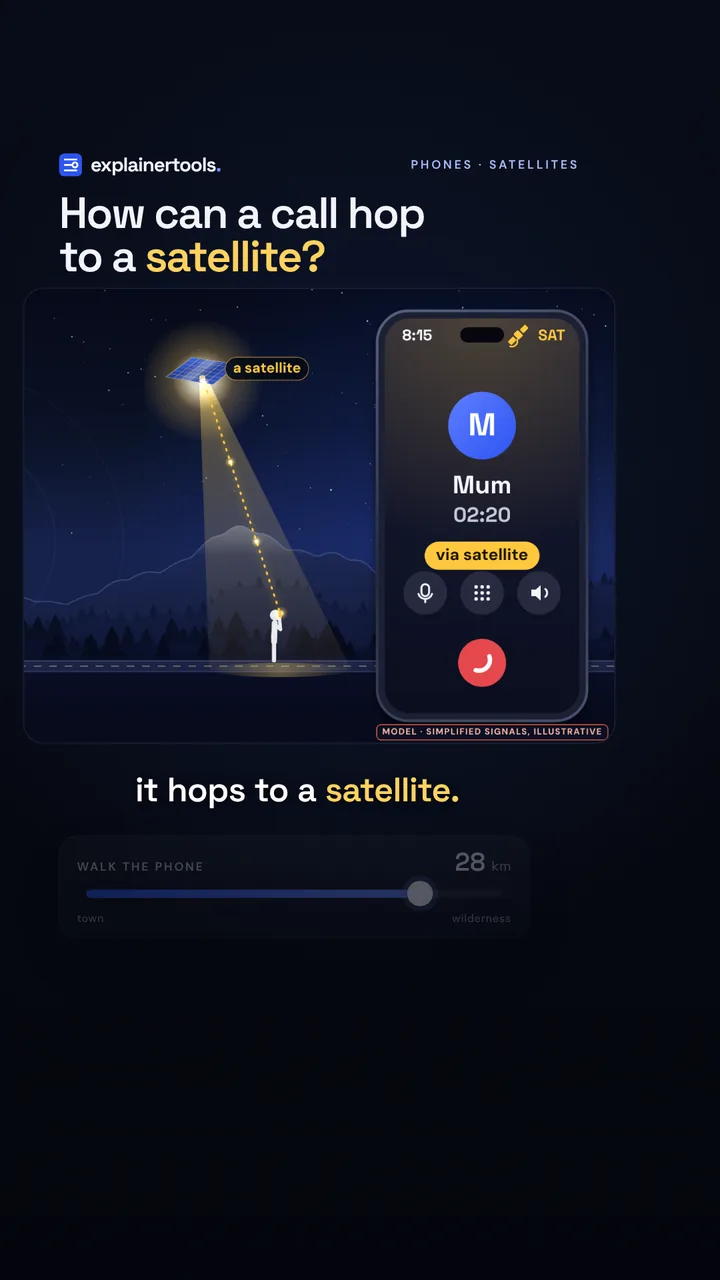
AT&T and AST SpaceMobile say they handed a phone’s connection from their ground network to a satellite in a test near Granite Falls, Washington, in October 2026. The trick: the satellite sends the same LTE signal on the carrier’s own 850 MHz band, so to the phone it is just another tower, and the network hands the call to whichever cell is stronger. The catch is distance: about 500 km up, a hundred times farther than a tower 5 km away, so ten thousand times weaker. AST’s newest satellites unfold antennas of about 223 m², nearly a tennis court, and the phone transmits at its full 0.2 W to reach them, which costs battery.
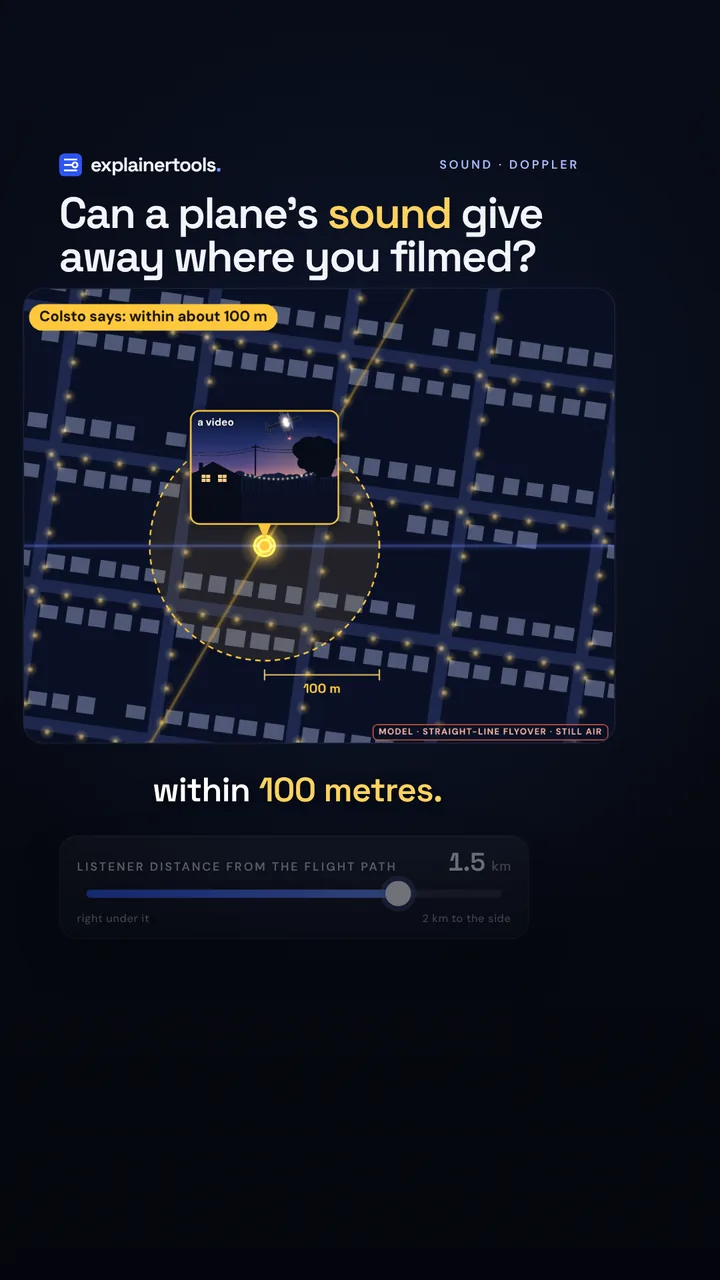
As a plane passes, its hum drops in pitch: sound waves bunch up ahead of it and stretch out behind. The shape of that drop is a fingerprint. Right under a plane 300 m up at 70 m/s, half the drop takes about 5 seconds; 1.5 km to the side it takes about 25. Planes broadcast their position every second, so flight tracks are public: one flyover puts you on a line either side of its track, and a second crosses it. YouTuber Colsto says he used this to locate a video to within about 100 m.
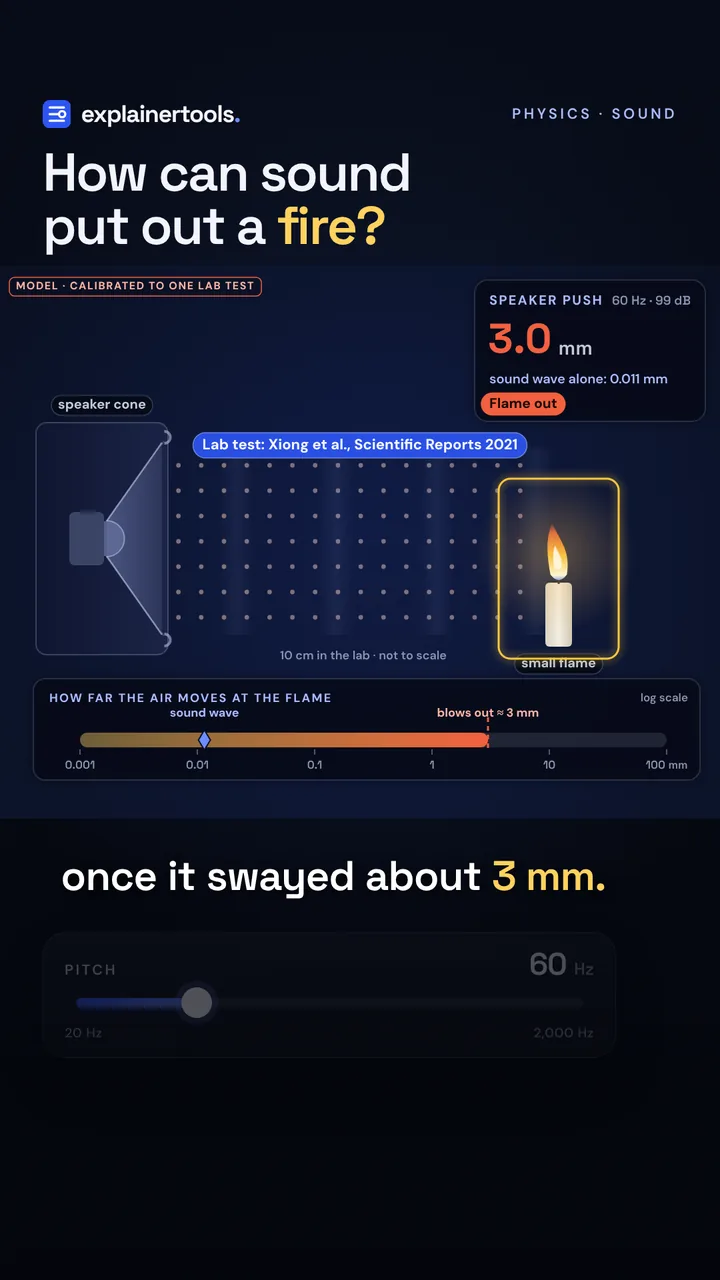
A high school student in Mexico, Ángela Karime Hernández Venegas, put out small fires with a 30 Hz hum and won gold in Indonesia. The trick isn’t really the sound: a speaker’s cone shoves air back and forth, and in a lab test a small flame blew out once it swayed about 3 mm. Half the pitch, four times the push: at 30 Hz the same sound level shoves about 1,000 times more air than at 1 kHz. The catch: it’s a puff, not a hose, so it only works on small fires up close.
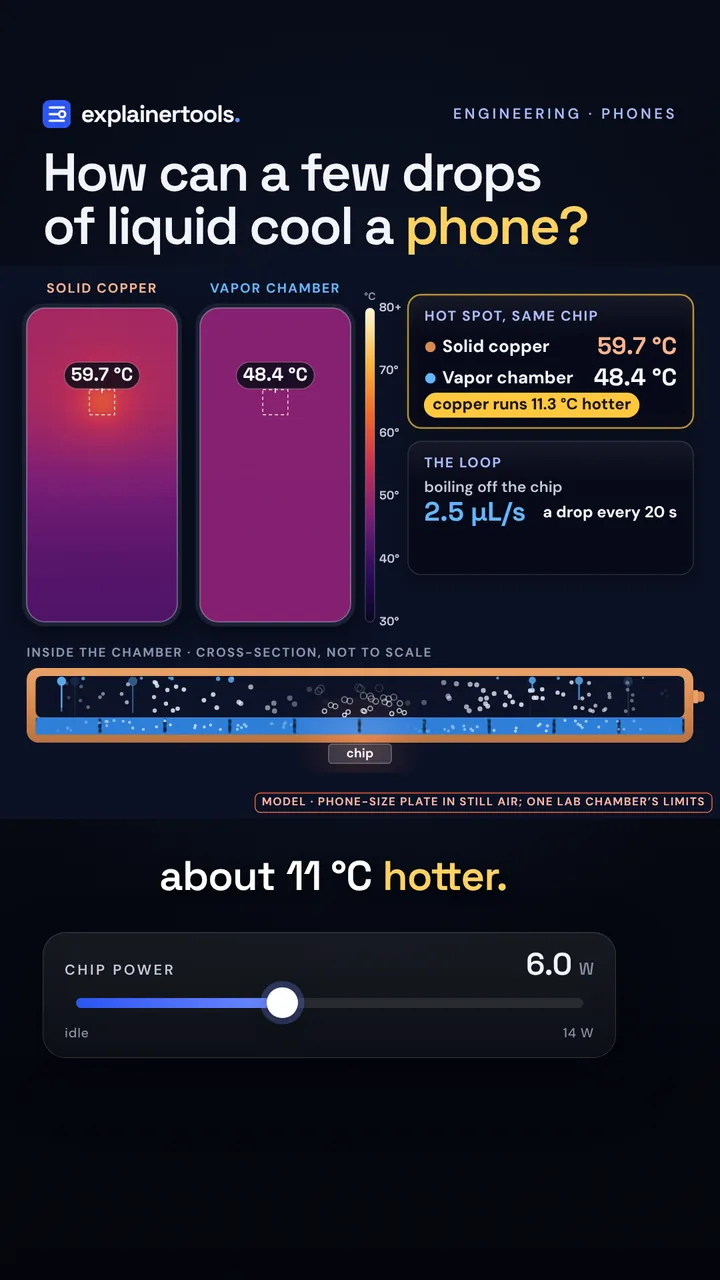
A phone’s chip turns its work into heat in one small spot. Many phones now spread it with a vapor chamber: a thin sealed copper pocket with a little liquid and almost no air, so the liquid boils at phone temperatures. It boils off the chip, the vapor races to cooler spots and condenses, and a wick pulls the liquid back. In our model, solid copper runs about 11 °C hotter at 6 W. The catch: push past what the wick can return, and the chip dries out.
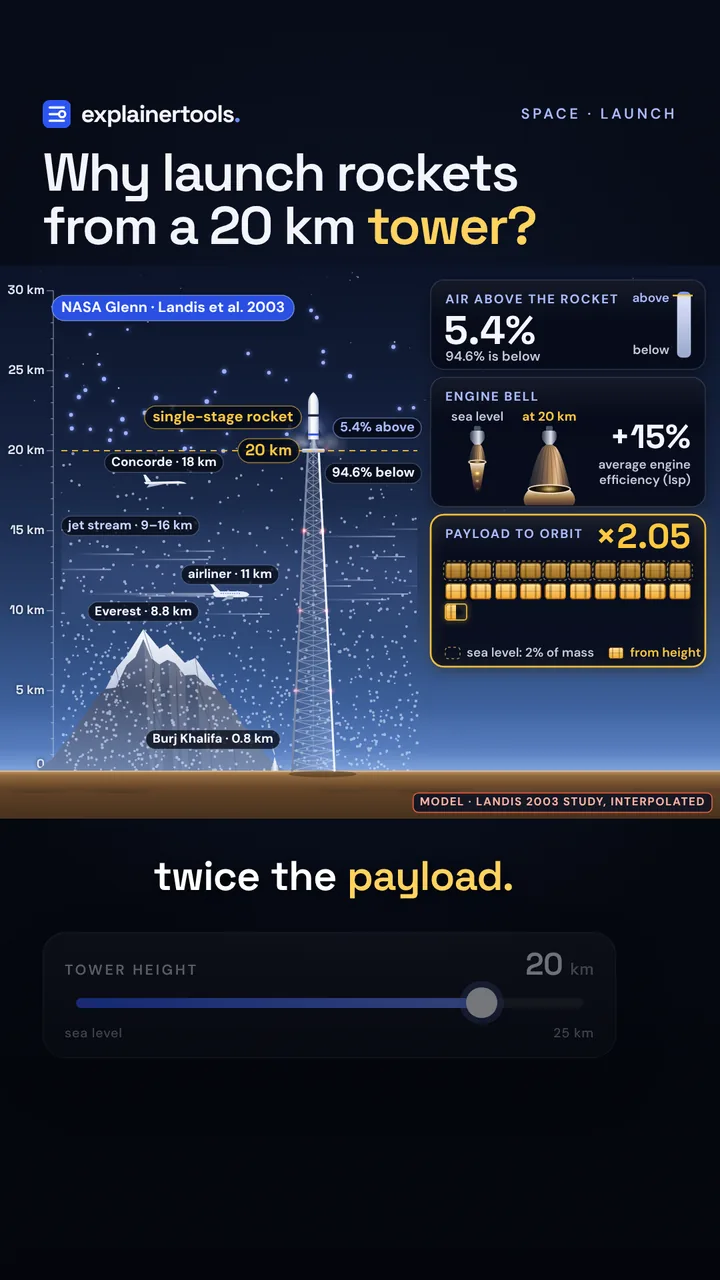
Neal Stephenson thinks somebody ought to build a tower 20 km tall with a rocket on top. Up there 94.6% of the air is below you: less drag, less noise, and the engine can wear a big vacuum bell from liftoff. A NASA Glenn study found that from 20 km a single-stage rocket carries about twice the payload, because payload is only 2% of that rocket. The catch: orbit still needs nearly 8 km/s, sideways.
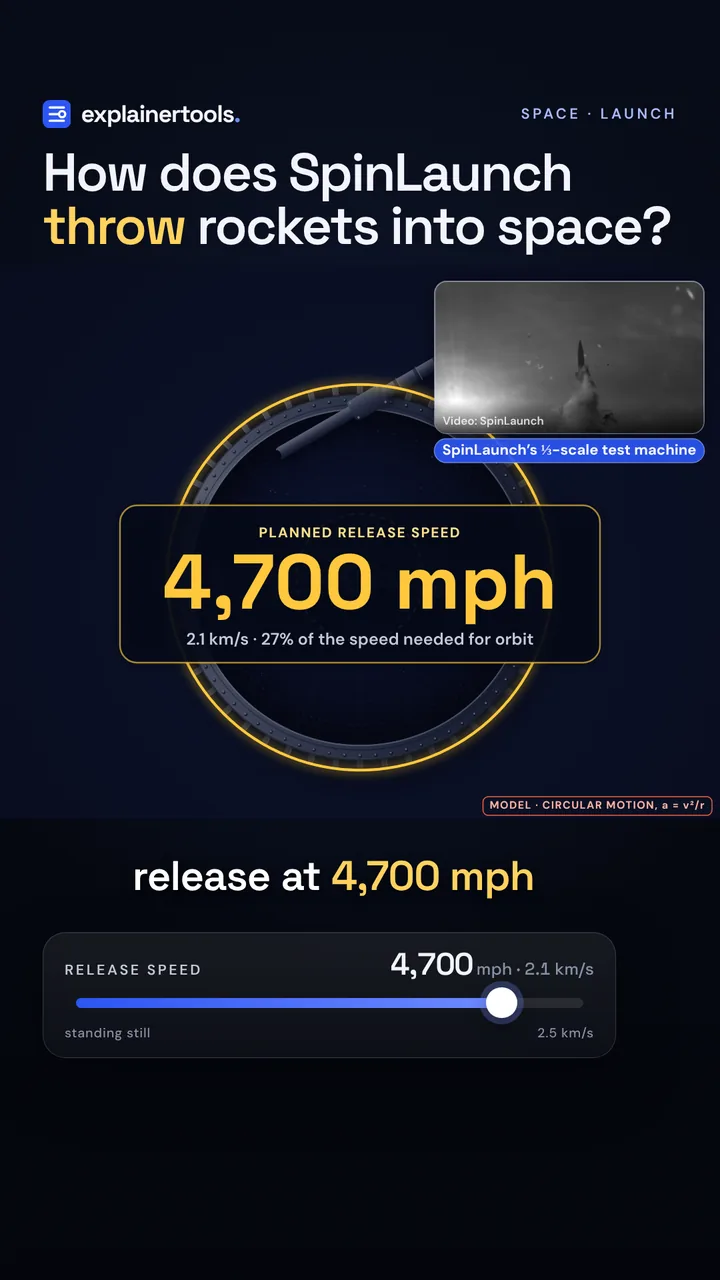
SpinLaunch spins a projectile inside a vacuum chamber, faster and faster, then lets go. Its full-size design would release at 4,700 mph, and a small rocket would finish the climb to orbit. The catch is the spin: the force grows with the square of the speed, so doubling the speed quadruples it. At full speed the payload feels about 10,000 g. Fighter pilots train for 9.
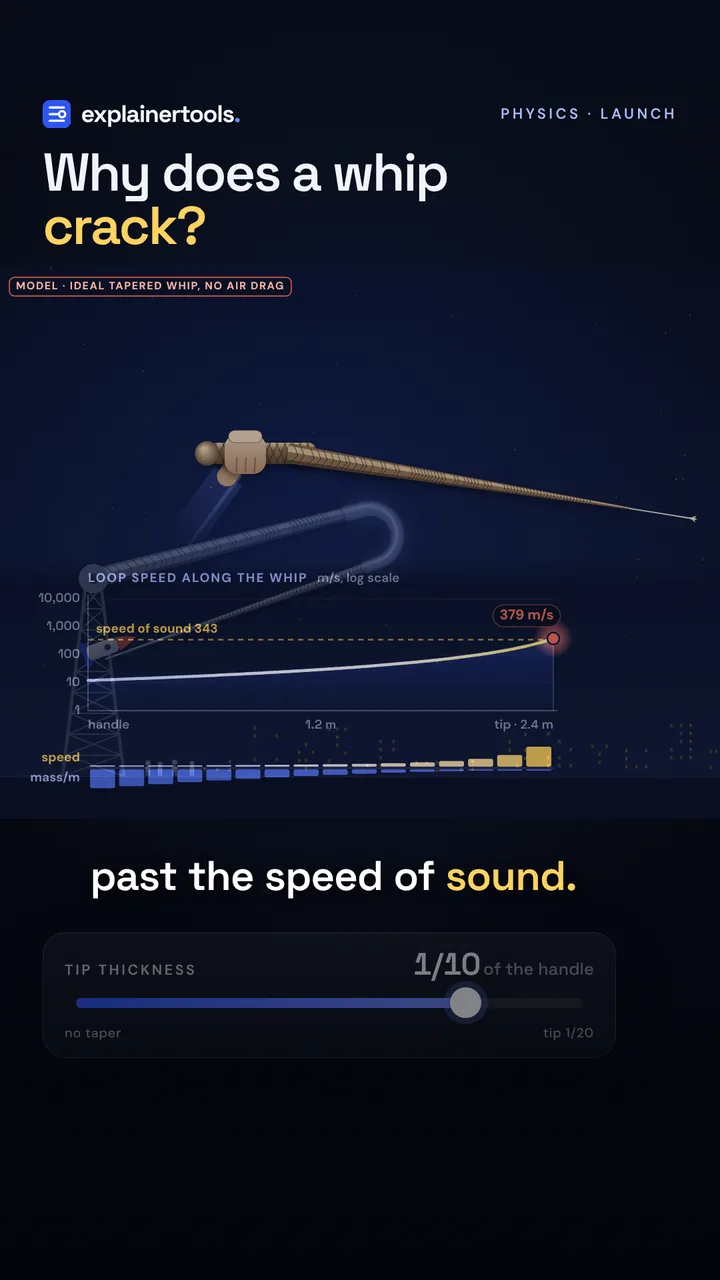
A whip crack is a tiny sonic boom. Your hand sends a loop rolling down the whip, and the whip gets thinner and thinner, so the same energy is carried by less and less mass and the loop speeds up. With a tip one tenth as thick as the handle, the loop ends up about 30× faster, past the speed of sound. Neal Stephenson has written five essays about giant steel whips: not to orbit, he says, but even a head start saves rocket fuel.
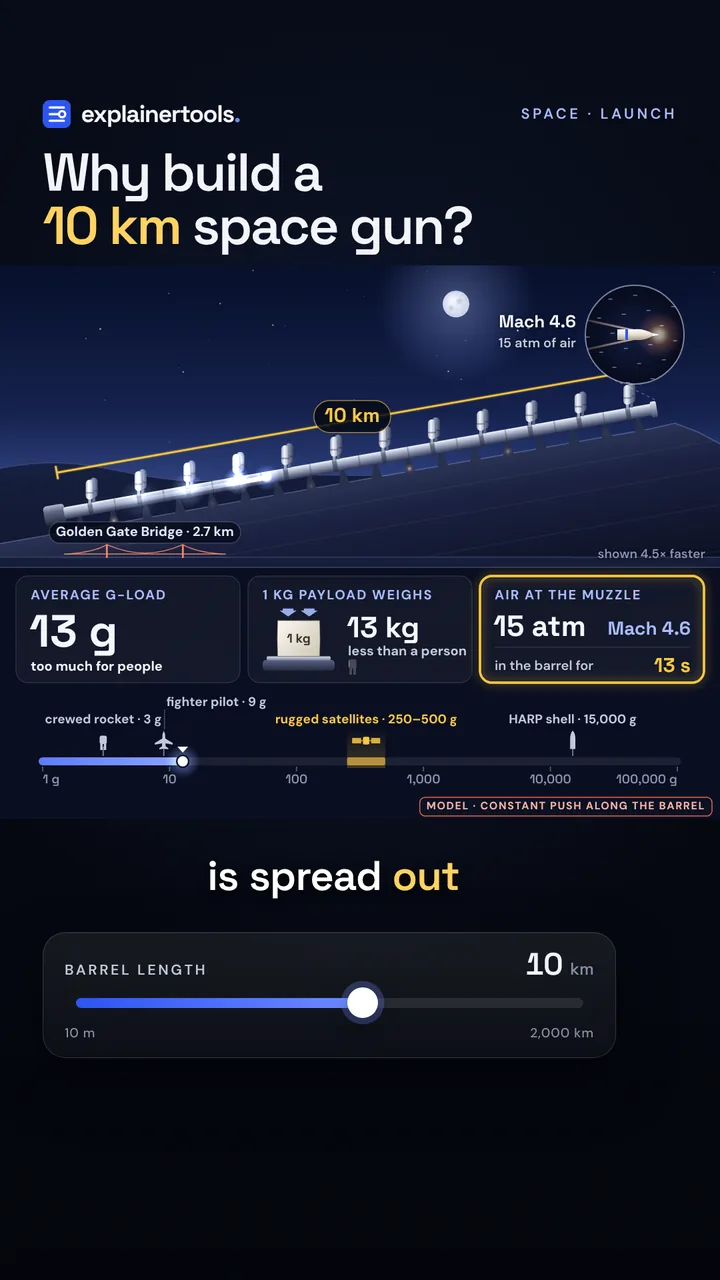
Ashlee Vance asked Neal Stephenson about it: Longshot, in Oakland, wants to build a space gun 10 km long, pushing a payload down a tube with blasts of gas. Why so long? A short barrel has to shove hard: their ~20 m test gun hit Mach 4 with thousands of g. Spread the same push over 10 km and near-orbital speed costs only a few hundred g. Rugged satellites can take that. People can’t: they would need a barrel about 1,000 km long.
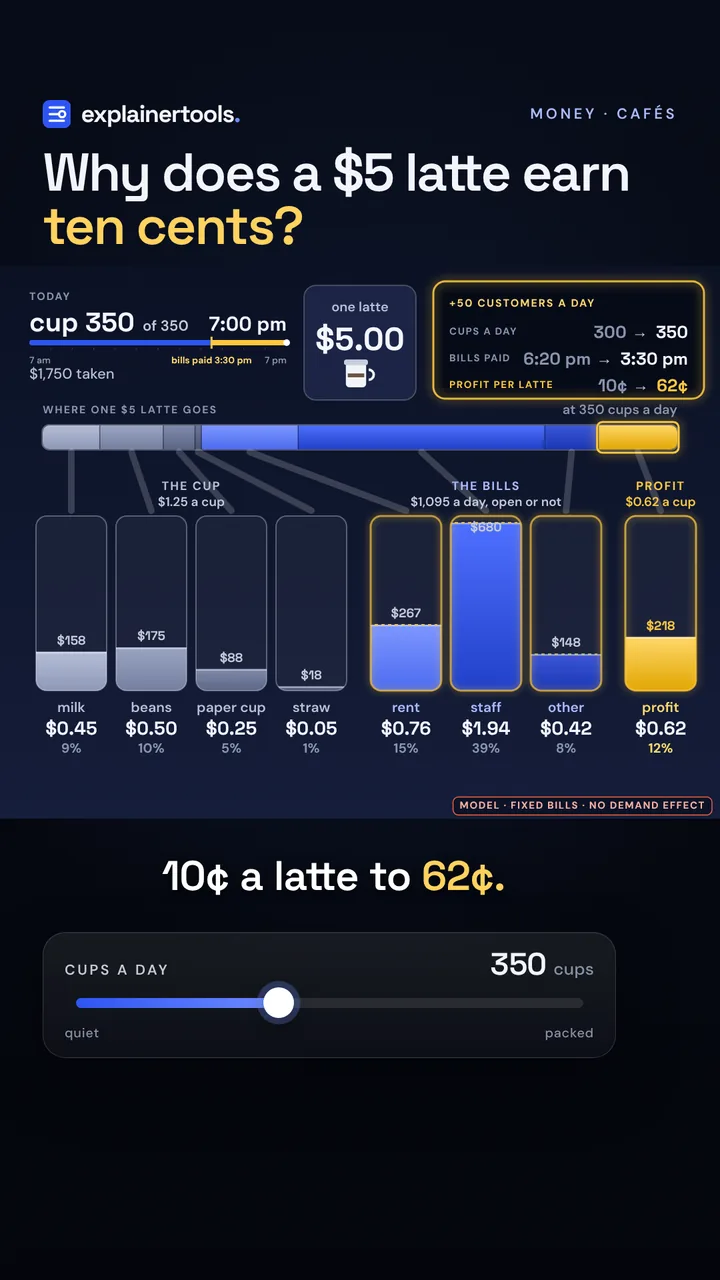
A $5 latte in New York earns the café about ten cents. $1.25 is the cup itself; $3.75 goes to rent, staff and the lights, owed whether anyone walks in. At 300 cups a day the first 292 only pay the bills. Add 50 customers and profit jumps from 10¢ a latte to 62¢, because past break-even nearly every cup is profit.
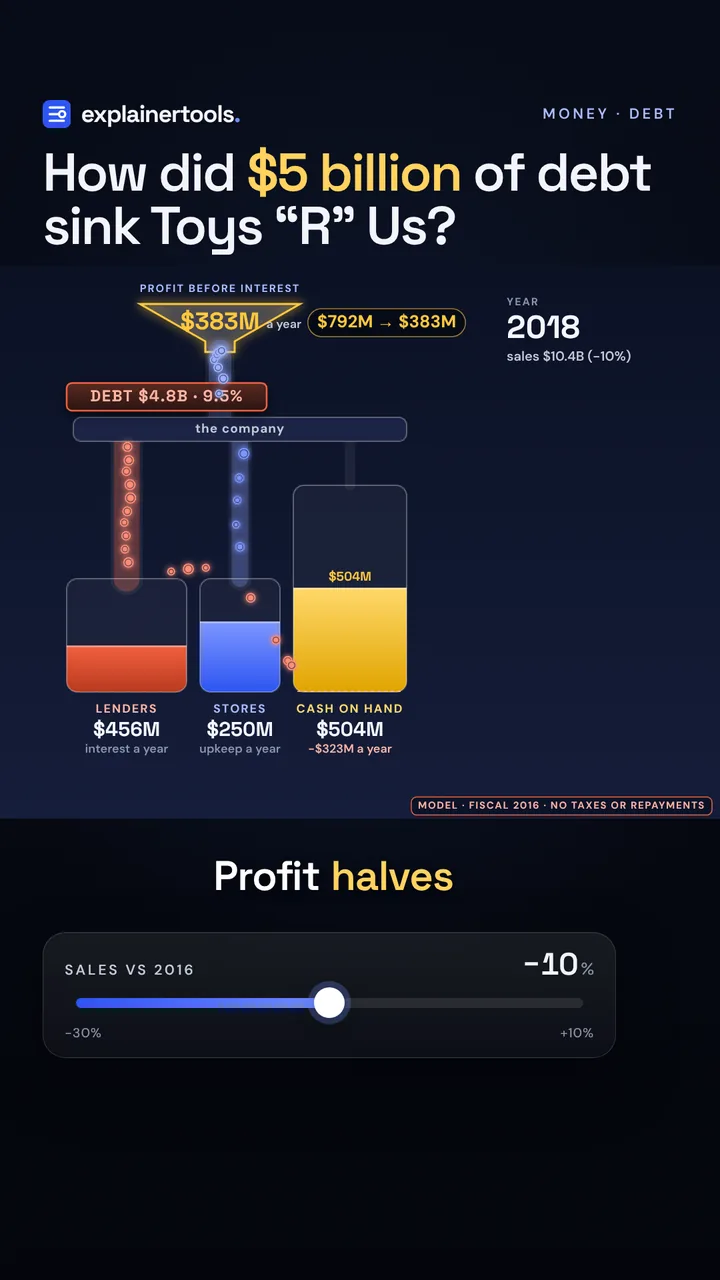
Toys “R” Us earned about $800M a year before interest and still went bankrupt: the 2005 buyout put a $5B loan on the company, interest took $450M a year and upkeep $250M more. Drop sales 10% and profit halves while the interest doesn't move, so the cash runs out.
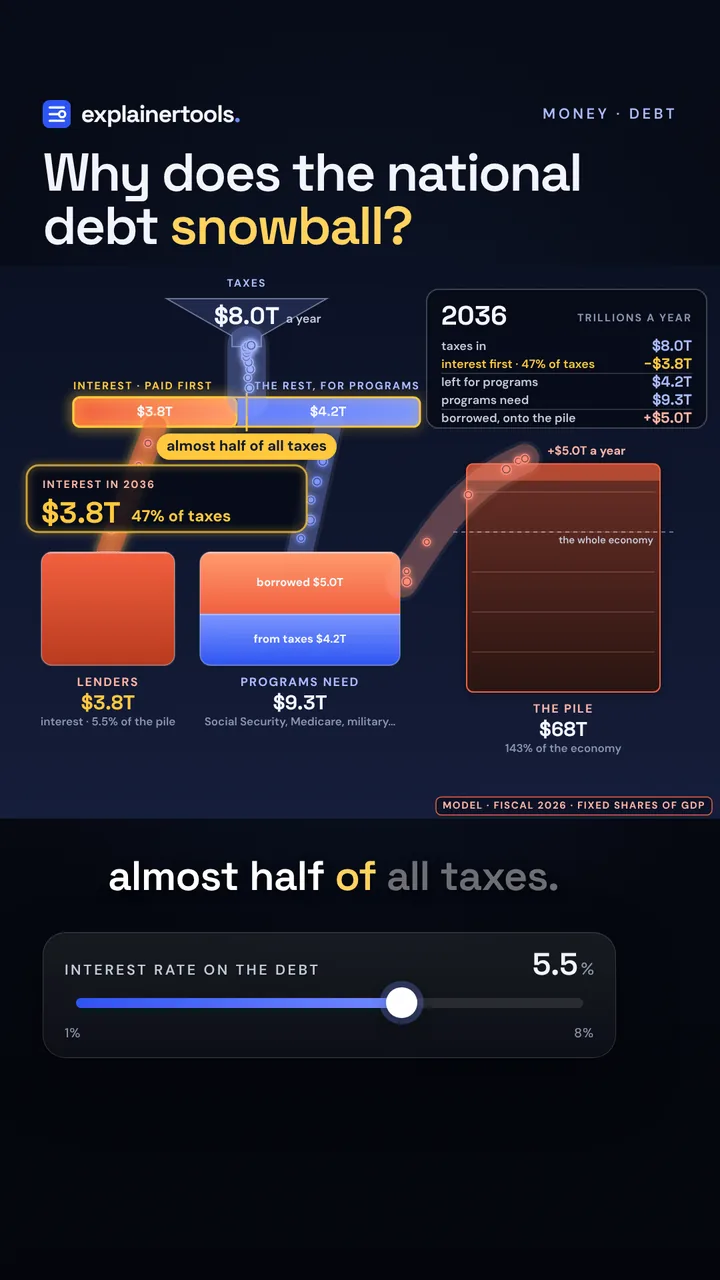
The US pays over $1 trillion a year in interest, more than its military. Taxes $5.4T; interest is paid first, $1.1T; programs need $6.3T, so the $2T shortfall is borrowed onto the pile, which charges interest on itself. Raise rates two points and interest is nearly $4T by 2036.
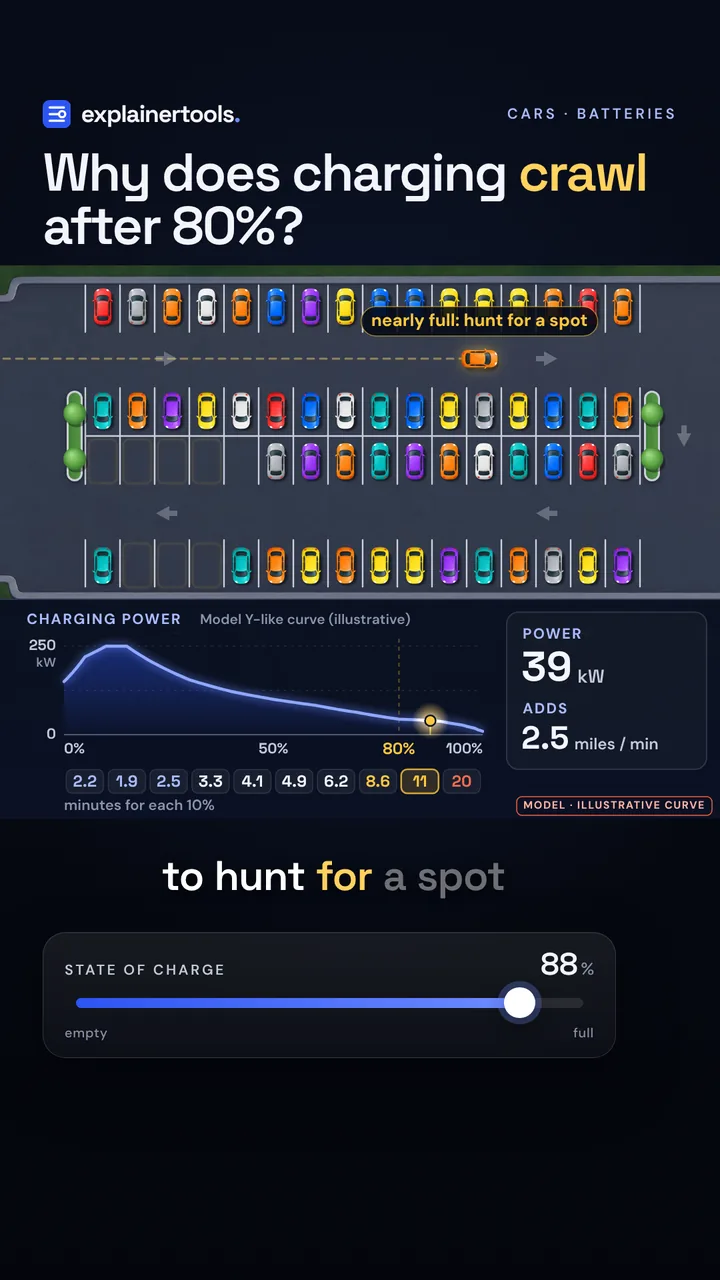
Elon Musk compares charging to parking: in an empty battery, lithium ions zip into spots, so the charger runs flat out. As it fills, they hunt for space, and forcing them in fast can plate lithium metal, so the car turns the power down. In a Model Y, 10 to 80% takes about 30 minutes and the last 20% about as long again, so road trips go faster with short, frequent stops.
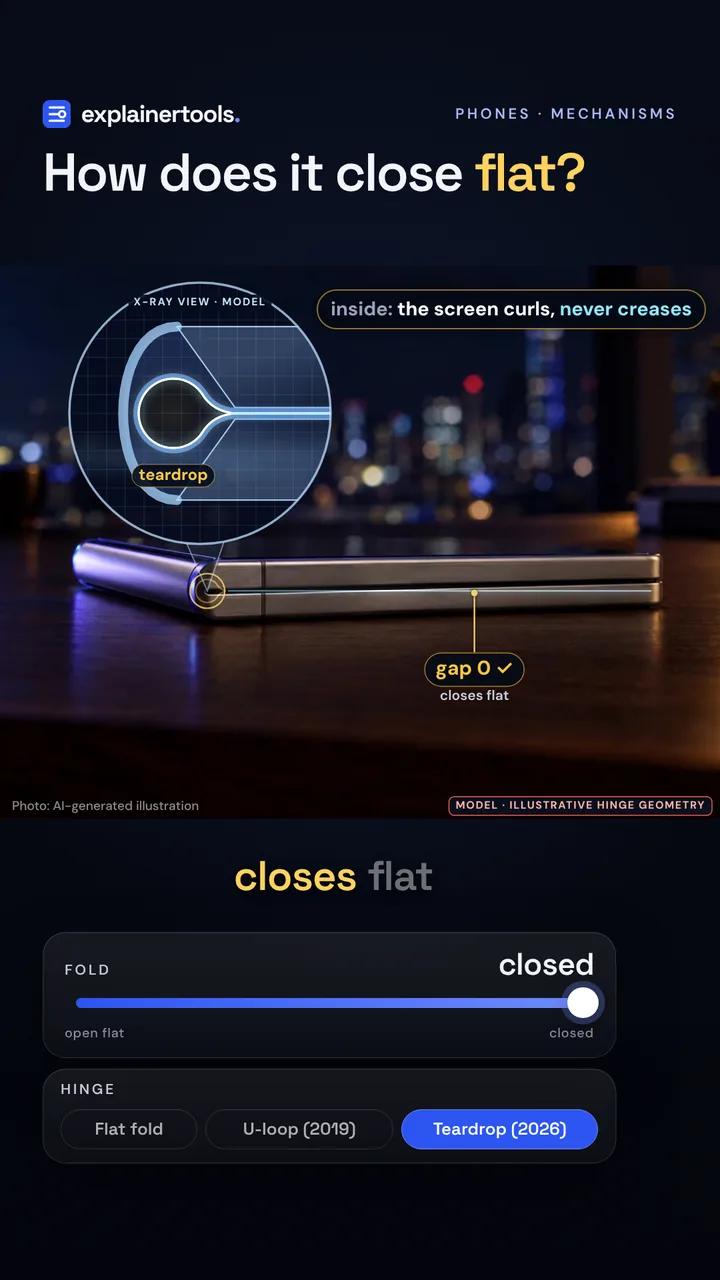
Press a screen flat on itself and its glass would crack, like paper creasing for good. So when the folding iPhone closes, the middle of its screen drops into the hinge and curls into a teardrop about 4 mm across, keeping its tightest bend near 2 mm. Older U-shaped hinges held the halves apart.
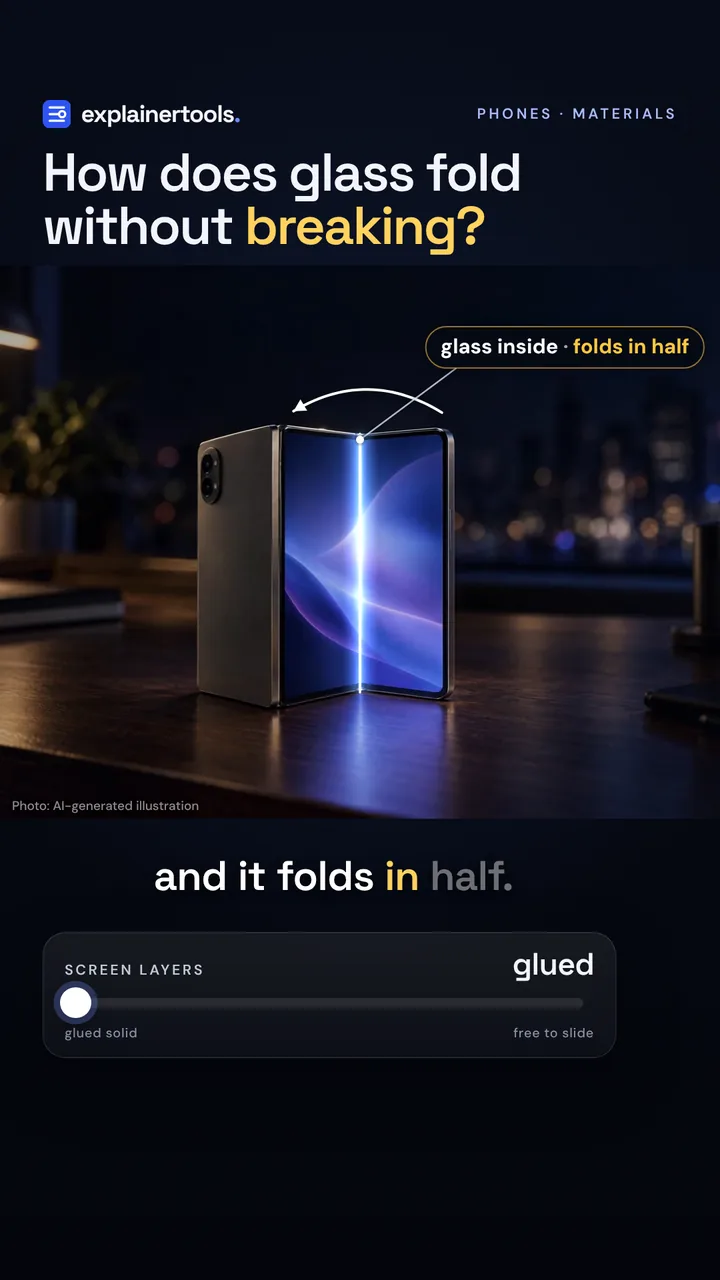
Bend glass and its outer surface stretches. Folded 2 mm tight, normal 0.5 mm phone glass would stretch about 12% and shatter; 30-micron glass stretches under 1%. And layers that slide bend far more easily than one glued slab.
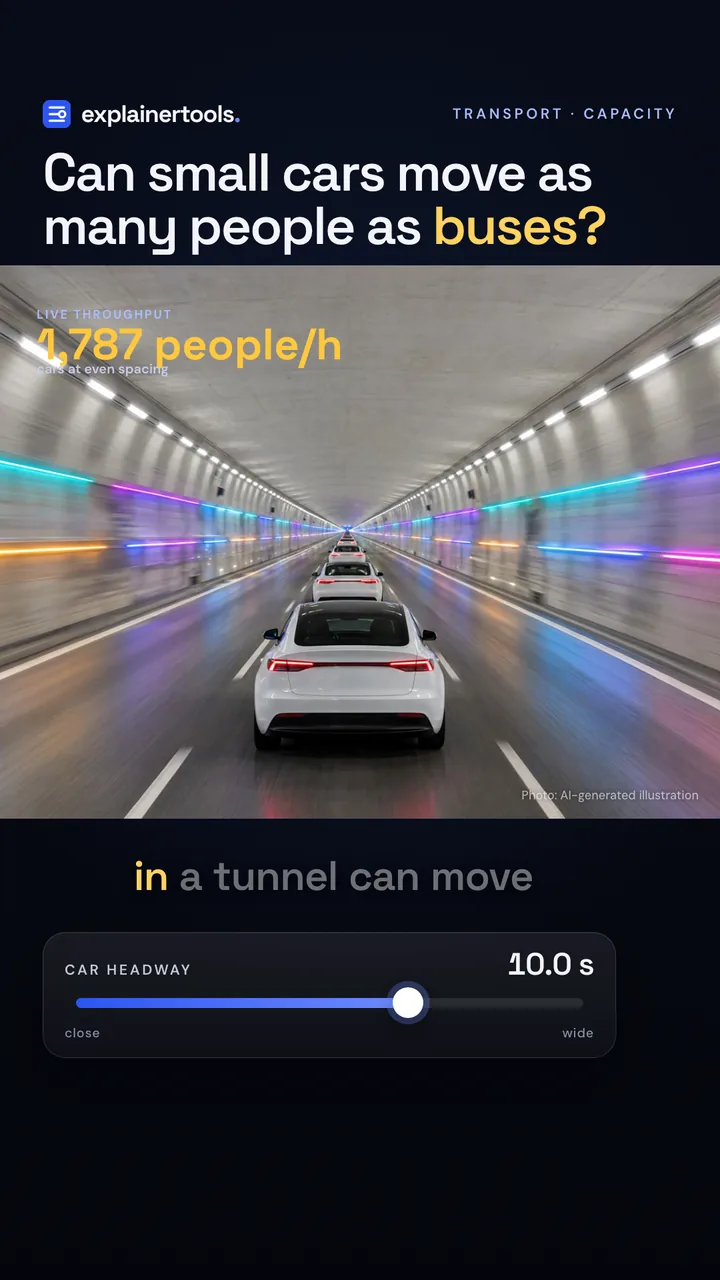
In the Las Vegas Loop, cars load in side bays off the main tunnel, so the line never stops. A car every 2 seconds is 1,800 cars an hour, and every 1 second is 3,600. With short trips and many stations, each seat is refilled again and again, so the loop can move tens of thousands an hour. The Boring Company's target is 90,000.
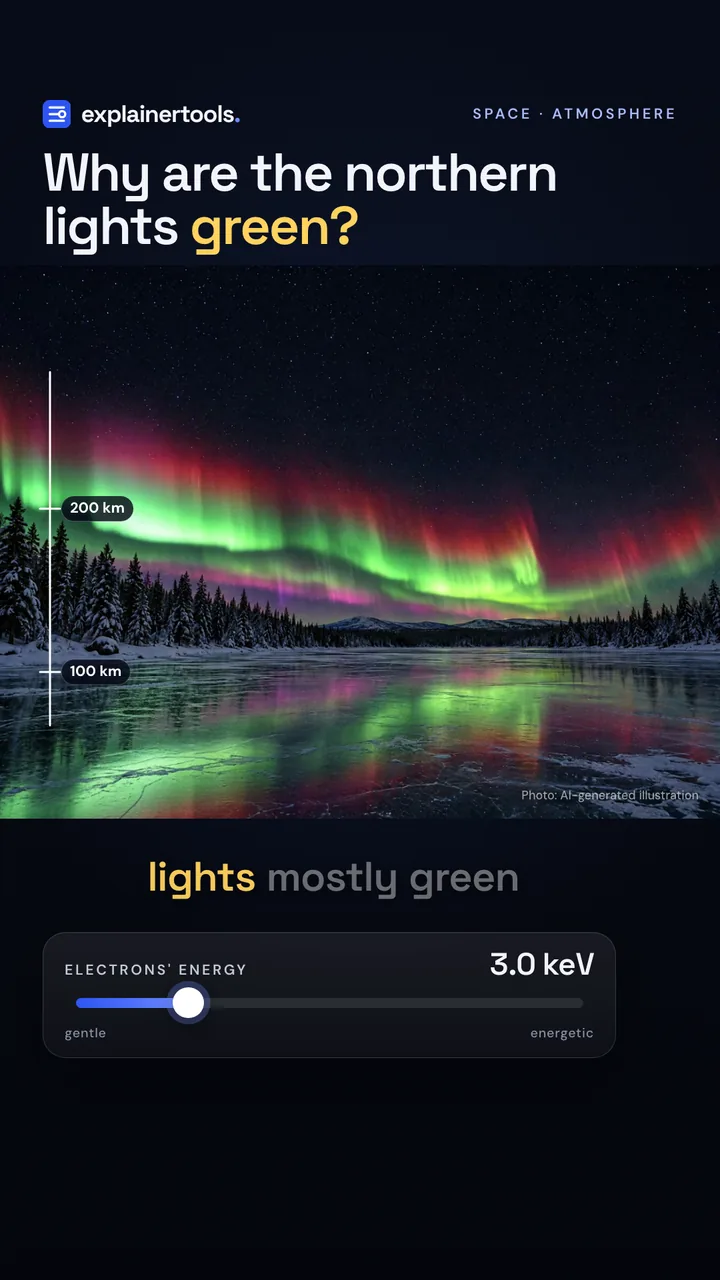
Oxygen emits green around roughly 100–250 km. Its slower red glow survives higher up, while energetic electrons can add nitrogen purple and pink lower down.
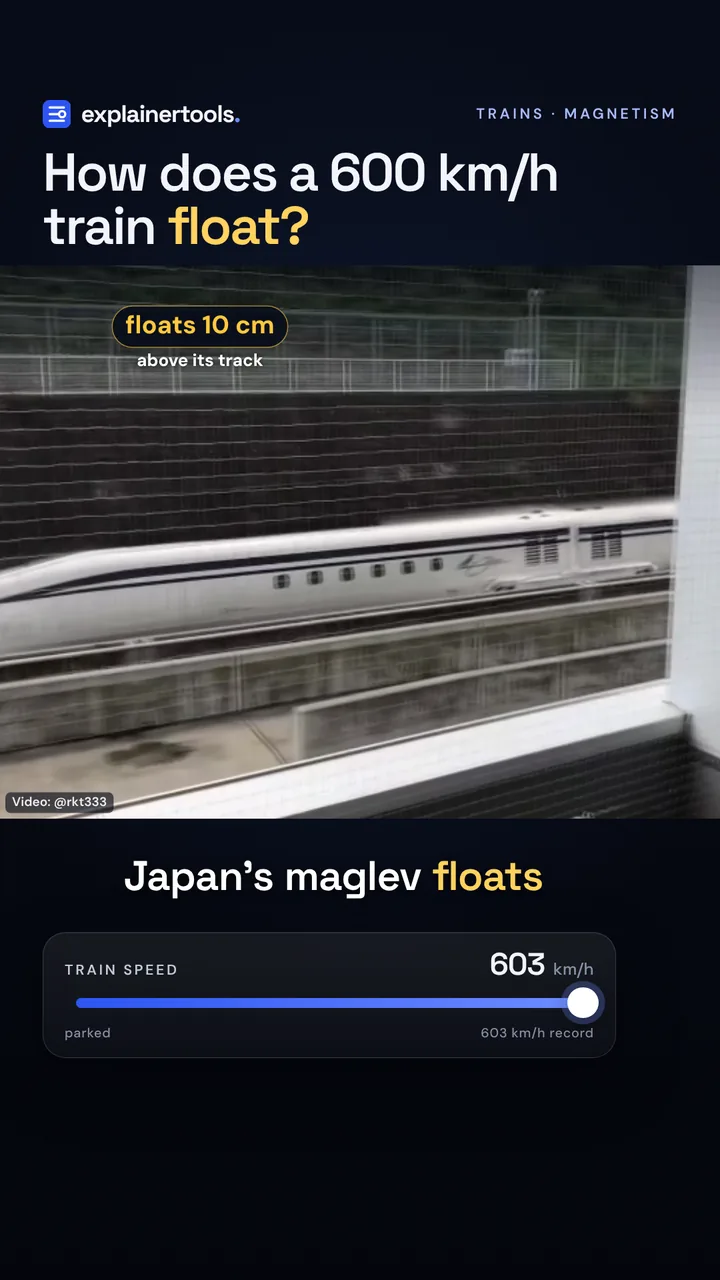
Japan's SCMaglev floats about 10 cm above its track, but only at speed. Superconducting magnets on the train sweep past figure-eight coils in the guideway walls; the currents they induce push back, lifting and centering the train. Above about 150 km/h the wheels fold away, and coils switching on in sequence carry it up to 603 km/h.
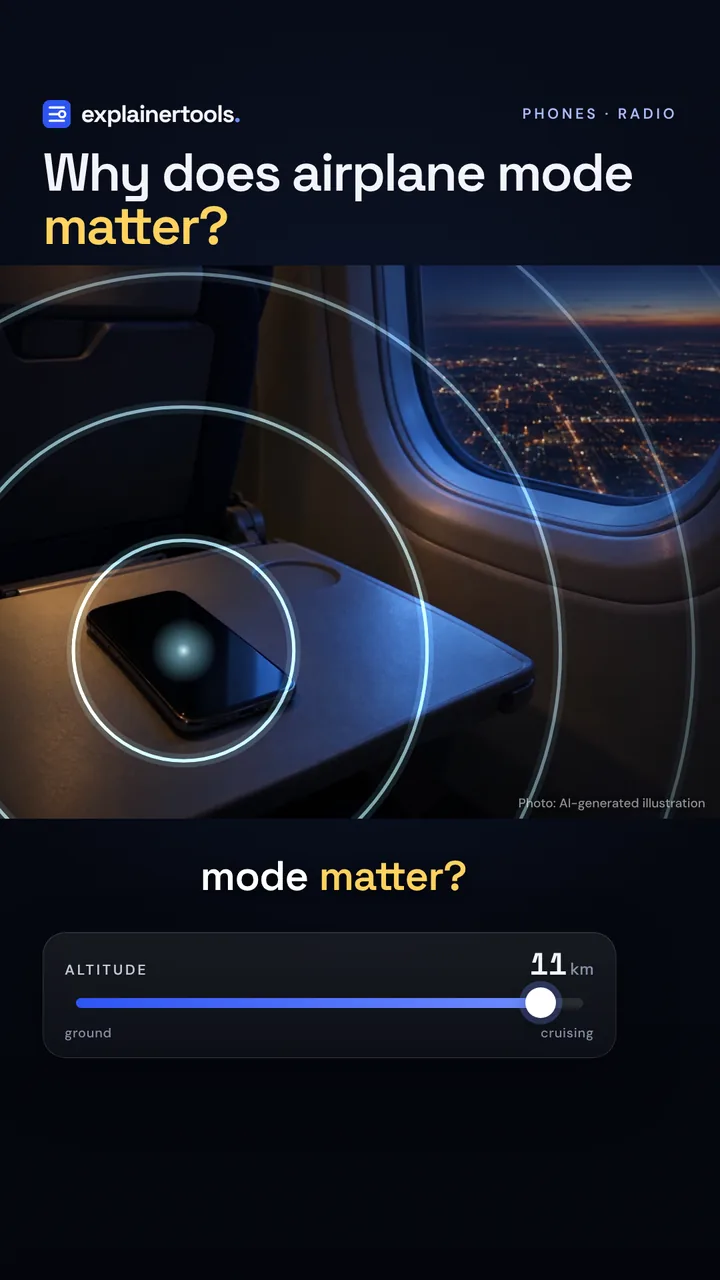
A phone turns its power up or down to reach the nearest tower. At cruising altitude it may shout at full power, which can disturb networks on the ground.
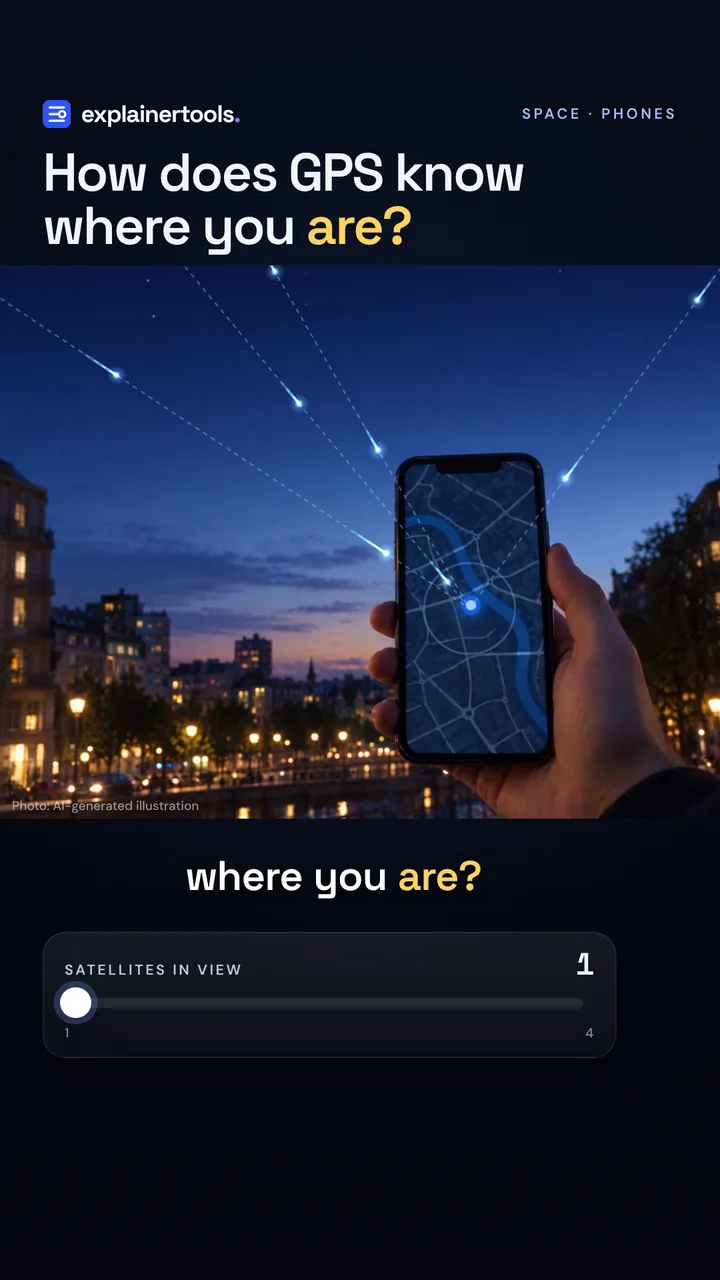
Your phone never sends anything to the satellites. It times each signal from their atomic clocks, and four distances, one of them fixing the phone's own clock, pin down your position.
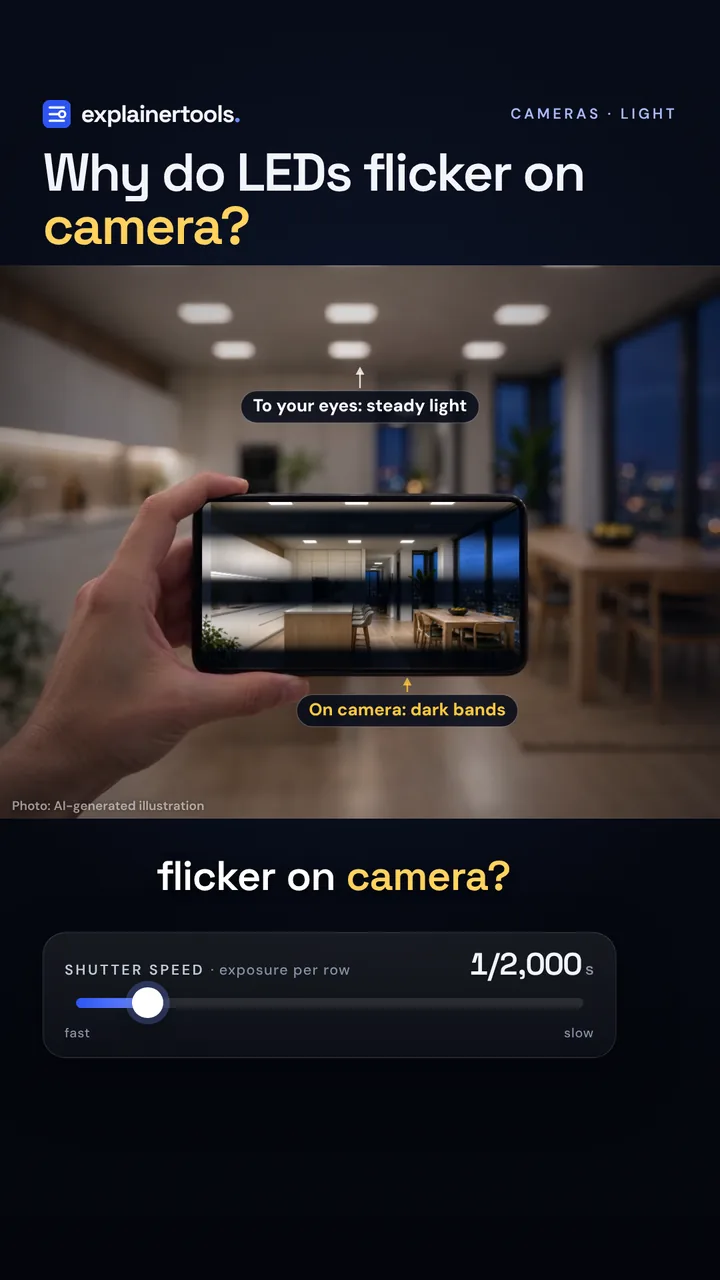
Many LEDs pulse with the mains power, about 100 or 120 times a second. A phone that reads one row at a time catches some rows on and some off, unless the exposure spans a whole pulse.
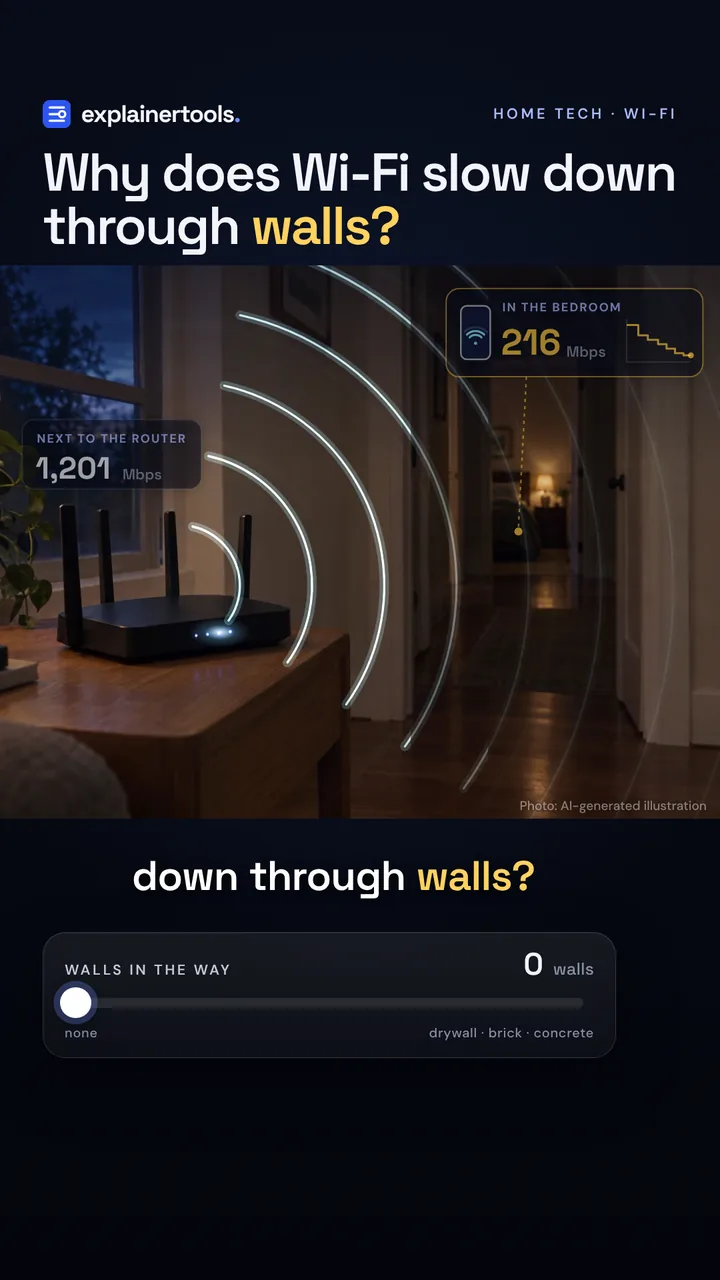
Wi-Fi is radio, and each wall soaks some of it up: drywall about half, concrete a tenth or less. As the signal fades, the link drops to slower, sturdier codes step by step.
A chatbot scores possible next tokens, turns those scores into probabilities, picks one and repeats. Lower temperature sharpens the top choice; higher temperature spreads the chance.
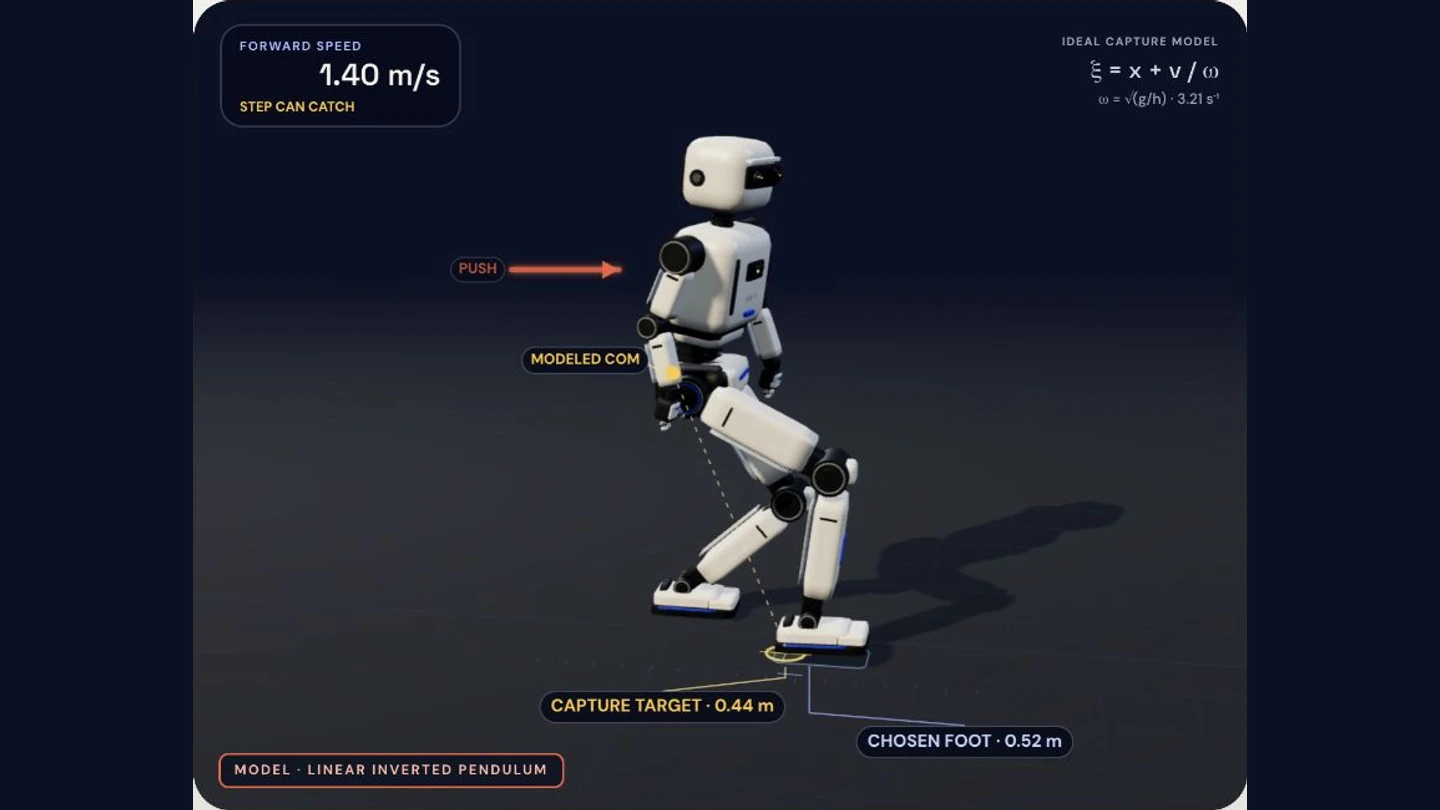
Walking is falling: lean forward and you tip, so a foot swings out to catch you. To stop, a robot’s next foot must land on the capture point, about a third of a second’s travel ahead. Land short and it topples; land on it and it stops dead.
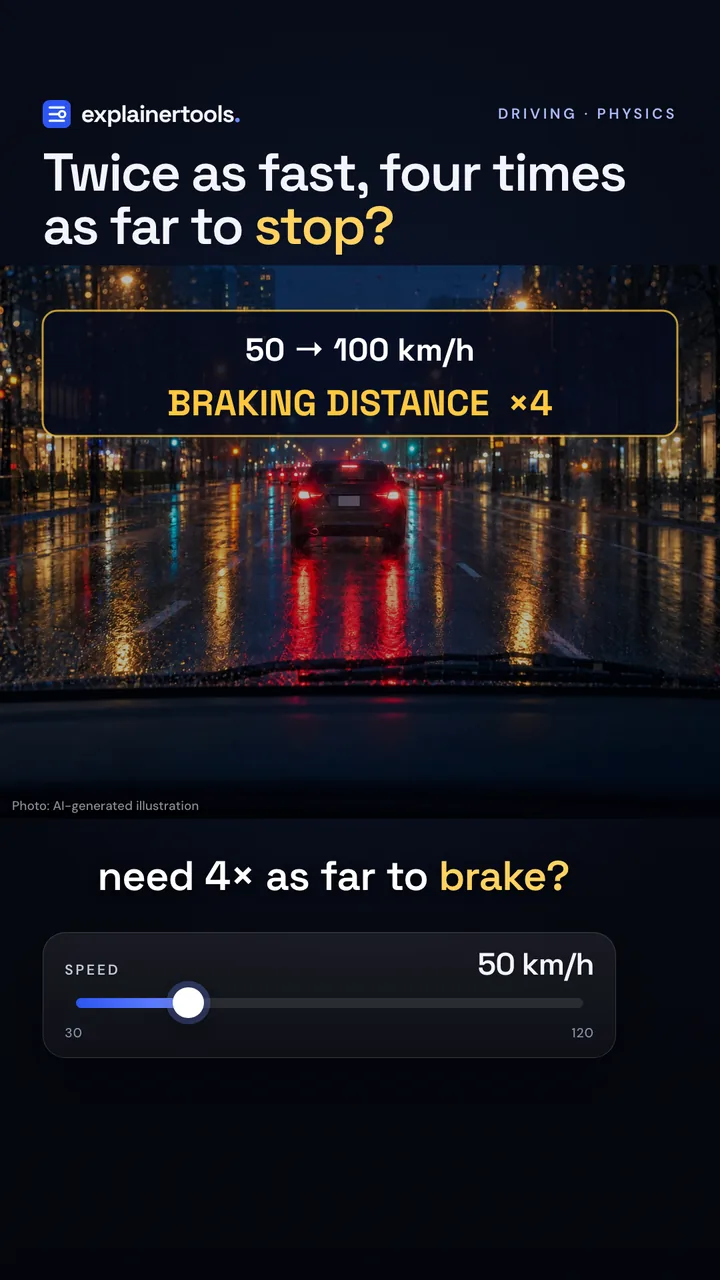
At fixed grip, reaction distance grows with speed while braking distance grows with speed squared. From 50 to 100 km/h, one doubles and the other quadruples.
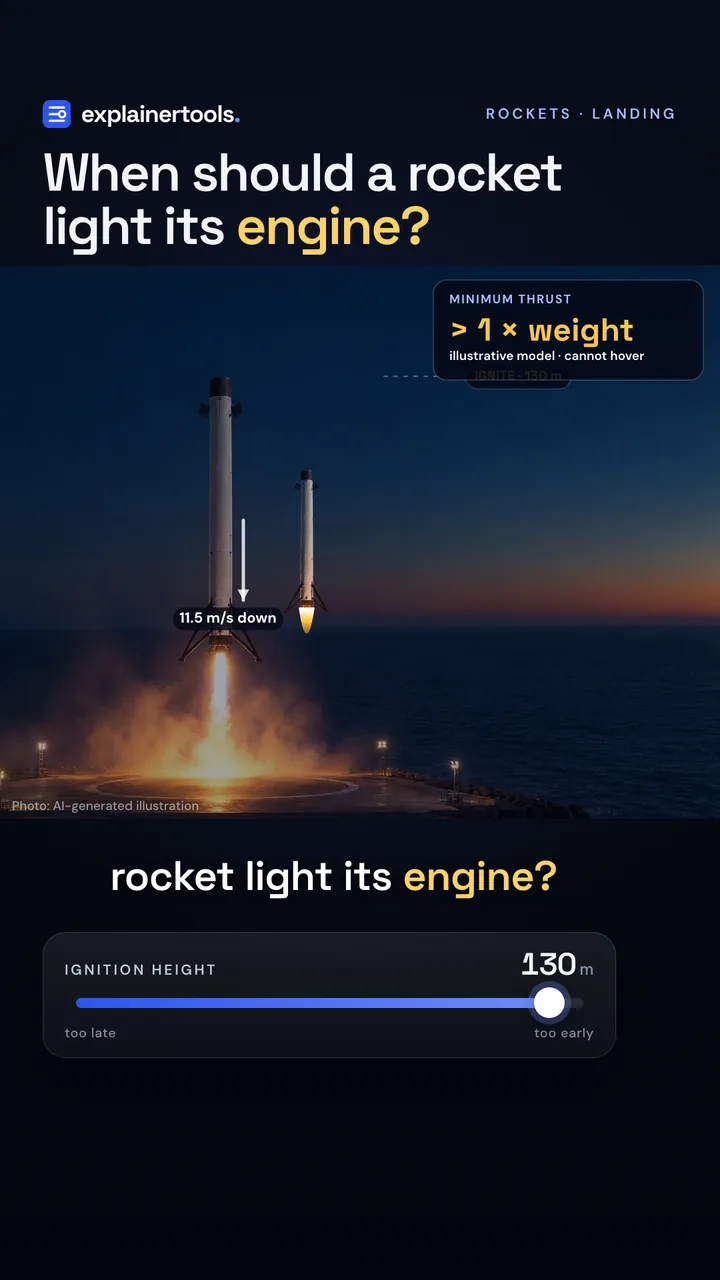
A returning Falcon 9 booster cannot hover when its minimum thrust exceeds its landing weight. In the teaching model, one ignition height removes its speed exactly at the pad.
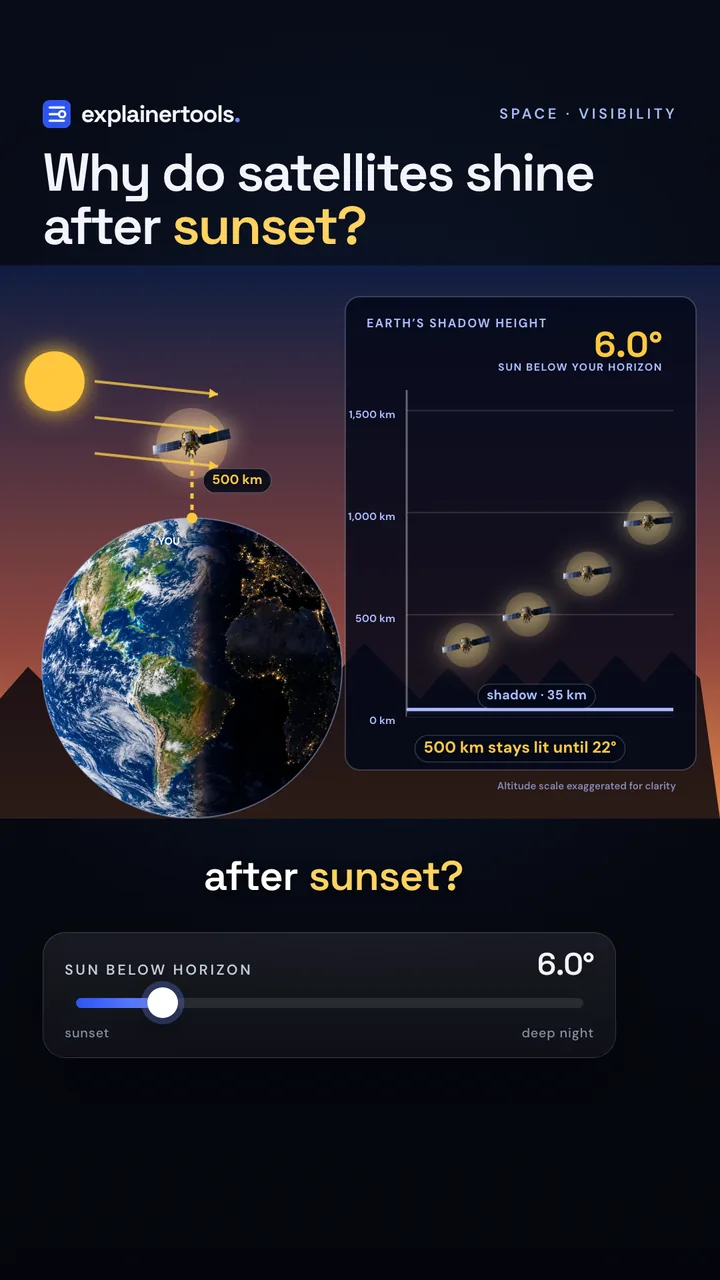
A satellite makes no light; it reflects sunlight. At about 500 kilometers up, an overhead satellite can stay sunlit until the Sun is roughly 22 degrees below your horizon.
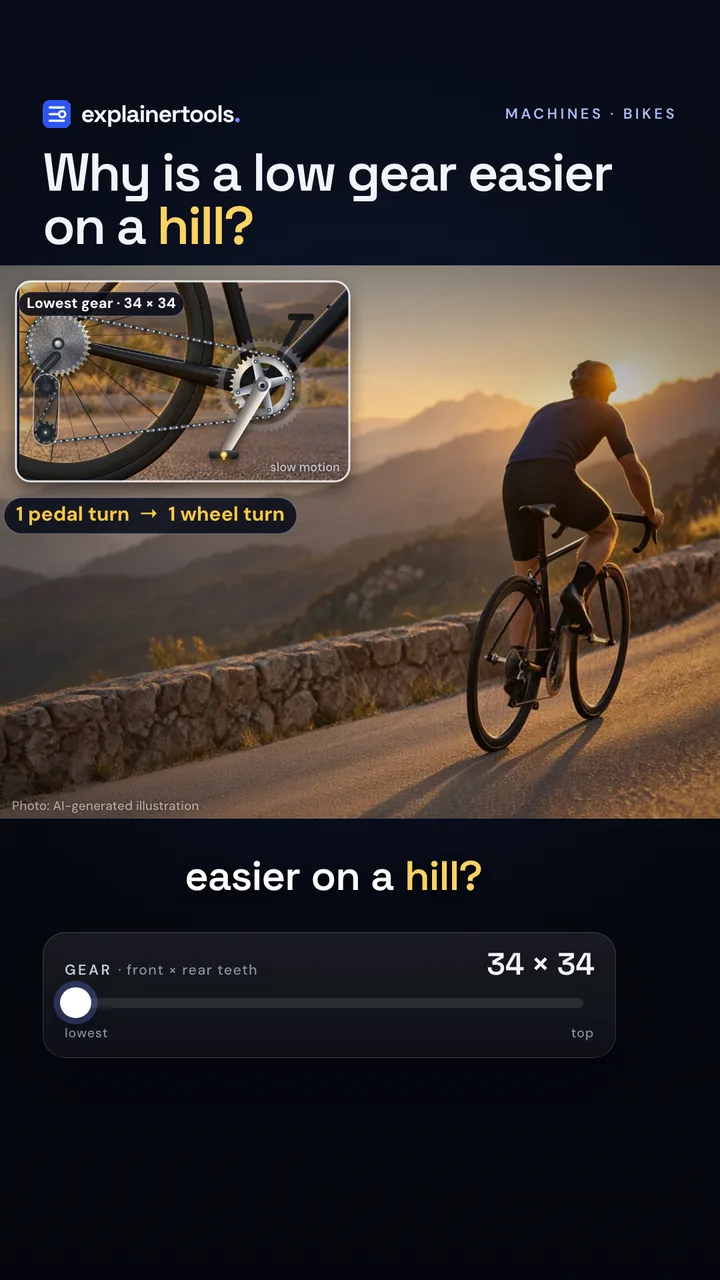
A road bike's 34-tooth front ring and 34-tooth rear cog turn the wheel once per pedal turn. Shift to 50/11 and the wheel turns 4.55 times, but the same road force needs 4.5 times the foot force.
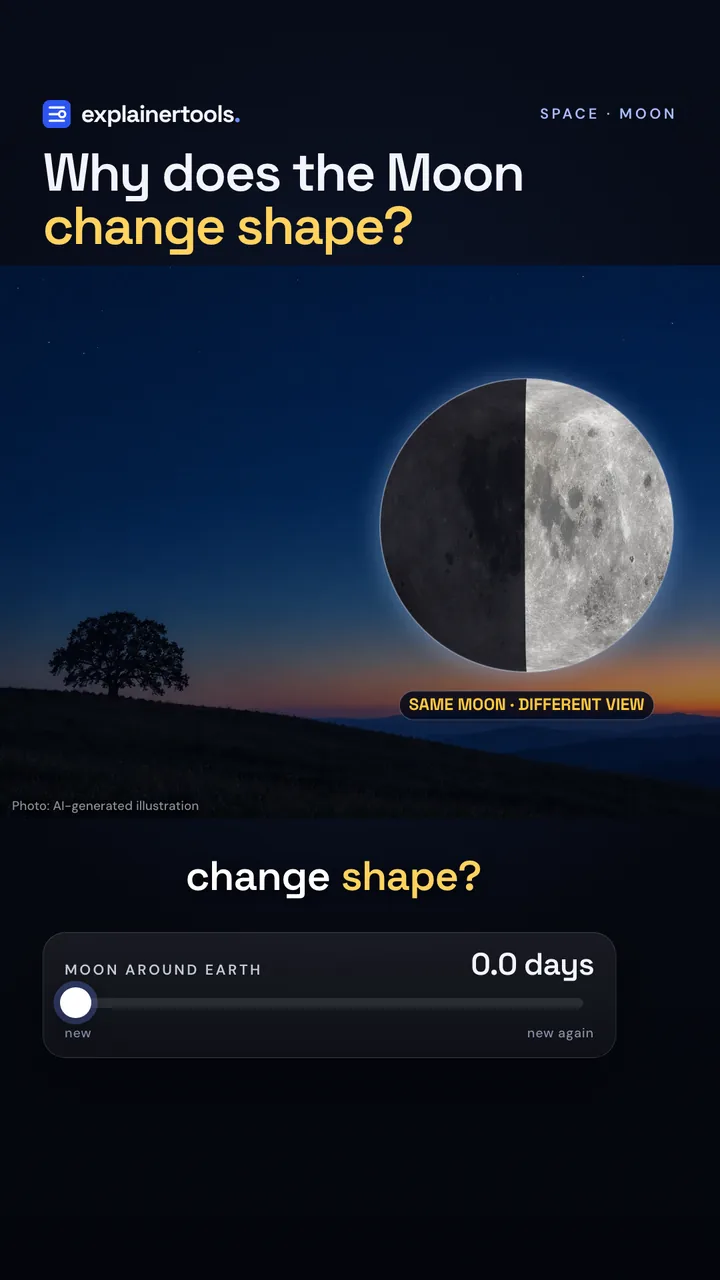
Sunlight always illuminates half the Moon. As the Moon moves around Earth, the fraction of that bright half facing us changes through a 29.5-day cycle.
A language model only writes text from its training, so it can only guess today's weather. With tools it writes a request, the app runs it, and the model reads the answer.
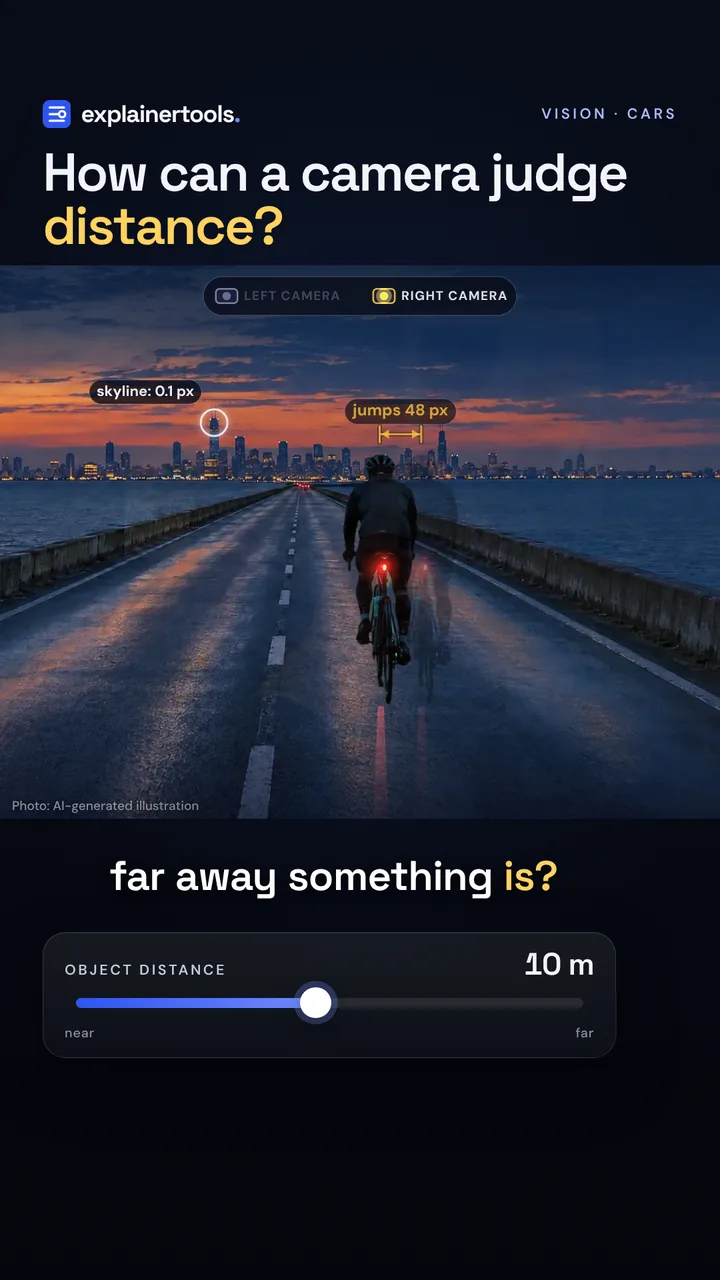
Blink one eye, then the other, and your thumb jumps while the far wall stays put. Two cameras set a little apart measure that shift, and simple geometry turns it into a distance.
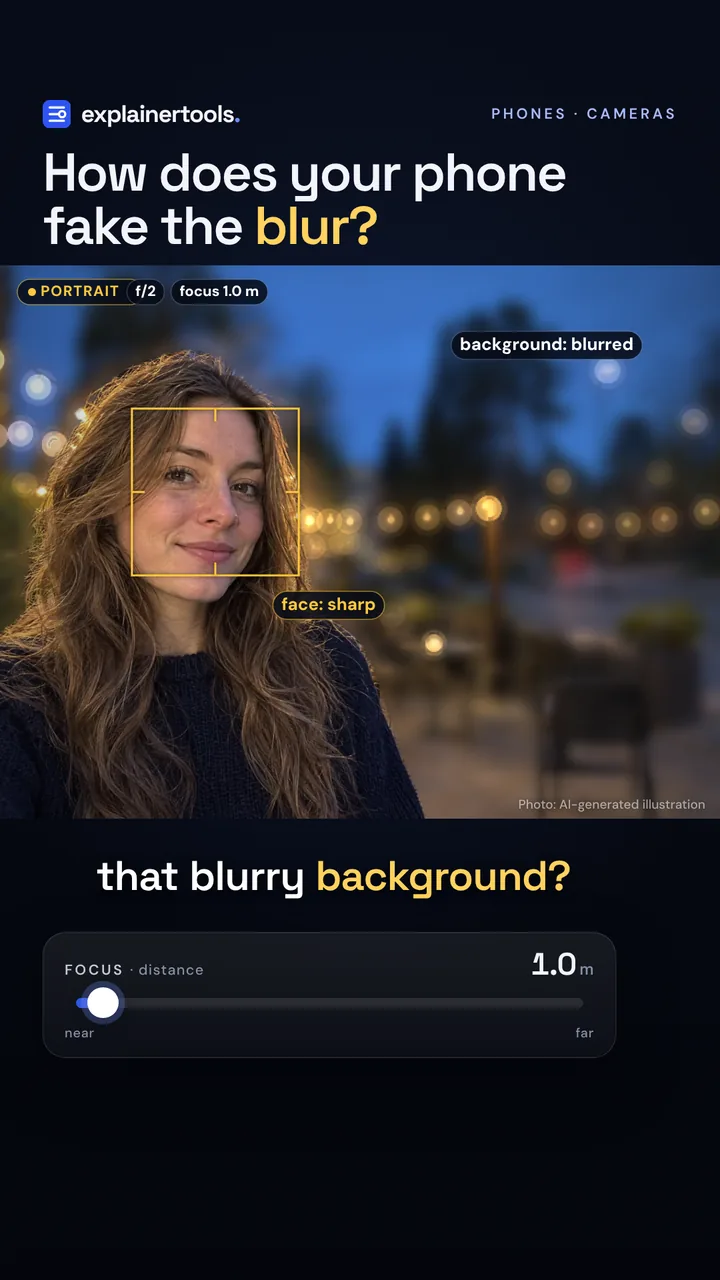
A phone's tiny lens keeps almost everything sharp, so Portrait Mode estimates how far away each part of the picture is, then blurs it by its distance from the focus point.
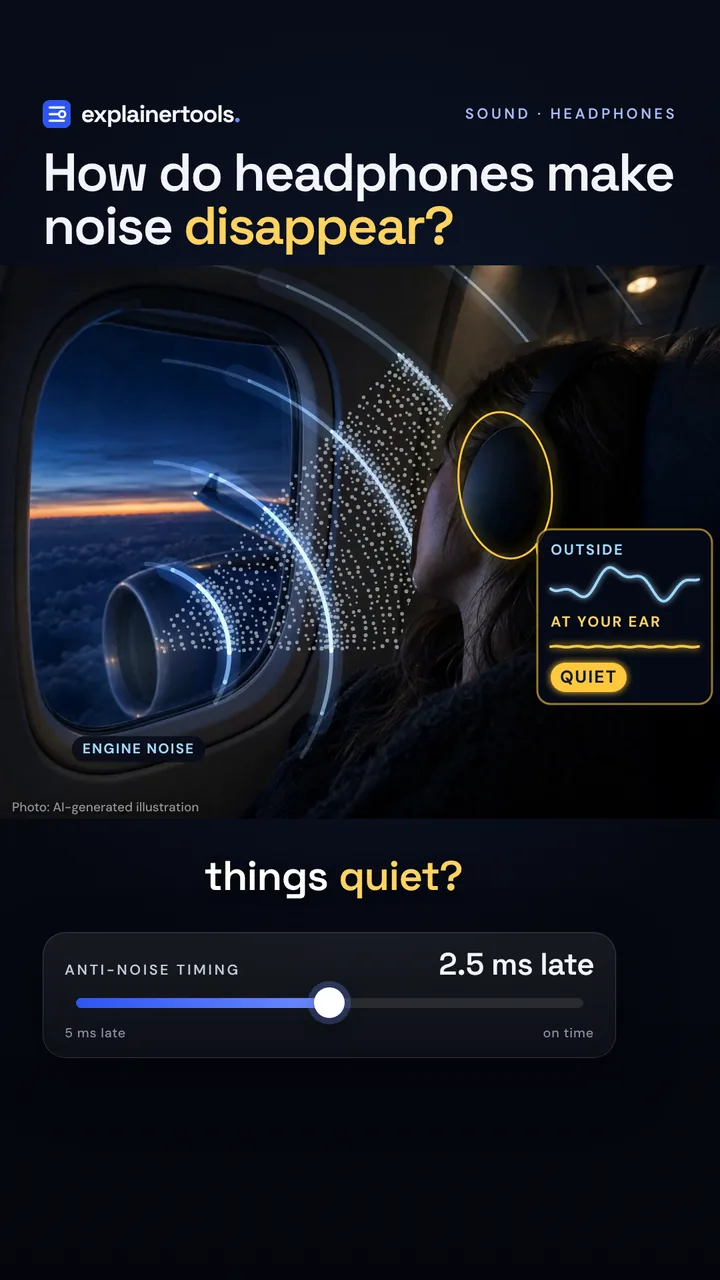
Headphones play the opposite of the noise, a wave that squeezes where the noise stretches. Get the timing wrong and the two add up, which is why low, steady hums are the easiest to cancel.
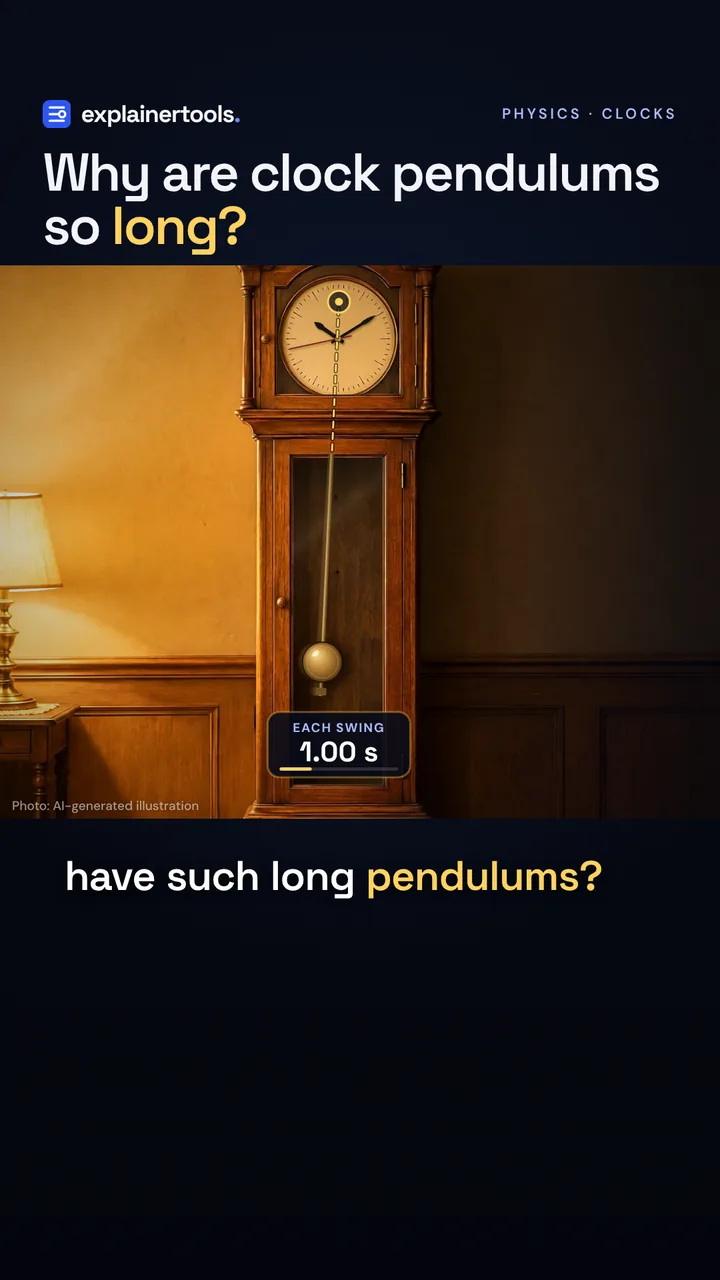
A pendulum's swing time depends on its length, not its weight. Four times the length gives twice the time, so a one-meter pendulum ticks once a second.
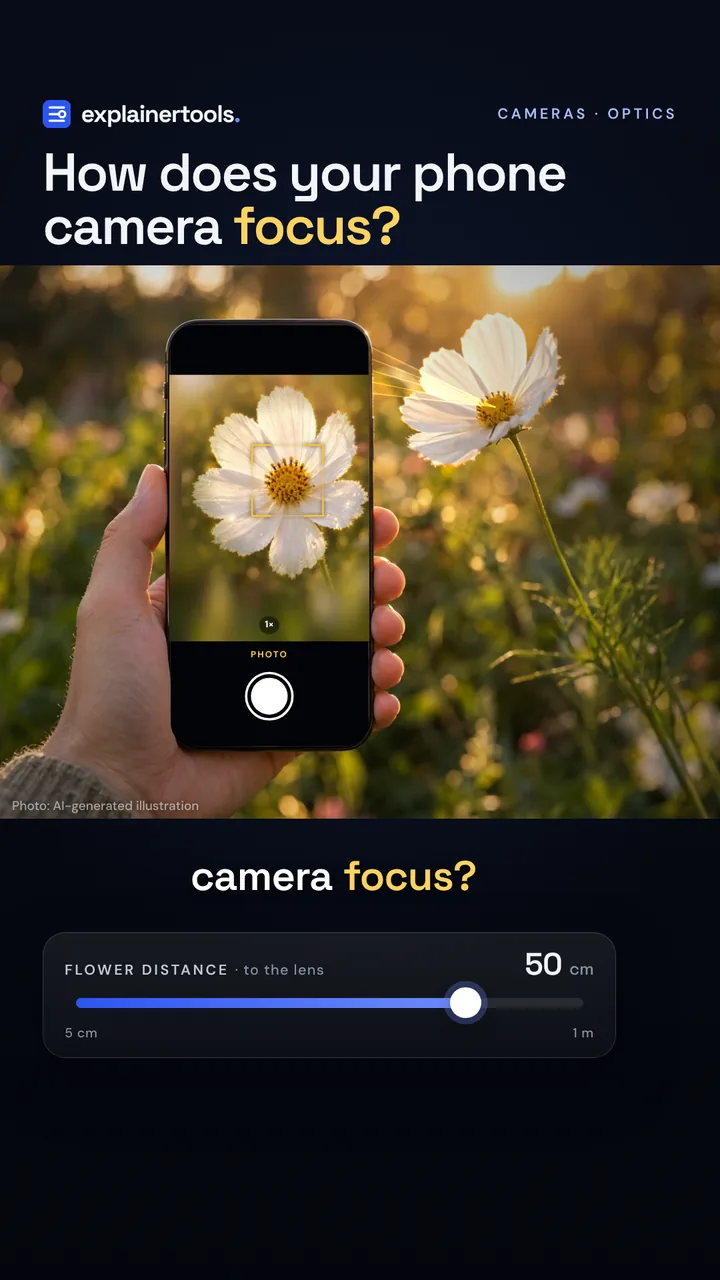
Light from each point meets again at one spot. If that spot lands on the sensor the point is sharp, and a motor moving the lens less than a millimeter makes it so.
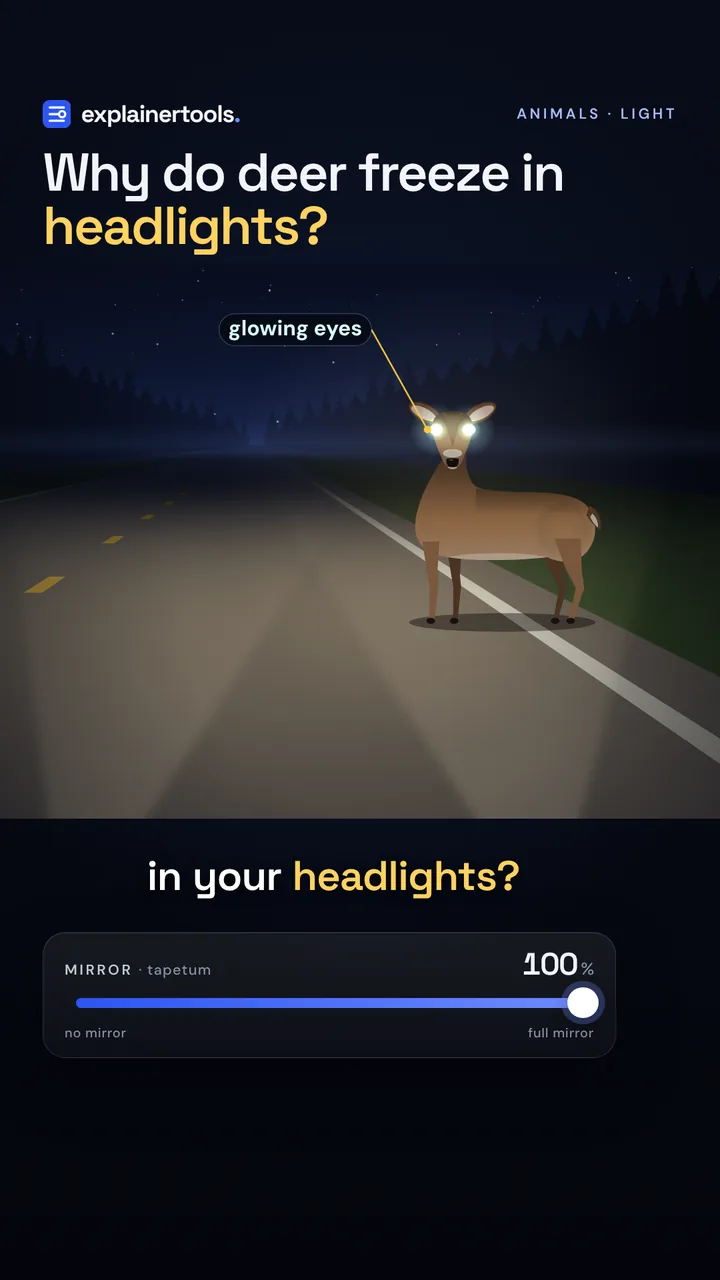
A mirror behind a deer's retina, the tapetum lucidum, gives its eyes a second chance at light and sends your headlights straight back. Why deer freeze is still an open question.
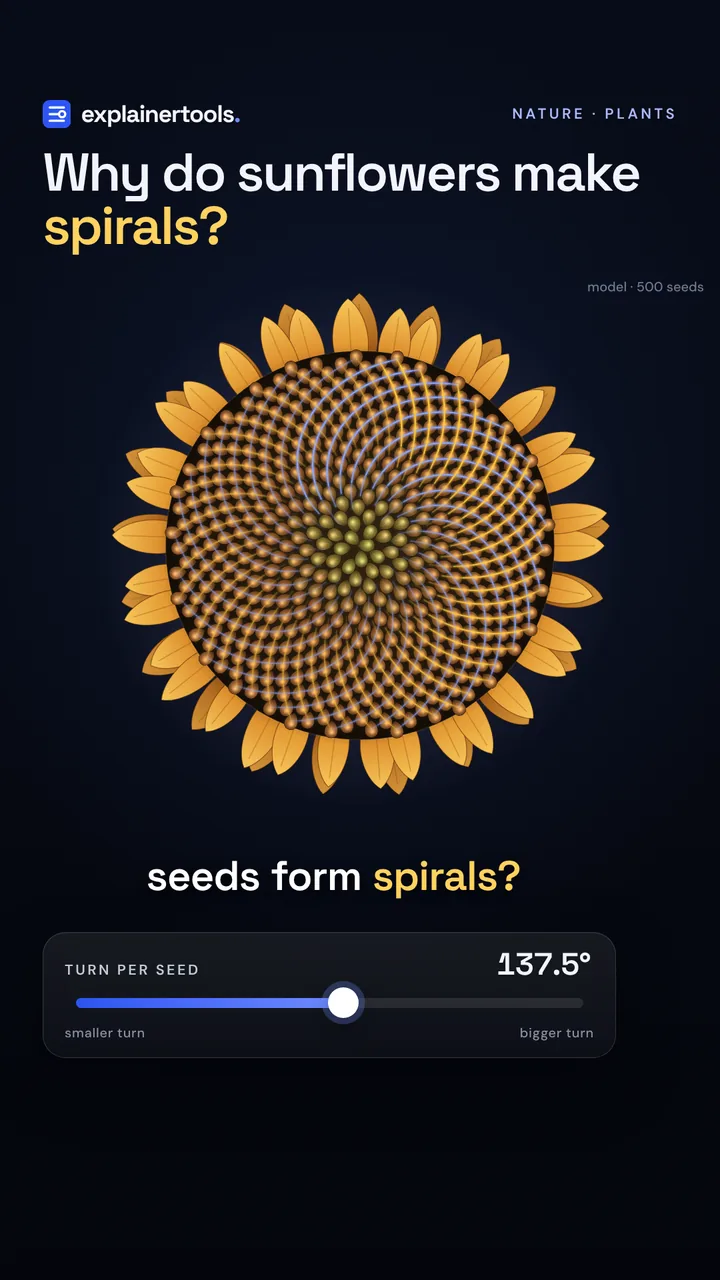
Turn every new seed by the same angle. A third of a turn leaves three straight arms with gaps; the golden angle, about 137.5°, packs the head evenly into 34 and 55 spirals.
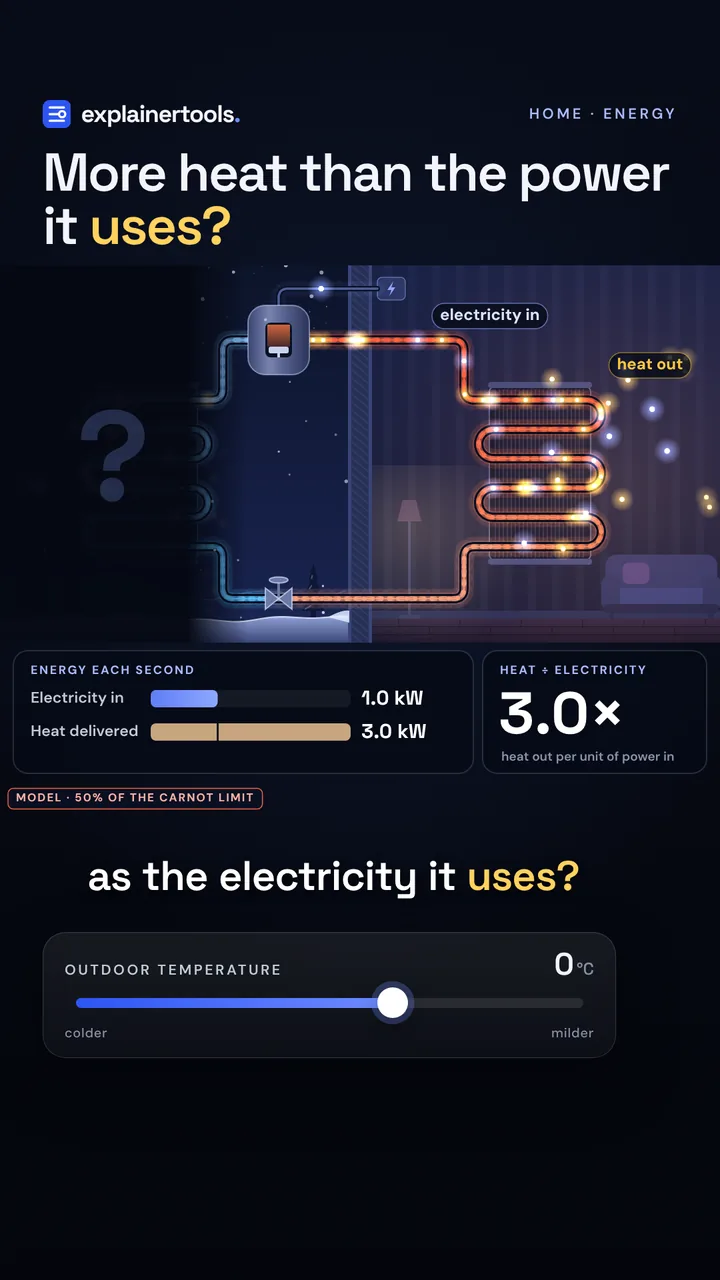
A heat pump doesn't make most of its heat. It moves it in from outdoor air, even freezing air. The colder it gets outside, the bigger the lift and the lower the ratio.
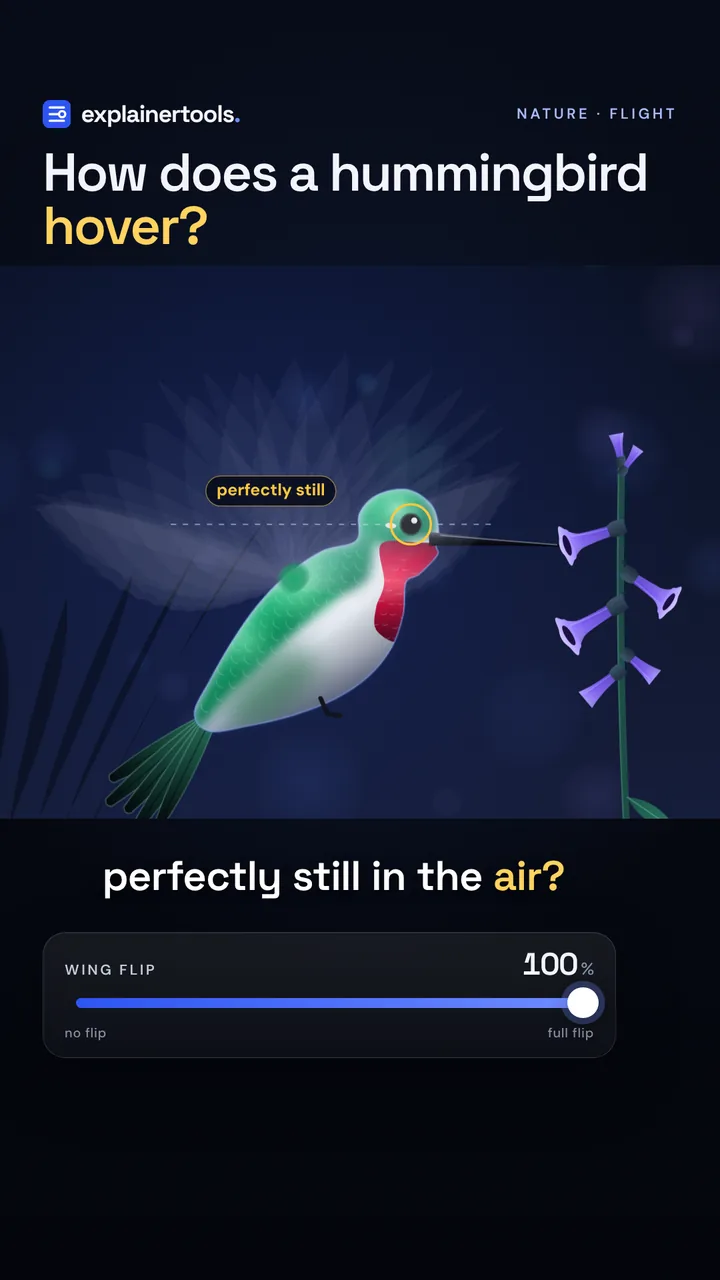
Hummingbird wings sweep forward and back about 50 times a second, flipping over at each end so both strokes push air down. In real birds the back stroke gives about a quarter of the lift.
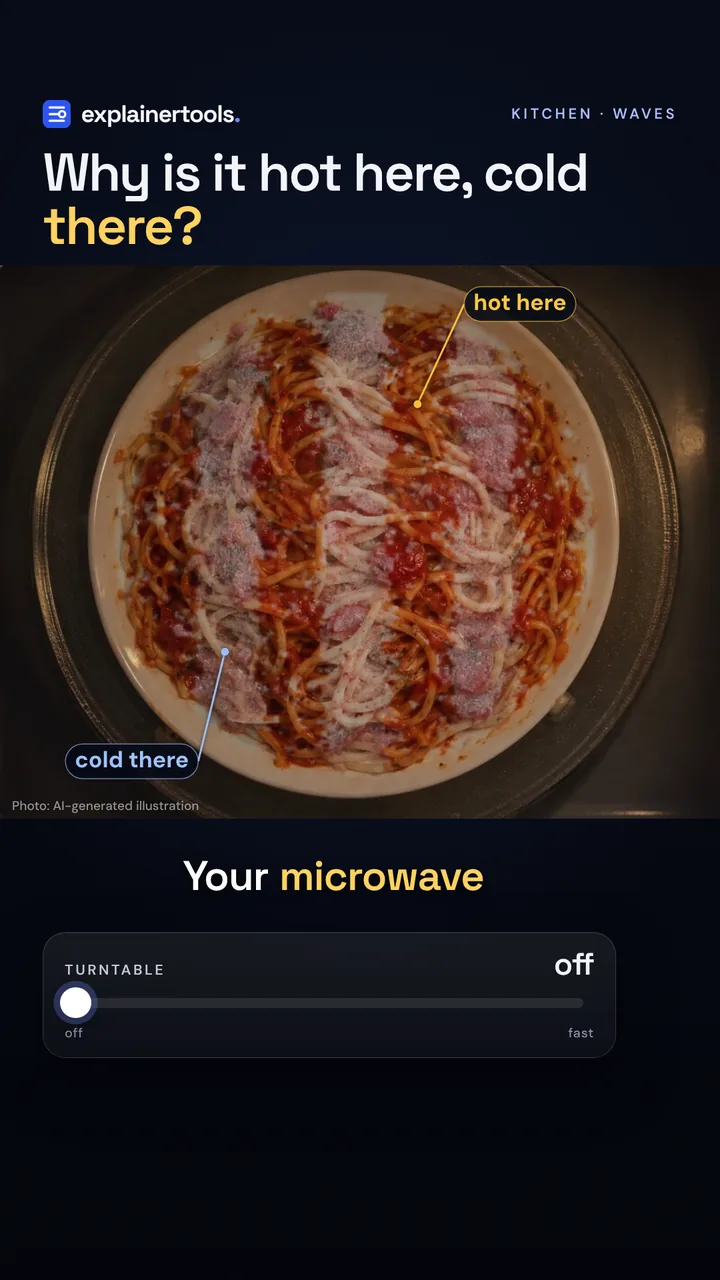
Microwaves overlap into a standing wave: fixed hot bands about 6 cm apart, with weak spots between. Spinning the plate evens it out, but not at the very center.
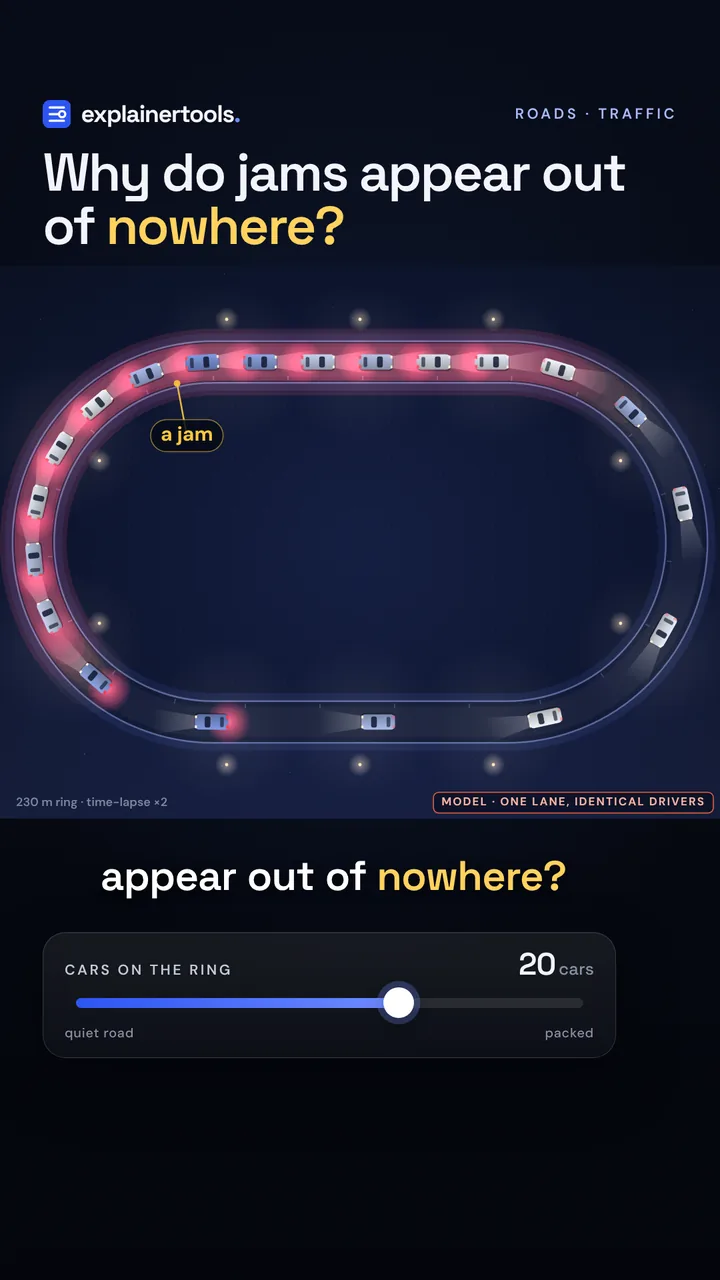
One driver taps the brakes. On a quiet road the gaps soak it up; on a busy one each driver brakes harder until someone stops, and the jam drifts backward at about 20 km/h.
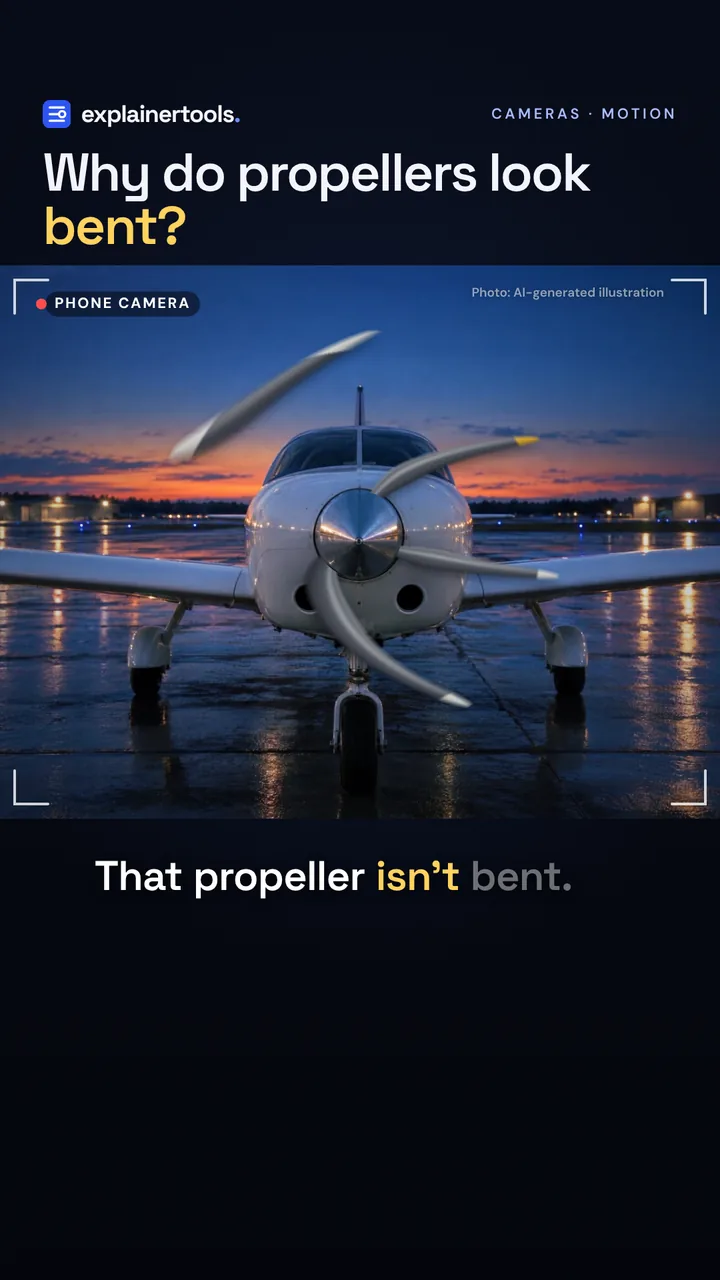
Phones read the sensor row by row over about 1/50 s. A fast propeller swings around during that time, so each row catches the blades somewhere new and straight blades come out curved.
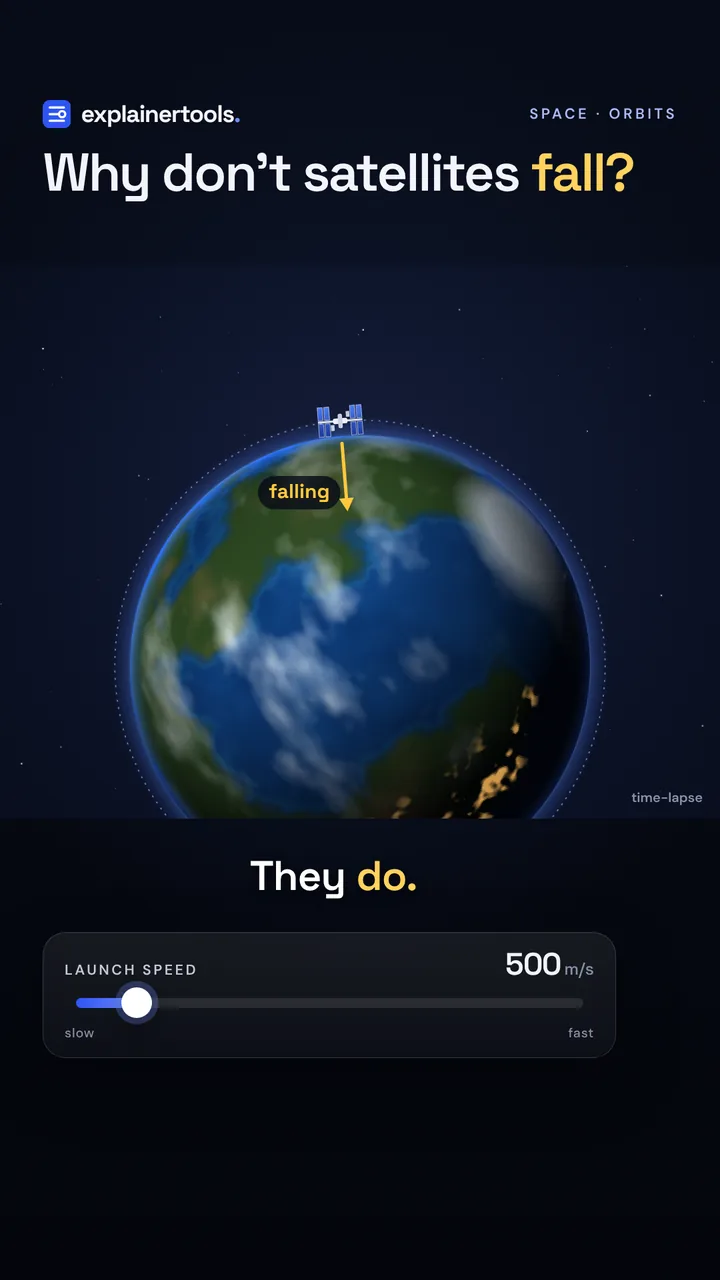
Satellites are falling right now. Fire Newton's cannonball faster and faster, and see why at about 8 km/s the curved Earth drops away as fast as the ball falls.
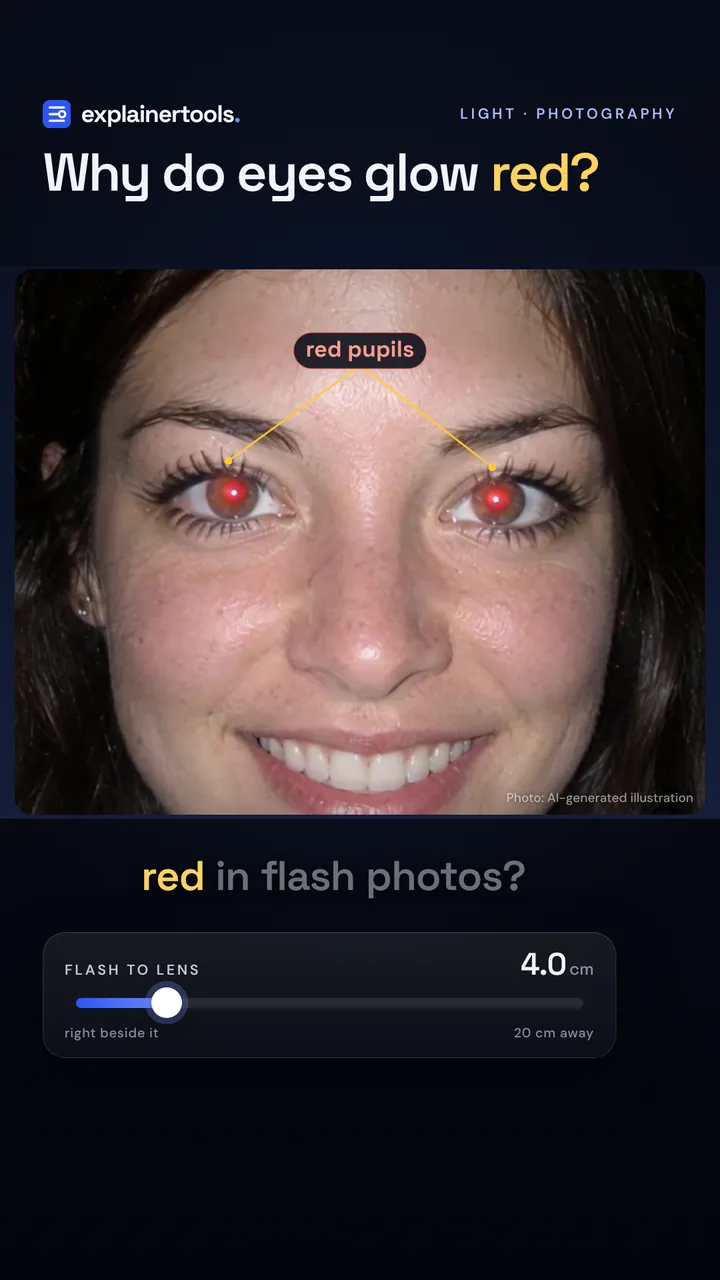
That red glow is the inside of the eye, lit by the flash and sent straight back. Slide the flash away from the lens, or shrink the pupils first, and the red disappears.
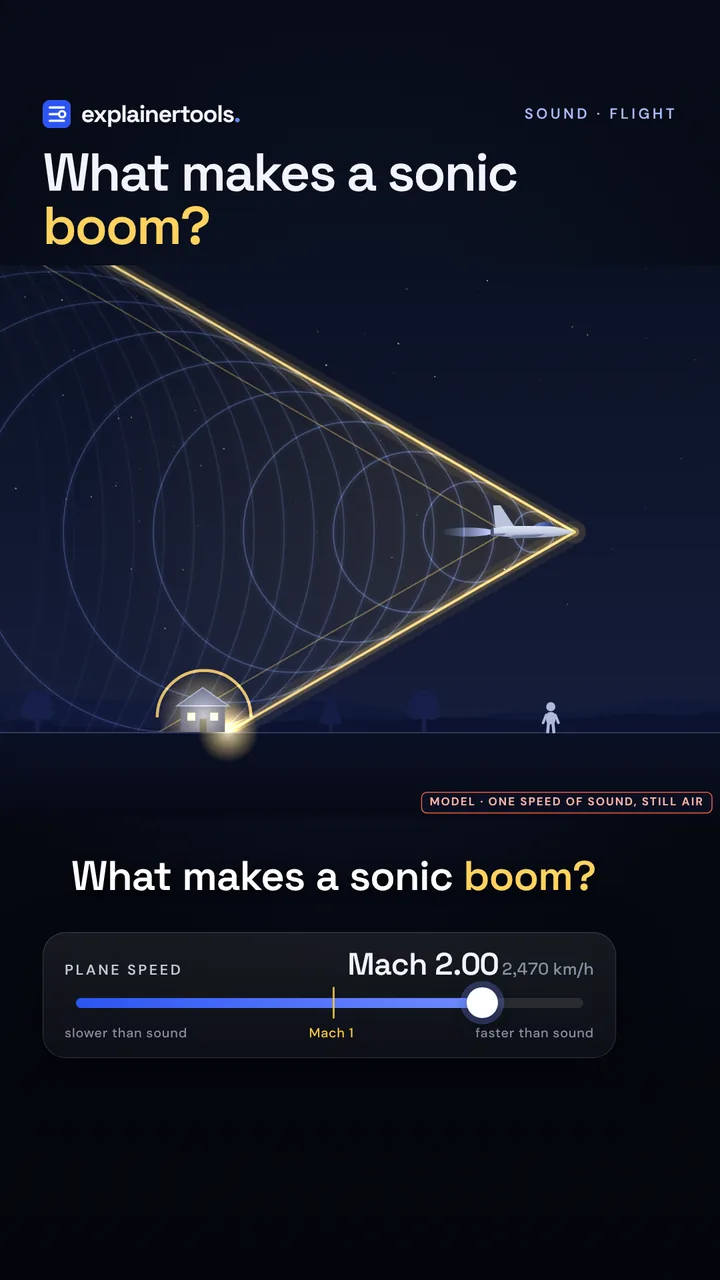
A sonic boom isn't a one-time bang. Drag a plane past the speed of sound and watch its rings pile into a cone that booms along the ground the whole time it flies.
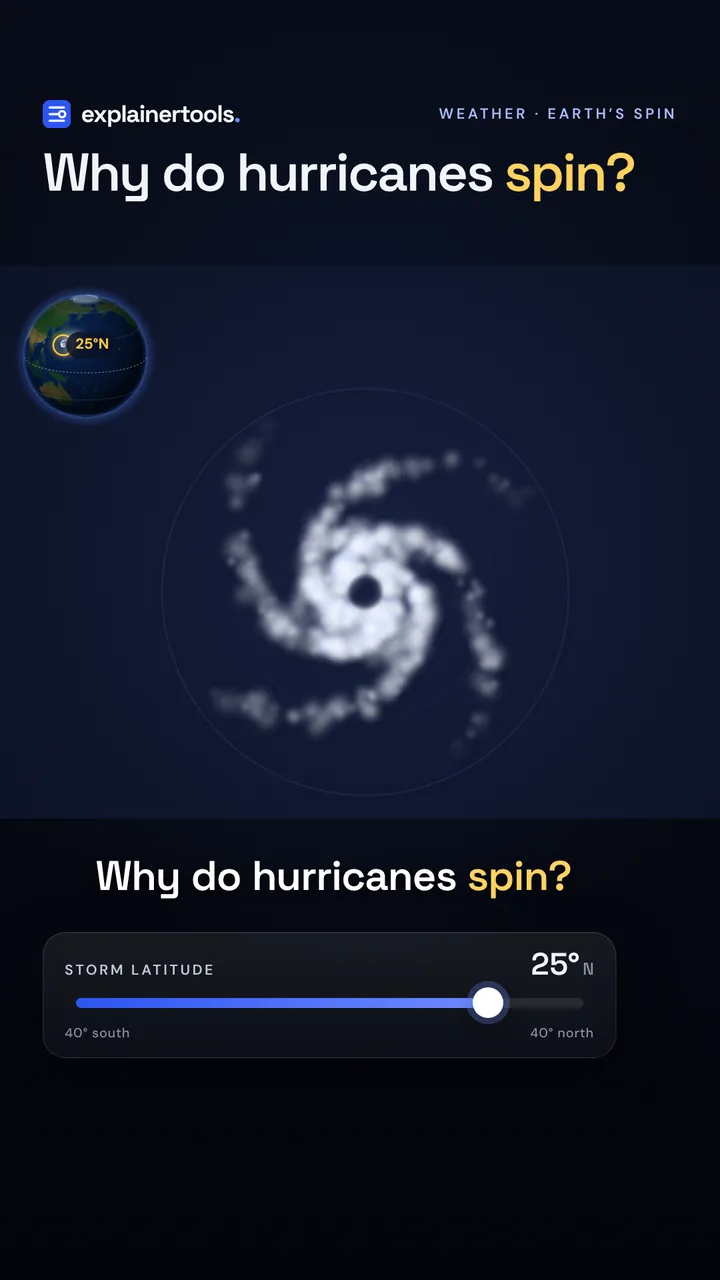
Air rushing into a hurricane curves the same way on every side, because Earth is turning. Move the storm across the equator and the spin flips; right at the equator, it stops.
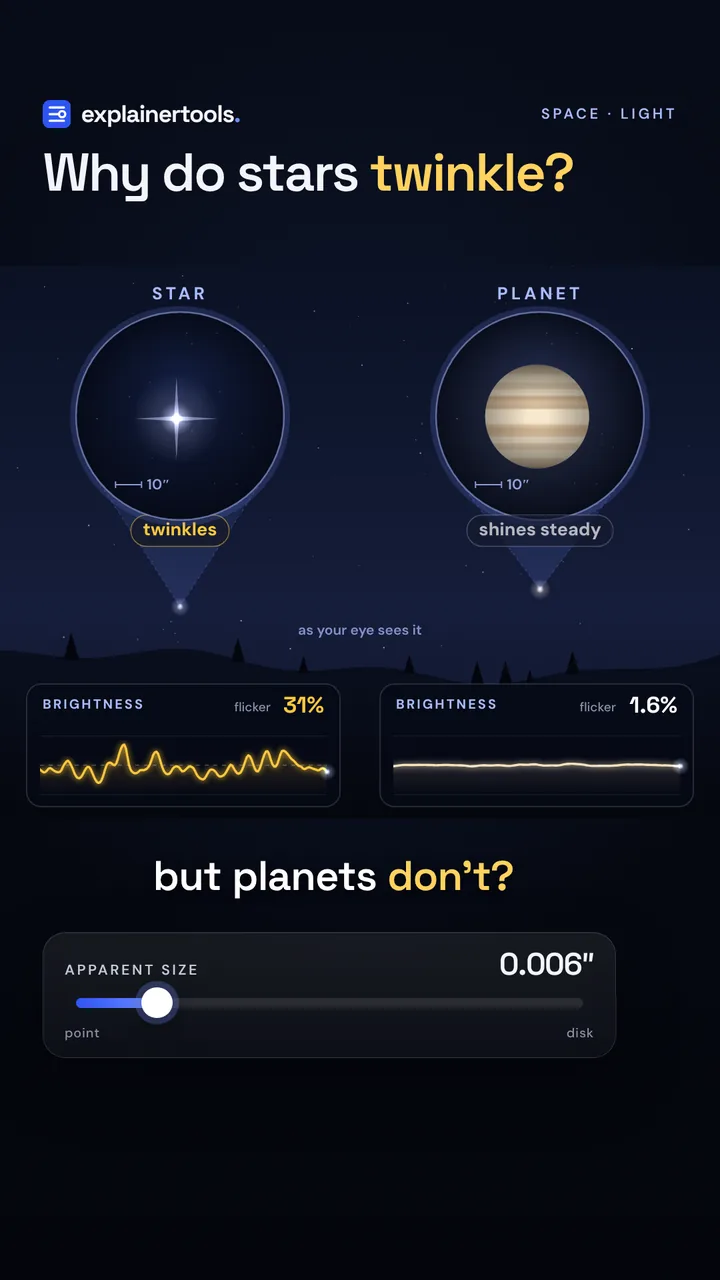
Moving pockets of warm and cool air bend starlight like lenses. A star is a single point, so it flickers; a planet is a tiny disk of many points, and their flickers average out.
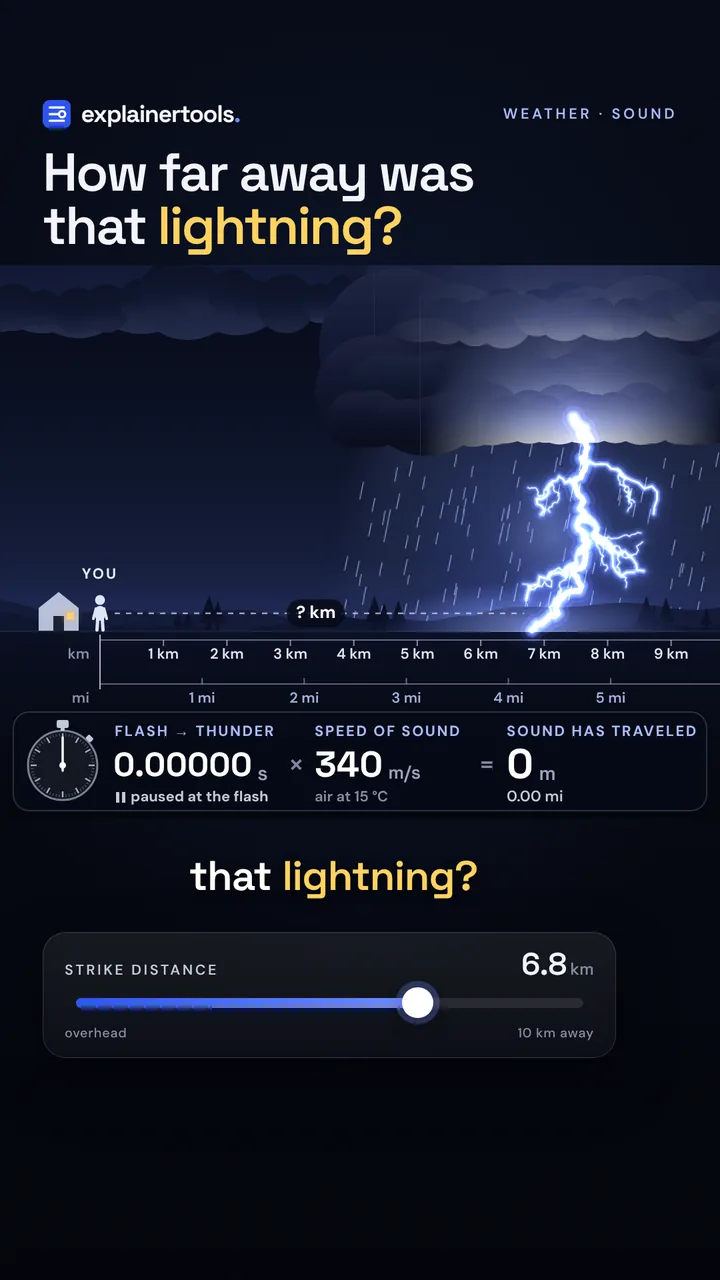
Light arrives almost instantly; thunder crawls at about 340 m/s. Count the seconds between them: every 3 seconds is about a kilometer, or 5 seconds a mile.
Your first pick wins one time in three, and the host can't change that. Add doors until it's obvious: with a hundred, switching wins ninety-nine times in a hundred.
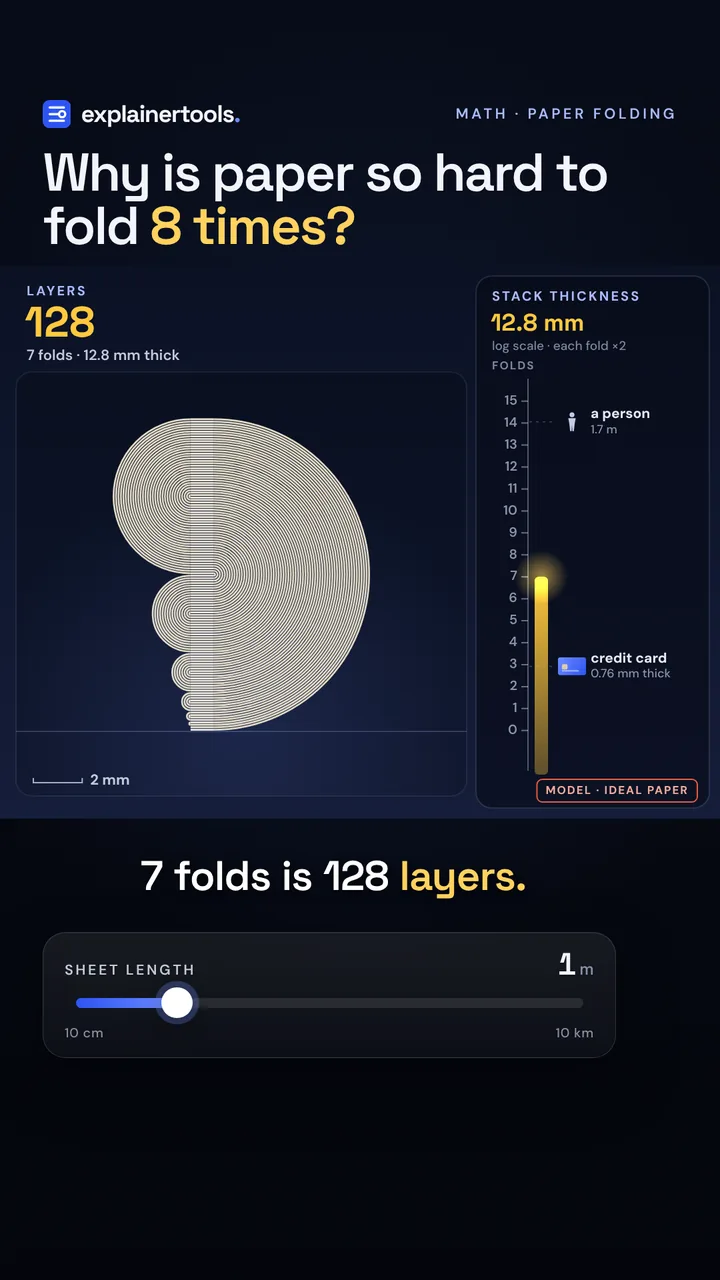
Each fold doubles the thickness, and every bend has to wrap all those layers. That's why twelve folds need a strip nearly a kilometer long, and 42 would reach past the Moon.
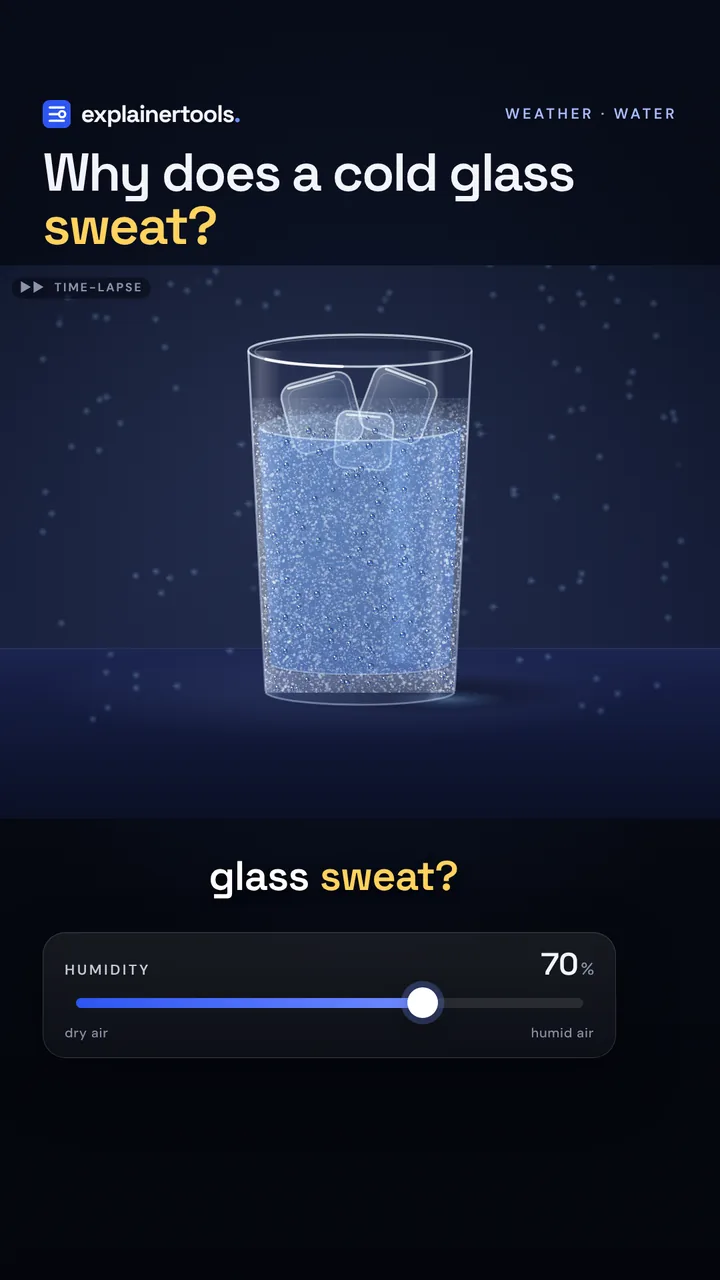
The water on a cold glass comes out of the air. When the air touching the glass chills below its dew point, vapor condenses into droplets; on a dry day, the glass stays dry.
Many of a QR code's squares are backup: Reed–Solomon math built from your link. Tear a chunk out and it still scans; damage a corner finder and it fails.
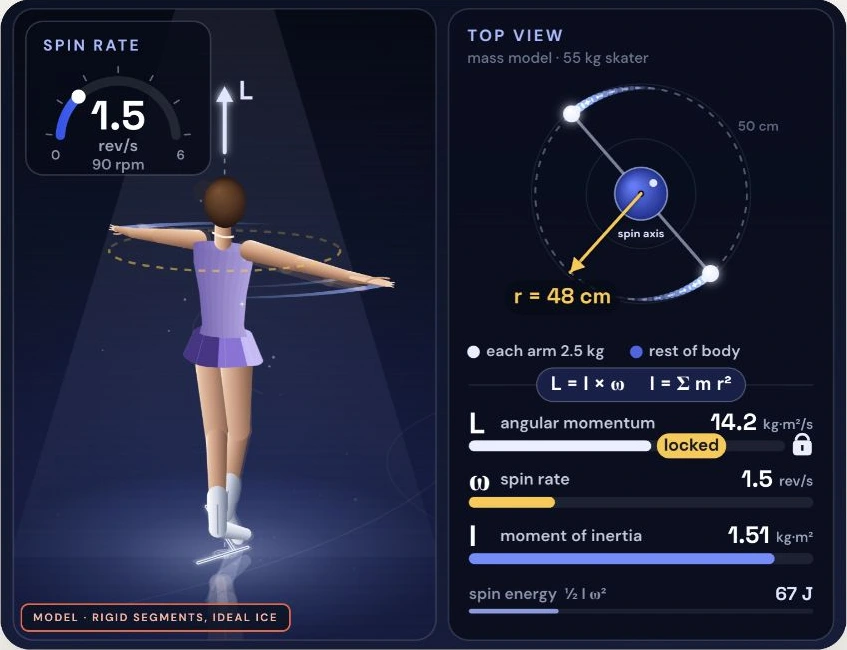
No outside twist speeds a skater up. Pulling the arms in lowers the moment of inertia, so to keep the same angular momentum, the body has to turn faster.
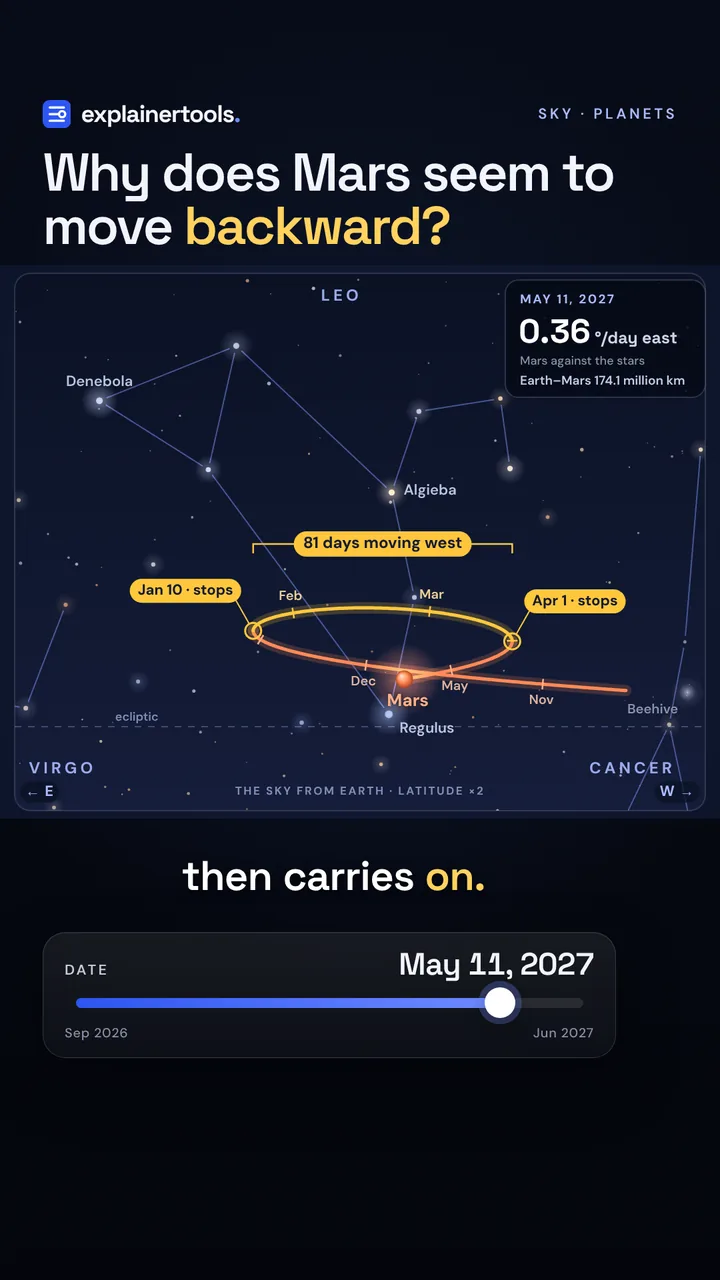
Every two years or so, Mars stops, loops back west and carries on. It isn't reversing: Earth, on the inside track, is overtaking it, as it does around February 19, 2027.
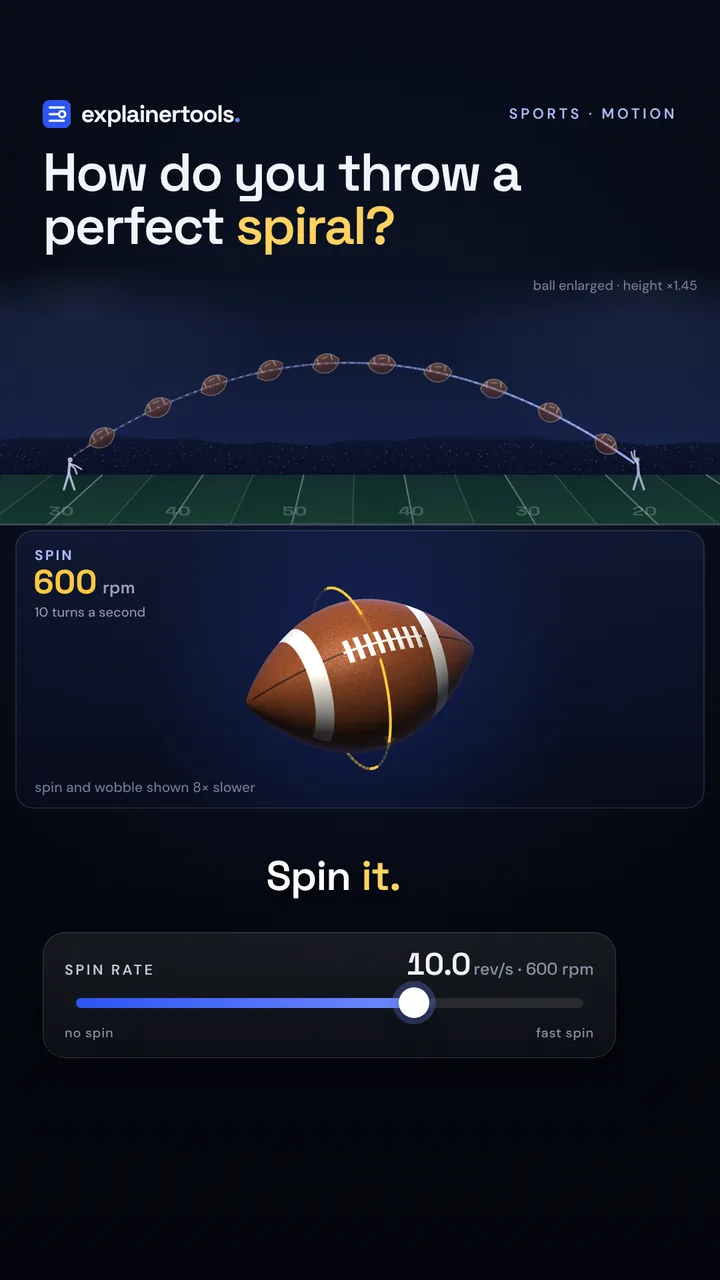
A spinning football is a gyroscope. Every throw starts with a little wobble; with enough spin, about ten turns a second, it shrinks into a tight spiral and the nose follows the arc.
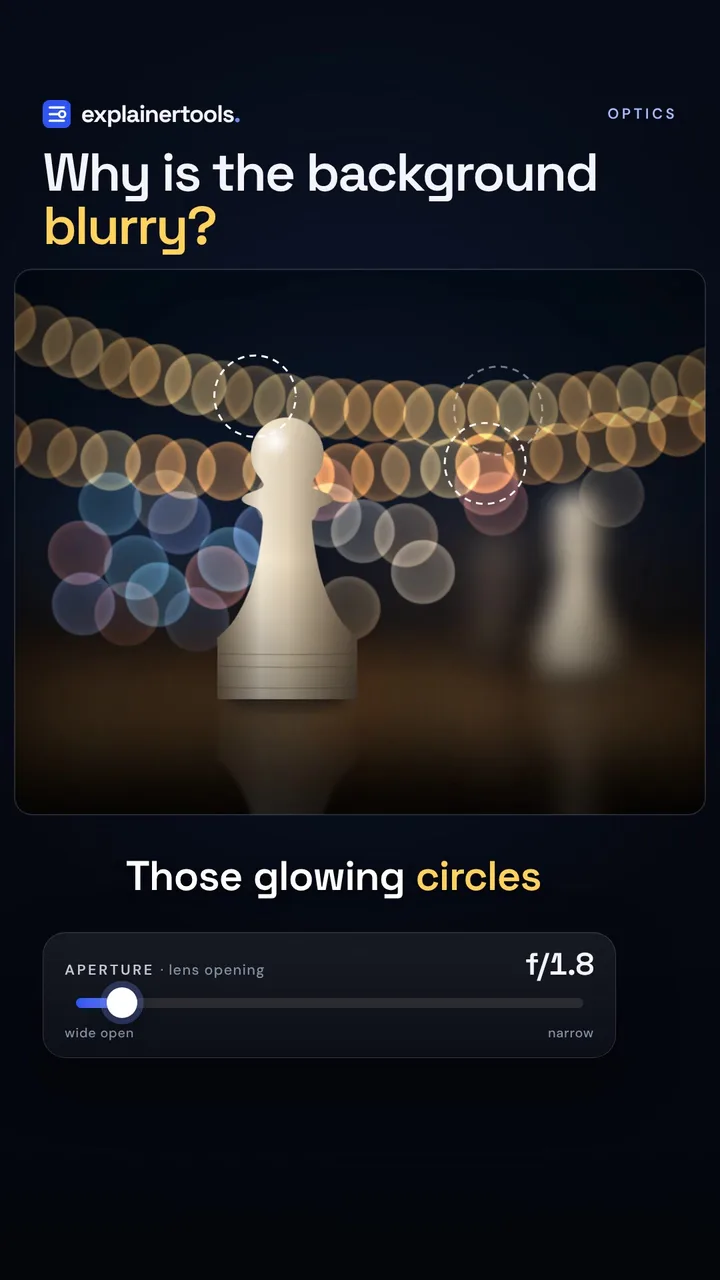
Those glowing circles behind a portrait are tiny lights, smeared into discs. See why a lens focuses only one distance, and why closing the aperture shrinks the blur.
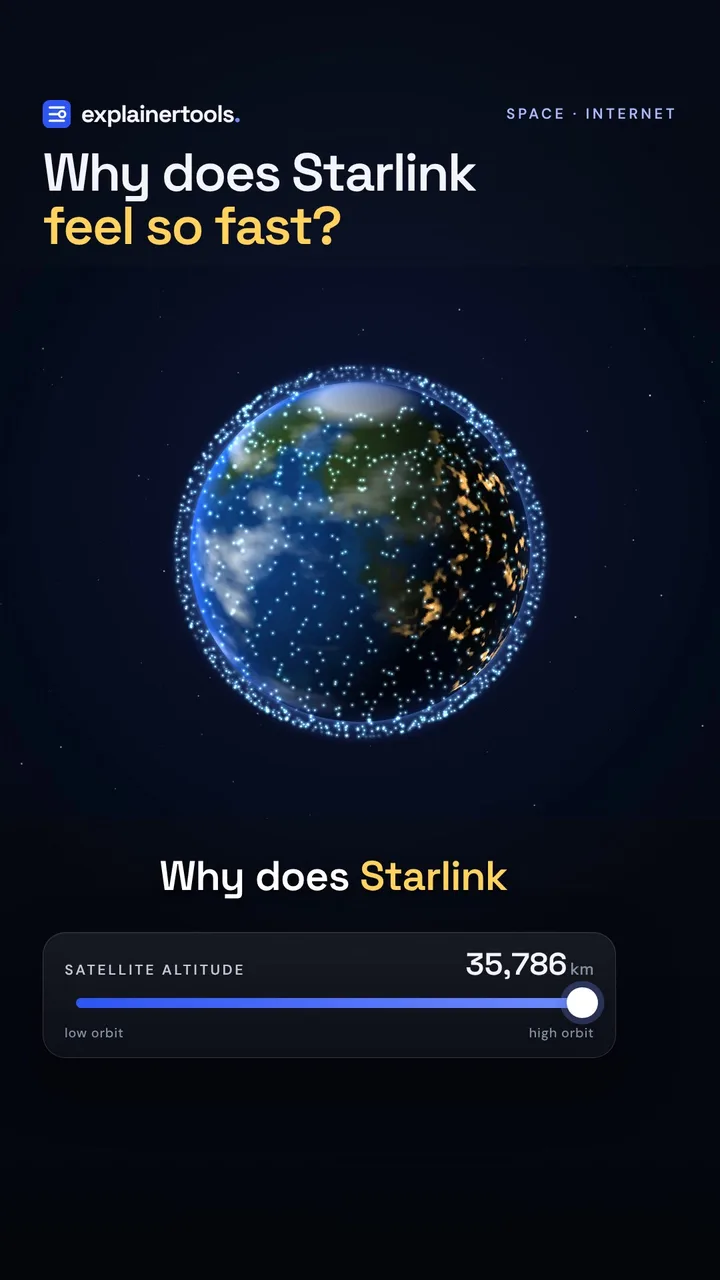
Light is fast, but space is big. See why a satellite 36,000 km up adds half a second to every click, and why dropping to about 500 km means you need thousands of satellites.
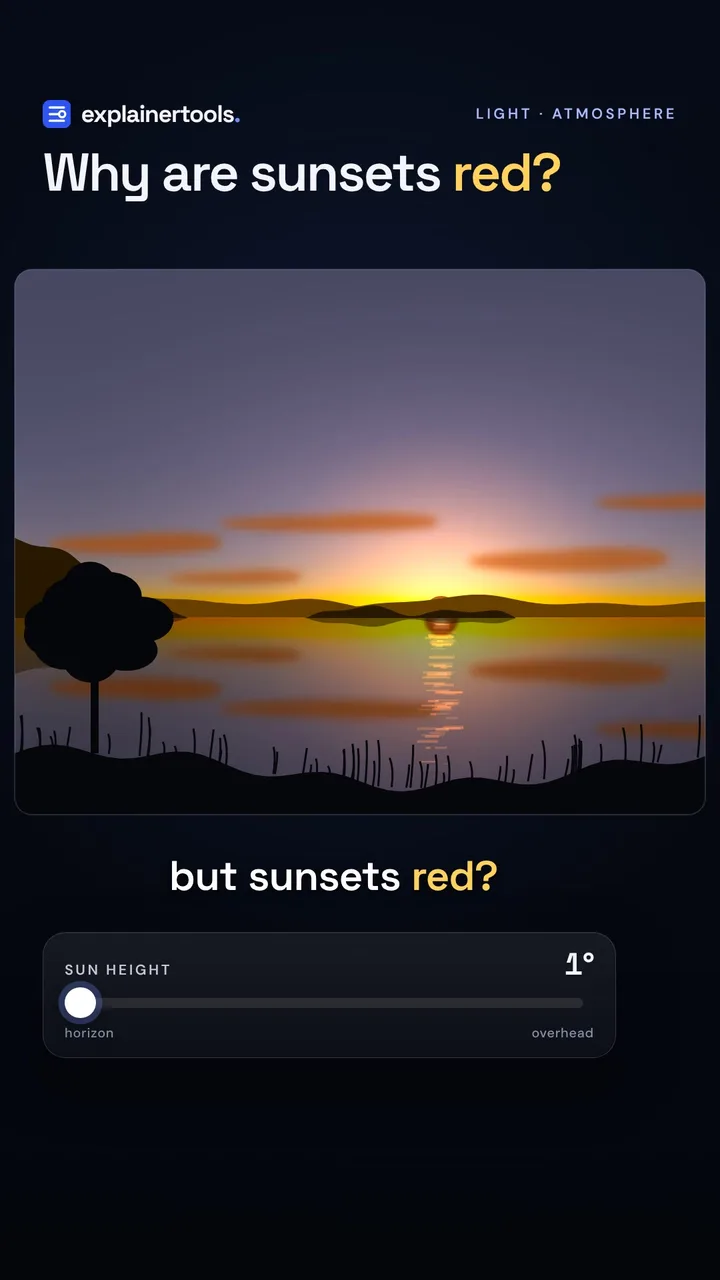
Air scatters blue light nearly six times more than red. Drag the sun to the horizon and its light crosses nearly forty times more air, so the blue is scattered out before it reaches you.
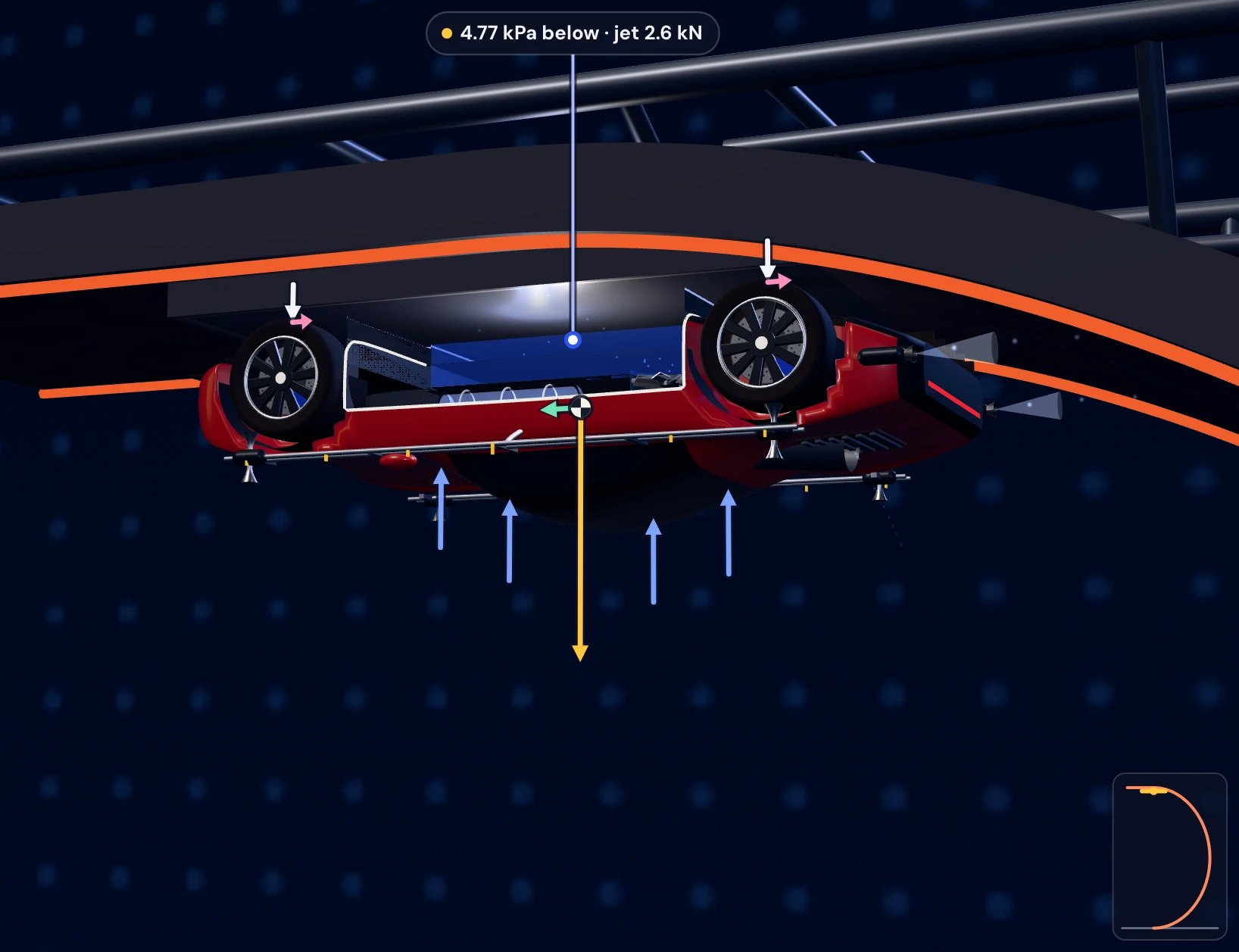
Move a fan car up a curved ramp to upside down. Push it with a jet. See when it holds, slides or falls off, then flip it with two jets. An illustrative model.
Every model and film here is original ExplainerTools work. When an idea comes from someone else, we say so and link to them.
Charge CurveAn ExplainerTools Original. Footage: @zacharymorris (plug-in), Elon Musk on The Joe Rogan Experience #2054 (clip via @NarutoNolimits) and a measured curve by @TeslaClubIN, credited on screen; the parking lot, charging curve and trip numbers come from the model.
Teardrop HingeAn ExplainerTools Original. Photos are AI-generated illustrations of a generic foldable; the hinge shapes and numbers are drawn in code.
Folding Screen LabAn ExplainerTools Original. Photos are AI-generated illustrations of a generic foldable; the mechanism and numbers are drawn in code.
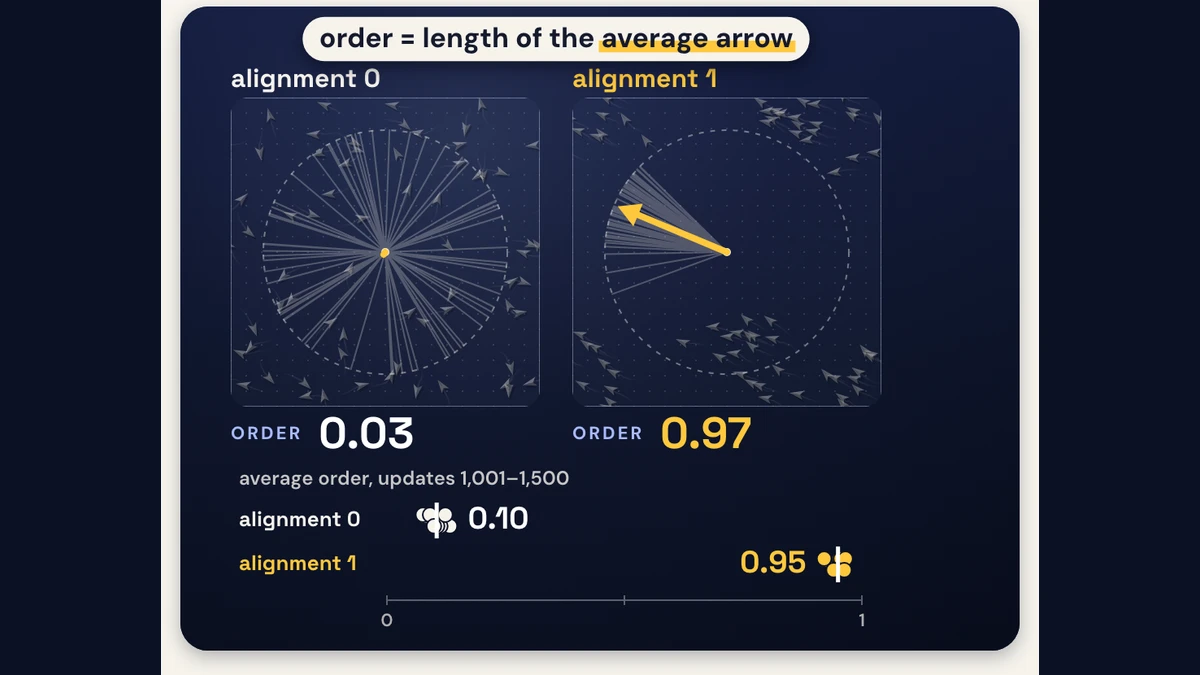
Flocking Local RulesAn ExplainerTools Original. Independent implementation and visuals; motivated by primary research on local alignment.
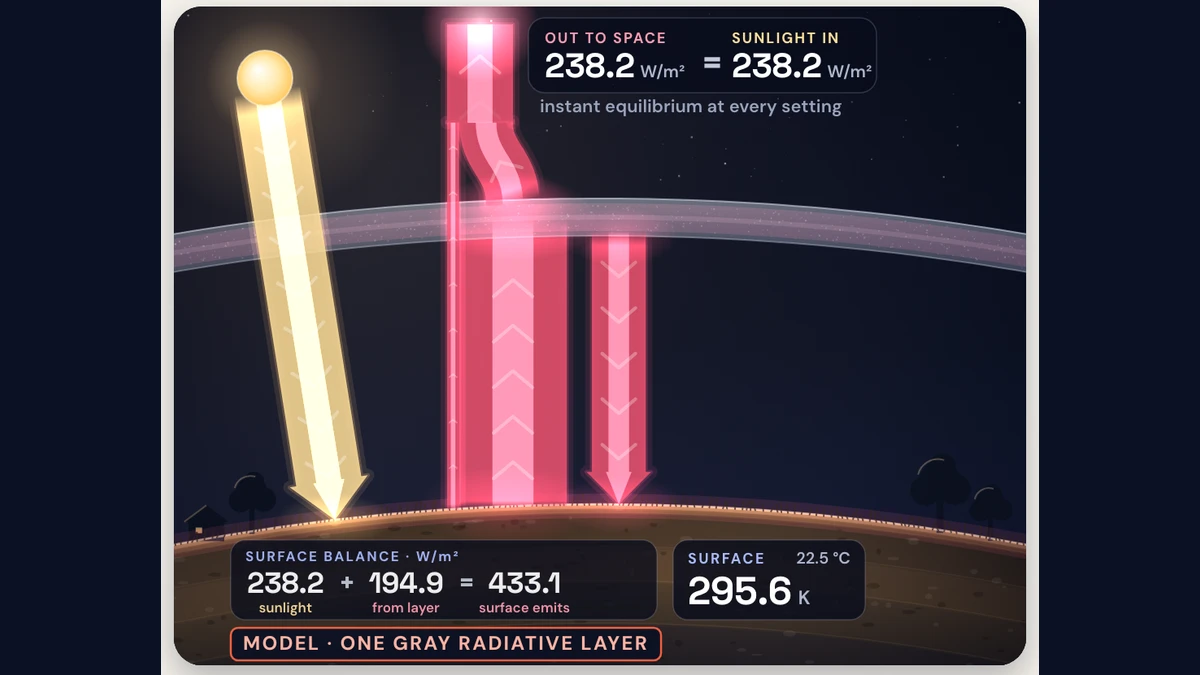
Greenhouse BalanceAn ExplainerTools Original. An independently built one-layer energy-balance teaching model; not a reproduction of PhET’s Greenhouse Effect.
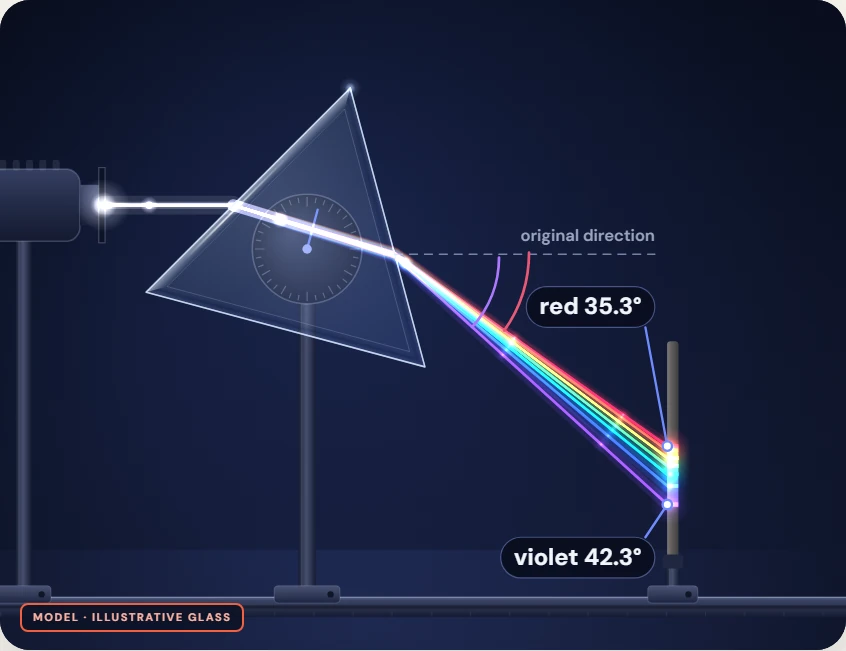
Prism LabAn ExplainerTools Original. The optical bench, prism and ray paths are code-drawn; seven wavelengths are samples and display colors are approximate.
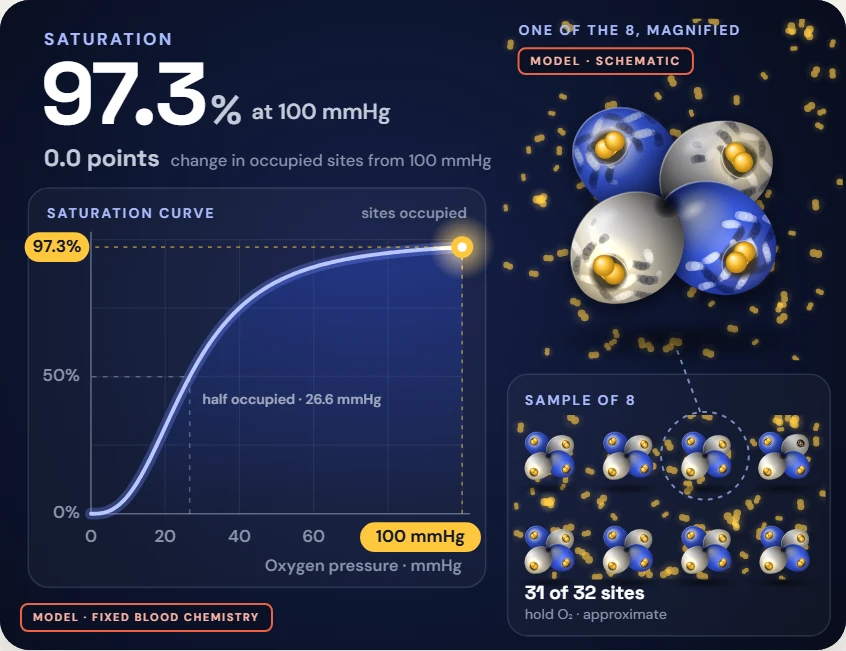
Hemoglobin HandoffAn ExplainerTools Original. A schematic hemoglobin and illustrative binding-site sample accompany an independently built pressure dial and saturation curve; concept distinct from Newt Interactive’s The Story of Hemoglobin.
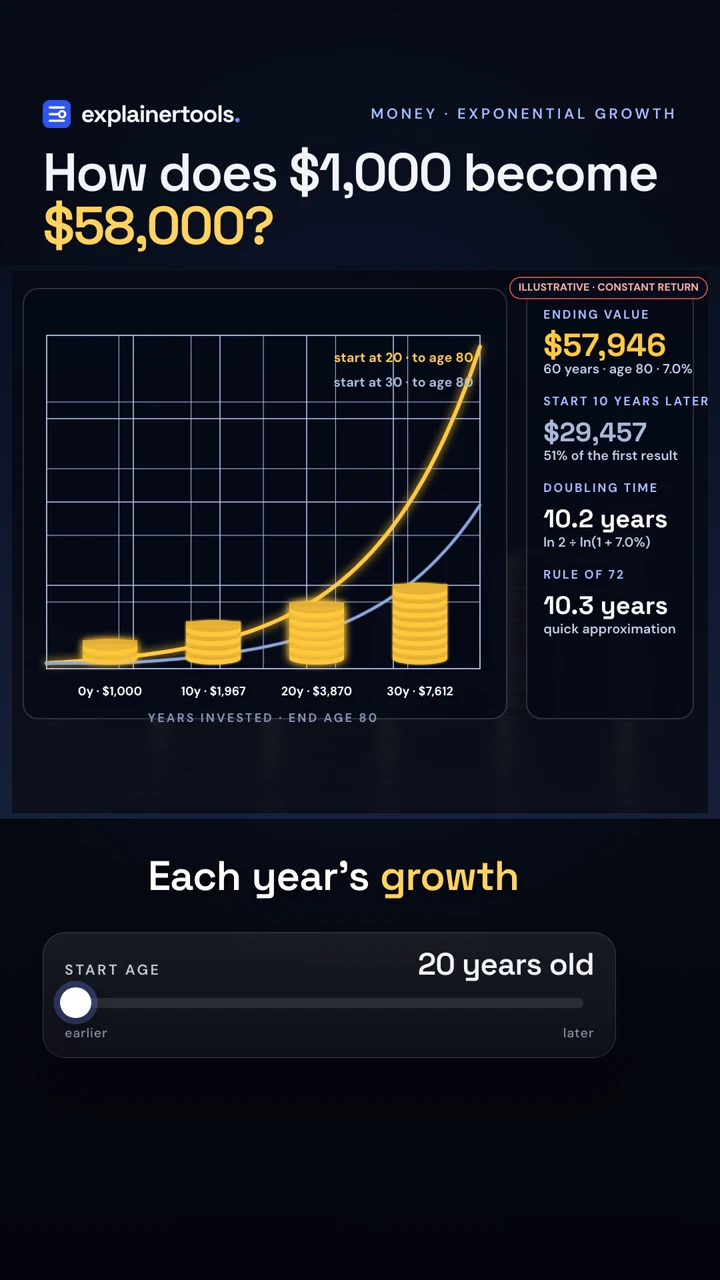
Compound GrowthAn ExplainerTools Original. Photos are AI-generated illustrations; curves, stacks and values are calculated from the compound-growth formula.
Loop LabAn ExplainerTools Original. Footage: @XFreeze (station time-lapse) and @wellandgoodtravel (ride), credited on screen; the loop, cars and capacity numbers are drawn from the model.
Aurora ChamberAn ExplainerTools Original. Photos are AI-generated illustrations; altitude-colored curtains and particles are drawn in code.
Compass FieldAn ExplainerTools Original. Photos are AI-generated illustrations; field lines and compass vectors are drawn in code.
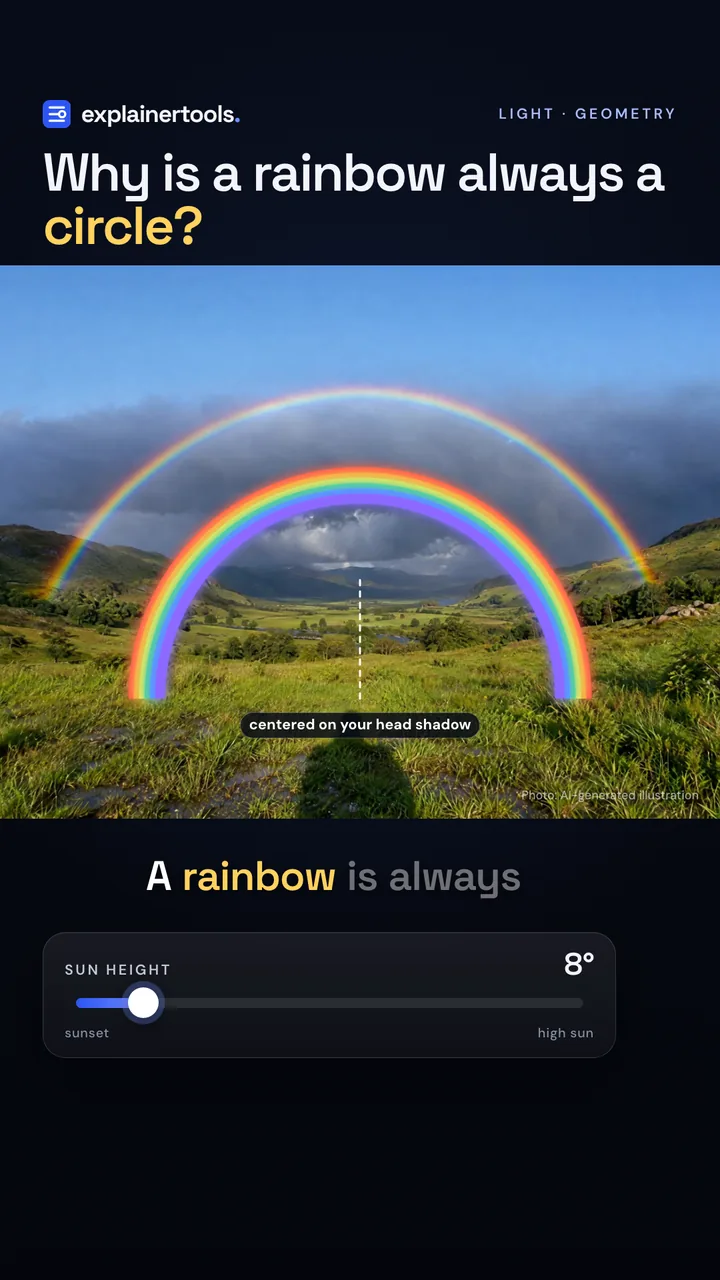
Rainbow LabAn ExplainerTools Original. Photos are AI-generated illustrations; ray paths and geometry are drawn in code.
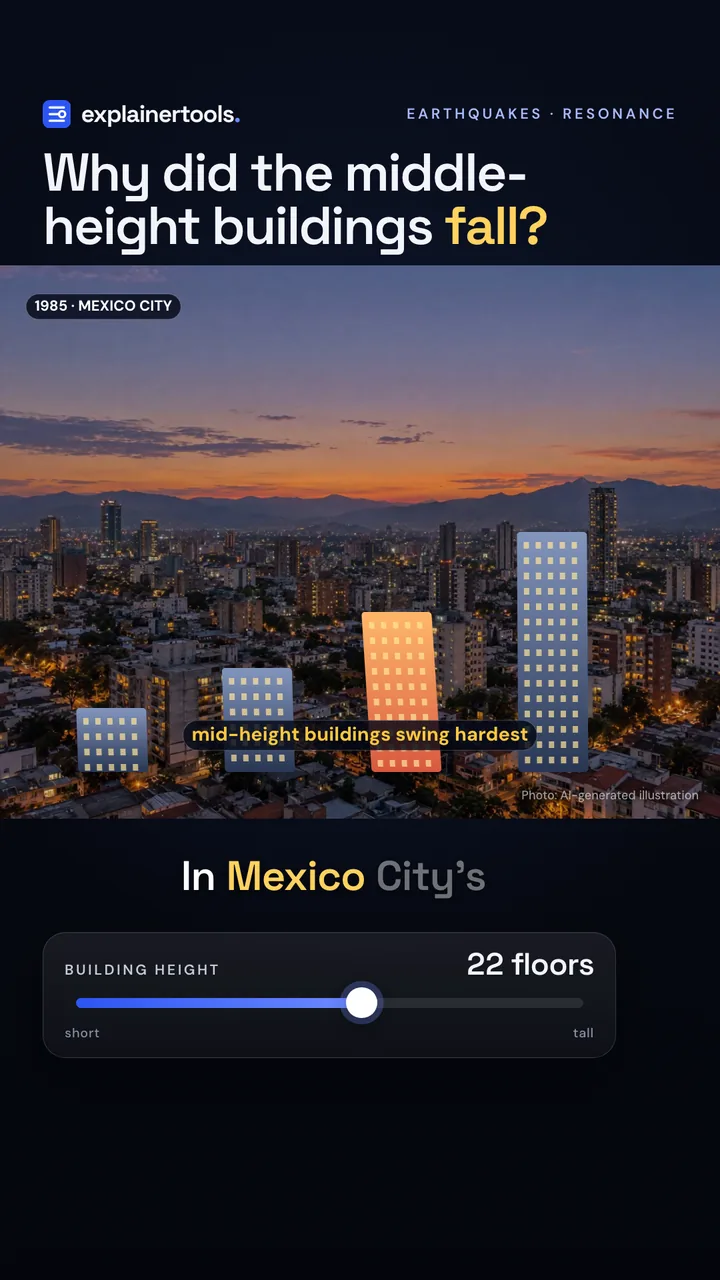
Quake TowerAn ExplainerTools Original. Buildings are abstract and code-drawn; photos are AI-generated illustrations.
Maglev LabAn ExplainerTools Original. Footage: @rkt333 (the L0 in the Yamanashi guideway) and @smart.sources (BBC News pictures of the 603 km/h record), credited on screen; the cross-sections, coils, currents and forces are drawn in code from an illustrative model.
Next WordAn ExplainerTools Original. All screen text, tokens, bars and numbers are drawn in code; the laptop photo is an AI-generated illustration.
Balance LabAn ExplainerTools Original. Footage: @techniahqrobot (a humanoid falling on stage) and @UnitreeRobotics (a G1 pushed, then catching itself), credited on screen; the robot, the lab and the balance model are drawn in code.
Stopping DistanceAn ExplainerTools Original. All cars, distance bars and calculations are model-drawn; photos are AI-generated illustrations.
Landing BurnAn ExplainerTools Original. The booster is generic and unbranded; photos are AI-generated illustrations and the trajectory is model-drawn.
Satellite DuskAn ExplainerTools Original. The dusk sky and shadow geometry are code-drawn; Earth and satellite art reuse AI-generated ExplainerTools illustrations.
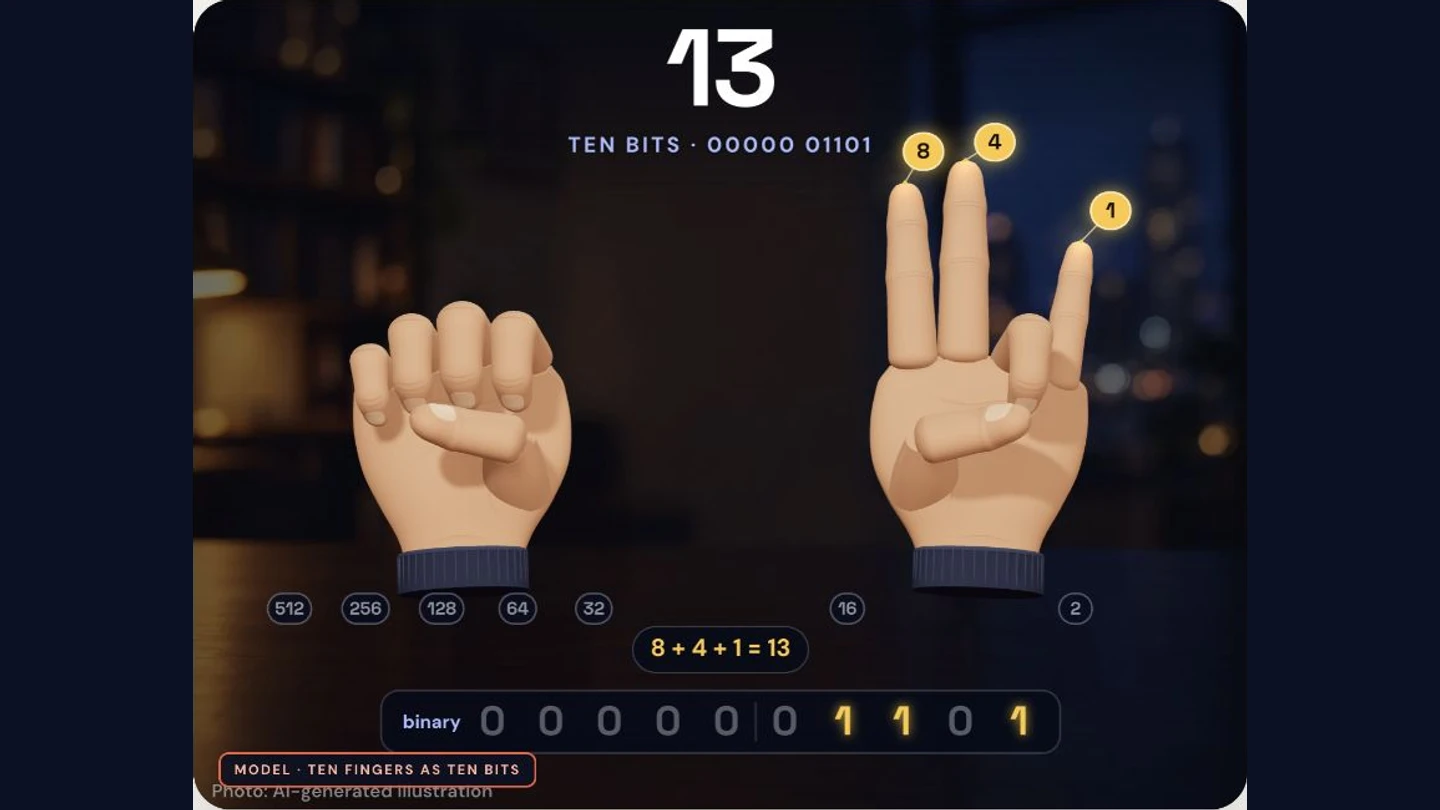
Binary FingersAn ExplainerTools Original. The hands, labels and numbers are drawn in code; background photos are AI-generated illustrations.
Gear LabAn ExplainerTools Original. All diagrams and calculations are original ExplainerTools work. Photos are AI-generated illustrations.
Moon Phase LabAn ExplainerTools Original. Moon phases and orbit geometry are drawn from the model; photos are AI-generated illustrations.
Airplane ModeAn ExplainerTools Original. All visuals are original ExplainerTools work. Photos are AI-generated illustrations.
GPS LabAn ExplainerTools Original. All visuals are original ExplainerTools work. Photos are AI-generated illustrations.
Flicker LabAn ExplainerTools Original. All visuals are original ExplainerTools work. Photos are AI-generated illustrations.
Wi-Fi WallsAn ExplainerTools Original. All visuals are original ExplainerTools work. Photos are AI-generated illustrations.
Agent ToolsAn ExplainerTools Original. All visuals are original ExplainerTools work. Photos are AI-generated illustrations.
Depth LabAn ExplainerTools Original. All visuals are original ExplainerTools work. Photos are AI-generated illustrations.
Portrait Mode LabAn ExplainerTools Original. All visuals are original ExplainerTools work. Photos are AI-generated illustrations.
Noise Cancelling LabAn ExplainerTools Original. All visuals are original ExplainerTools work. Photos are AI-generated illustrations.
Pendulum LabAn ExplainerTools Original. All visuals are original ExplainerTools work. Photos are AI-generated illustrations.
Focus LabAn ExplainerTools Original. All visuals are original ExplainerTools work. Photos are AI-generated illustrations.
Lens LabConcept inspired by Ryan Sael’s The Plane of Focus (sael.net). All visuals are original ExplainerTools work.
Low Orbit InternetConcept inspired by Ryan Sael’s Home internet from space (sael.net). All visuals are original ExplainerTools work.
Sunset LabAn ExplainerTools Original.
Newton's CannonConcept: Isaac Newton's cannonball thought experiment (A Treatise of the System of the World). All visuals are original ExplainerTools work.
Red-Eye LabAn ExplainerTools Original.
Sonic Boom LabAn ExplainerTools Original.
Storm SpinAn ExplainerTools Original. Coastlines from Natural Earth.
Twinkle LabAn ExplainerTools Original.
Thunder TimerAn ExplainerTools Original. Safety guidance from the US National Weather Service.
Three DoorsConcept: Steve Selvin (1975) and Marilyn vos Savant (1990). All visuals are original ExplainerTools work.
Fold LabFolding limit from Britney Gallivan (2002). All visuals are original ExplainerTools work.
Dew Point LabAn ExplainerTools Original.
QR Repair LabAn ExplainerTools Original. Decoder: jsQR (Apache-2.0).
Spin LabAn ExplainerTools Original.
Mars LoopAn ExplainerTools Original. Stars from the Yale Bright Star Catalogue.
Spiral LabPhysics after Price, Moss & Gay (2020) and Rae (2003). All visuals are original ExplainerTools work.
Eyeshine LabAn ExplainerTools Original. Deer vision after Newman & D'Angelo (2024); the tapetum after Ollivier et al. (2004).
Sunflower LabSeed layout after Vogel (1979). All visuals are original ExplainerTools work.
Heat Pump LabModel: half the Carnot coefficient of performance, as in the earlier ExplainerTools heat pump explainer. All visuals are original ExplainerTools work.
Hover LabLift split from Warrick, Tobalske & Powers (2005, Nature). All visuals are original ExplainerTools work.
Microwave LabAn ExplainerTools Original. Wavelength from the 2.45 GHz microwave oven band.
Traffic Wave LabDriver model: Treiber, Hennecke & Helbing (2000). Ring-road experiment: Sugiyama et al. (2008). All visuals are original ExplainerTools work.
Shutter LabAn ExplainerTools Original. Readout times from DxO Labs' rolling-shutter measurements.
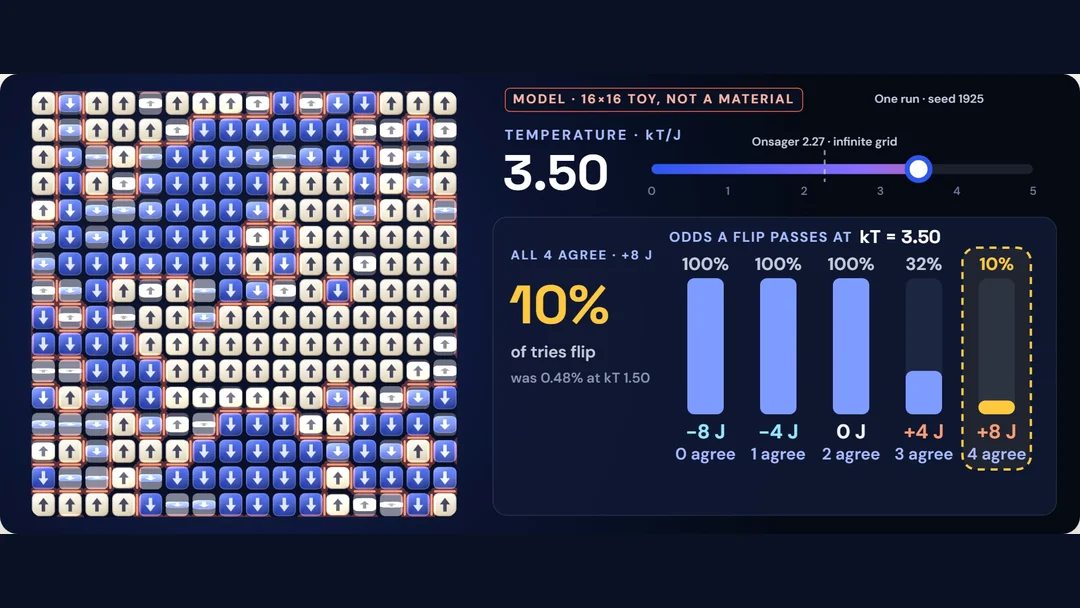
Ising DomainsAn ExplainerTools Original. The model is named for Ernst Ising, who studied a chain of two-way spins in 1925. Lars Onsager solved the infinite square lattice exactly in 1944. Each flip try follows the 1953 Metropolis rule.
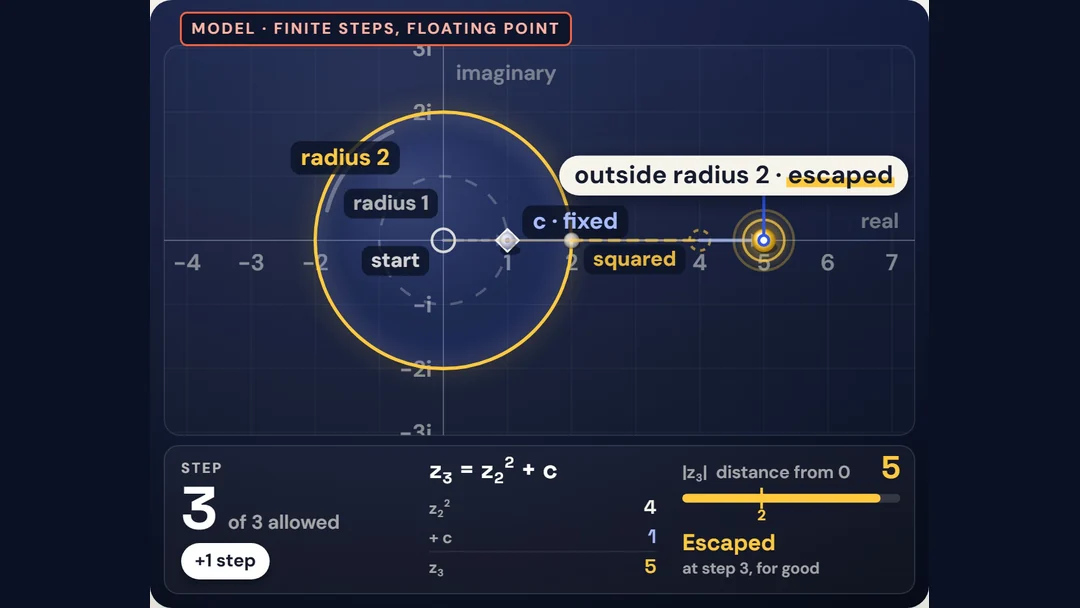
One Point OrbitAn ExplainerTools Original. The set is named for Benoit Mandelbrot; the bounded-orbit definition follows the Mandelbrot-set section of Curtis T. McMullen’s Complex Dynamics and Renormalization.
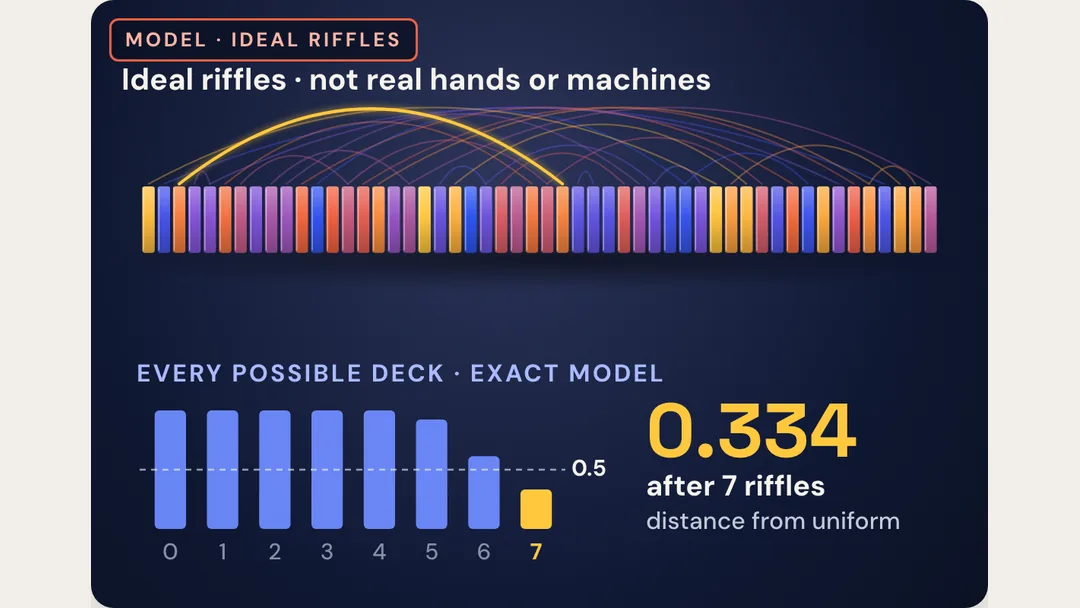
Seven RifflesConcept inspired by Dave Bayer and Persi Diaconis’s Trailing the Dovetail Shuffle to Its Lair (Annals of Applied Probability, 1992). The paper credits the riffle model to Gilbert, Shannon and Reeds. An ExplainerTools Original; all visuals are original and drawn by the tool.
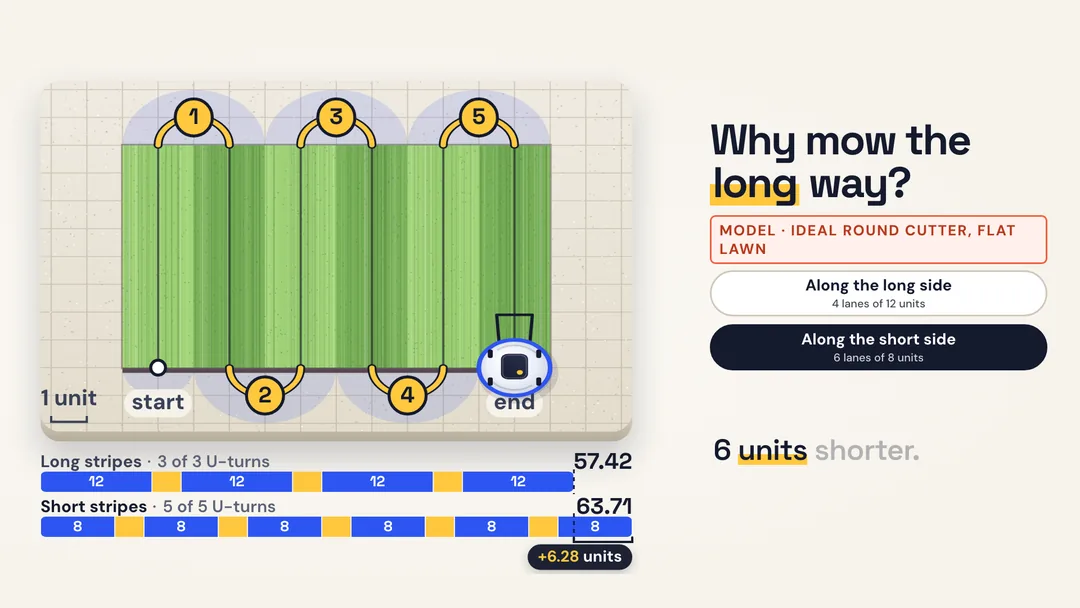
Lawn StripesAn ExplainerTools Original. The cutter-coverage model follows Fekete et al.'s A Closer Cut: Computing Near-Optimal Lawn Mowing Tours; the turn-cost idea follows Arkin et al.'s Optimal Covering Tours with Turn Costs. All visuals are original ExplainerTools work, drawn by the tool itself.
Latte LedgerAn ExplainerTools Original. Footage: @lbcoffeenyc (a latte poured at LB Coffee, Upper East Side), @romerosaarah (a barista's day in New Rochelle, New York) and @capstonepropertiesny (a West Village coffee shop for rent), credited on screen; the containers, coins and numbers come from the model.
Buyout LabAn ExplainerTools Original. Footage credited on screen; the machine, pipes and numbers are drawn from the model.
Debt SnowballAn ExplainerTools Original. Concept inspired by Ray Dalio's How the Economic Machine Works. Footage credited on screen.
Tall Tower LaunchAn ExplainerTools Original. Footage: Neal Stephenson on Core Memory with Ashlee Vance (@CoreMemoryPodcast) and a SpaceX Raptor engine photo (@SpaceX), credited on screen; the sky, tower, air and numbers are drawn from the model.
Spin Launch LabAn ExplainerTools Original. Footage: SpinLaunch test-flight video (@spinlaunch_inc), credited on screen; the chamber, arm and numbers are drawn from the model.
Whip Crack LabAn ExplainerTools Original. Footage: Smarter Every Day (@smartereveryday), Thomas Sagers (@thomas.sagers) and Neal Stephenson on Core Memory (@CoreMemoryPodcast), credited on screen; the whip, loop and numbers are drawn from the model.
Space Gun LabAn ExplainerTools Original. Footage: Ashlee Vance on Core Memory (@CoreMemoryPodcast), Longshot Space (@LongshotSpace) and Green Launch, credited on screen; the gun, landmarks and numbers are drawn from the model.
Sound Extinguisher LabAn ExplainerTools Original. Footage: Karime vortex (Ángela Karime Hernández Venegas’s VortexTech, YouTube), barevids and George Mason University, credited on screen; the speaker, air, flame and numbers are drawn from the model.
Vapor Chamber LabAn ExplainerTools Original. Footage: thermal-camera tests and real iPhone vapor chambers by @iphonedo on TikTok, credited on screen; the plates, chamber and numbers are drawn from the model.
Signed, Not MeantAn ExplainerTools Original. Footage: Binance co-CEO Richard Teng’s Oct 30 incident update (@_RichardTeng on X), credited on screen; the exchange, requests, signatures and numbers are drawn from the model and Binance’s reported figures.
Phosphene LabAn ExplainerTools Original. Footage: Neuralink (YouTube), credited on screen: its “Calibrated Vision” simulation, its visual-cortex map animation and its R1 surgical robot; the dots, brain map and numbers are drawn from the model.
Quiet Boom LabAn ExplainerTools Original. Footage: the X-59 landing at and taking off from Fort Worth (@LensOfMae) and NASA’s schlieren image of two T-38s (NASA Armstrong, YouTube), credited on screen; the jets, shock waves, ground and numbers are drawn from the model.
Orbit Chip LabAn ExplainerTools Original. Footage: the Falcon 9 launch (@Google) and Gemma’s haiku arriving at the ground station (@sundarpichai), credited on screen; the satellite, Earth, graphs and numbers are drawn from the model.
Space Mirror LabAn ExplainerTools Original. Footage: Reflect Orbital’s balloon mirror test (@bennbuilds) and satellite trails over Mt Taranaki (@blarsenphoto), credited on screen; the valley, Earth, mirrors and numbers are drawn from the model.
Space Radiator LabAn ExplainerTools Original. Footage: NASA (the space station from the Crew-2 Dragon) and @ivy_doll_too (thermal camera, TikTok), credited on screen; the spacecraft, air, radiator and numbers are drawn from the model.
Galactic Path LabAn ExplainerTools Original. Footage: DjSadhu’s 2012 helical-model animation, morn1415 and @PhilosophyOfPhy, credited on screen; the coils, galaxy and numbers are drawn from the model.
Tower-to-Satellite LabAn ExplainerTools Original. Footage: AST SpaceMobile (@AST_SpaceMobile on X: the Granite Falls test phone; YouTube: BlueWalker 3’s array), credited on screen; the towers, satellite, signals and numbers are drawn from the model.
Flyover Doppler LabAn ExplainerTools Original. Footage: While on my Journey (YouTube) and colsto (YouTube), credited on screen; the side view, pitch curves, map and numbers are drawn from the model.
Vowel LabAn ExplainerTools Original featuring CHIMERA by Jameson Hodge. Screen recordings of CHIMERA’s live app, with its own sound; clips by Jameson Hodge (@jamesonhodge), Klaus Brave (@klausbrave) and @frolic, credited on screen; the airway, spectra and vowel map are drawn in code.
Double CatchAn ExplainerTools Original. Video and animation: SpaceX (its posts on X: the Flight 5, 7 and 8 booster catches, the ship from a Starlink camera on Flight 13, and its ship-catch animation, labelled as animation); the maps, timeline and side view are drawn in code.
Touch LabAn ExplainerTools Original. Opening and electron-cloud shots from An Xuan’s film (@anxuanng on X), credited on screen; the zoom drawings, Zeno bar and repulsion chart are drawn in code.
Rolling shutter (earlier versions)Concept inspired by camera sensor timing. Technical background: Basler shutter types.