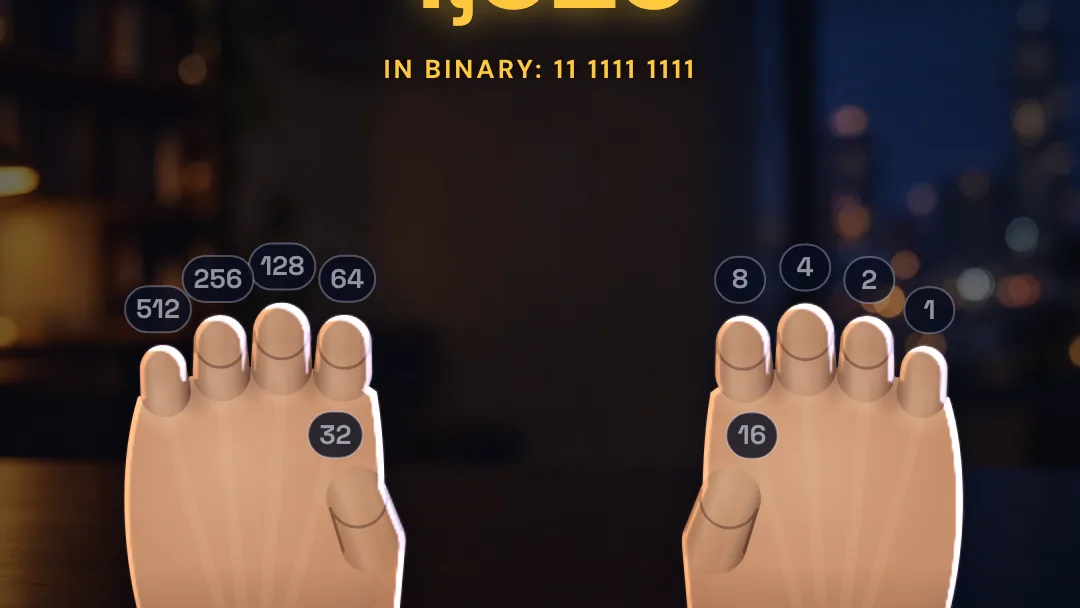
Ten fingers usually stop at ten. Give each finger a value that doubles—1, 2, 4, 8 and onward—and the same hands can represent 1,024 different patterns.
Try it yourself: choose any number from 0 to 1,023 and see its exact ten-bit pattern.
Why does doubling work?
Finger i is worth 2i, from 1 through 512. A raised finger contributes that value; a lowered finger contributes zero. Adding the raised values gives the number.
Each of ten fingers has two states. That makes 210 = 1,024 patterns, enough for the integers 0 through 1,023. A computer applies the same two-state idea to tiny switches.
What does the model leave out?
The hands are drawn in code so every bit is exact, and the film skips any state with only a middle finger raised. The model does not cover signed integers, fractions, text encodings or transistor circuitry.
Sources: NIST, binary number; Binary number; Finger binary.
Sources & further reading
Make the next question an experiment.
Browse independent creators who make big ideas visible.
Find an explainer