Two closed doors are left. One hides a car, the other a goat. You picked one a moment ago, and now the host offers you the other. It feels like a coin toss, so sticking seems as good as switching. It isn't. Under the usual rules, switching wins two times in three.
Try it yourself in Three Doors: turn the doors up to 100 and watch the host open 98 goats.
Why isn't it 50/50?
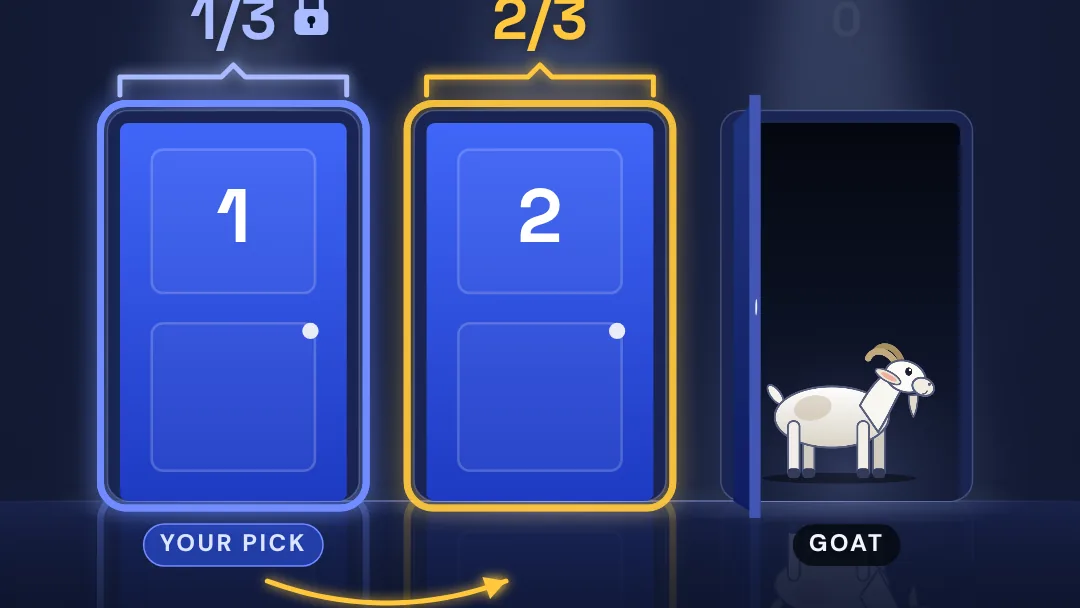
Start with your first pick. One door in three hides the car, so your pick is right one time in three. The host knows where the car is. He always opens another door, never yours and never the car. Whatever you picked, he can always show a goat.
So the goat he reveals tells you nothing new about your own door. It still wins one time in three. The other closed door holds the rest: two times in three.
It helps to walk through every case. Say you pick door 1:
- Car behind door 1. The host opens either goat door. Switching loses.
- Car behind door 2. The host must open door 3. Switching wins.
- Car behind door 3. The host must open door 2. Switching wins.
Switching wins in two of the three equally likely cases. Wikipedia: Monty Hall problem.
Why does the host's knowledge matter?
The answer depends on the rules. Here, the host knows where the car is, always opens a goat door and always offers the switch. His forced choice is what moves the odds onto the other door.
Change the rules and the answer changes. Suppose the host forgets where the car is and opens a door at random, which happens to show a goat. Then sticking and switching each win half the time. The statistician Jeffrey Rosenthal calls this version "Monty Fall." Rosenthal (2008): Monty Hall, Monty Fall, Monty Crawl.
And if the host could choose whether to offer a switch at all, there is no fixed answer. Monty Hall, the real game-show host the puzzle is named for, said as much in 1991: "It all depends on his mood." Wikipedia: Monty Hall problem.
What happens with a hundred doors?
More doors make the answer easier to feel. With 100 doors, your first pick wins one time in 100. The host then opens 98 of the others, every one a goat, and leaves one closed.
Out of 99 doors you didn't pick, he kept that one shut. Either your 1-in-100 guess was right, or the car is behind the door he skipped. Switching wins 99 times in 100.
The film's tally is 10,000 games with 100 doors, from a fixed random seed. Sticking won 94 times, or 0.9%. Switching won 9,906 times, or 99.1%. Run your own games in Three Doors and the bars settle near the same split.
Why did so many people get it wrong?
The puzzle is older than its fame. The statistician Steve Selvin posed it in a 1975 letter to The American Statistician. Selvin (1975): A Problem in Probability. A follow-up letter that year is the first known use of the name "Monty Hall problem." Wikipedia: Steve Selvin.
It became famous in 1990, when Marilyn vos Savant answered it in her "Ask Marilyn" column in Parade. She said to switch. Wikipedia: Marilyn vos Savant.
About 10,000 readers wrote in, nearly 1,000 of them with PhDs, and most said she was wrong. Even the mathematician Paul Erdős remained unconvinced until he was shown a computer simulation. Wikipedia: Monty Hall problem. The last two doors look alike, but the host's choice between them was not random.
What does the model leave out?
Three Doors follows one set of rules. The host knows where the car is. He opens every other door but one, all goats and never yours. When he has two goats to choose from, he picks at random. With N doors, sticking wins 1 time in N, and switching wins the other N − 1 times.
It does not model a host who opens doors at random, or one who decides whether to offer a switch. Real TV game shows didn't follow these rules either.
The tallies count real games, played with a random number generator. Auto-play scores each game both ways, as if one player always sticks and another always switches. Your own games count only for the choice you made.
Can you play it with three cups?
You need three cups, one coin and two players. These steps are a suggestion, so adapt them to the child beside you. One person is the host. The host must know where the coin is, and must never lift that cup early.
Predict. Ask your child: after the host lifts an empty cup, is it better to stick, to switch, or does it not matter? Write the guess down.
Try. The host hides the coin while the player looks away. The player points to a cup. The host lifts a different, empty cup and asks, "Stick or switch?" Play 20 rounds always sticking, then 20 always switching, and keep score.
Explain. Switching should win about 13 of 20, and sticking about 7. Twenty games is a small sample, so your numbers will wobble. Then swap roles. As host, your child will notice something. When the player picks an empty cup, only one empty cup is left to lift. That forced choice points straight at the coin.
Back in Three Doors, set the doors to 10 and turn on auto-play. Before the bars settle, predict where sticking and switching will land.
Three Doors is an ExplainerTools Original. Its concept was inspired by Steve Selvin's 1975 letters to The American Statistician and Marilyn vos Savant's 1990 Parade column.


Sources & further reading
Make the next question an experiment.
Browse independent creators who make big ideas visible.
Find an explainer