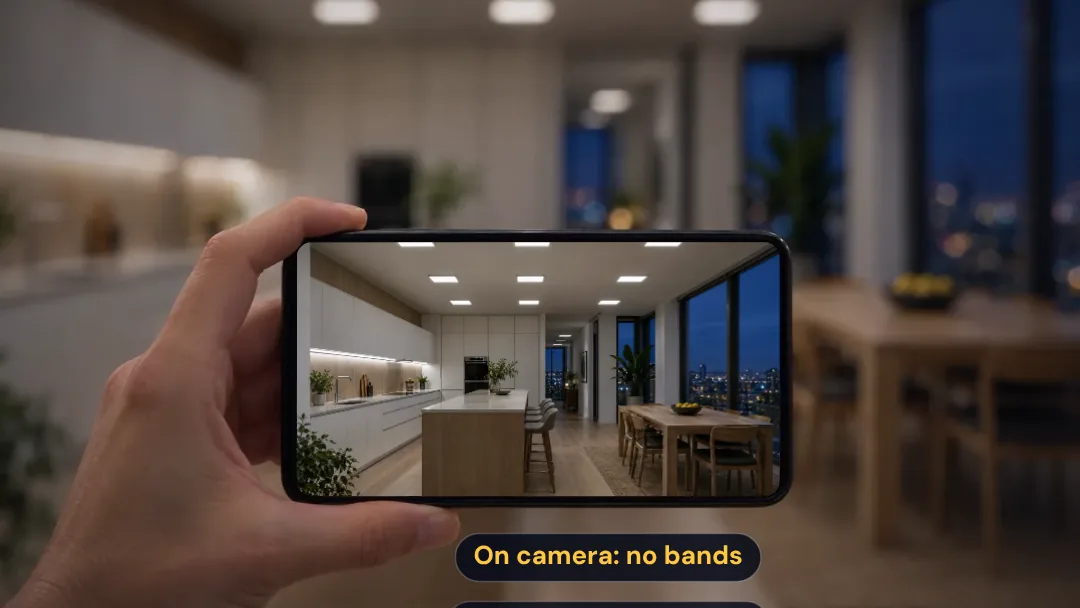
Film a room lit by LEDs, and dark bands can roll across your phone’s screen. The room looks perfectly steady to you. What is the camera catching that your eyes miss?
Try it yourself in Flicker Lab: drag the shutter speed and watch the dark bands fade when each exposure spans one whole pulse.
Why are LED lights not steady?
Many LEDs run from a simple driver whose output ripples at twice the mains frequency. On 50 hertz power, the light pulses 100 times a second. On 60 hertz power, it pulses 120 times a second. Those pulses are too fast for your eyes, which rarely notice flicker above about 90 hertz.
The model uses the simplest such driver. The LEDs light only while the rectified voltage is above their threshold, so each pulse is a clipped half-sine, and the light is fully off for about 30 percent of every pulse.
How does a rolling shutter make bands?
A rolling shutter reads the sensor’s rows from top to bottom over a readout time. The model uses 20 milliseconds, about 1/50 of a second. Each row collects light for its exposure in the moment before it is read.
If the exposure is not a whole number of pulses, some rows catch the light on and others catch it off. The result is dark bands, with the brightest and darkest rows set by the light curve.
Why does a whole pulse make the bands vanish?
When the exposure is a whole number of pulse periods, every row’s window holds the same light, and the bands vanish. On 60 hertz power, that means 1/120 or 1/60 of a second. On 50 hertz power, it means 1/100 or 1/50.
Video runs at 30 frames a second. On 60 hertz power, that is exactly four pulses per frame, so every frame starts at the same point in the light’s cycle, and the bands stand still. On 50 hertz power, each frame starts a third of a pulse later, so the bands roll.
Predict first, then try
Before you drag, predict this: on 60 hertz power, which exposure erases the bands, 1/100 of a second or 1/120 of a second? Then check it in Flicker Lab by dragging the shutter speed to each one.
Explain to yourself why only one of those holds a whole number of pulses. Then try a speed that falls between pulses, and watch the bands return.
What does the model leave out?
The model’s tag reads “idealized LED pulses and shutter.” It leaves out much of what a real light and camera do:
- Other dimming. Pulse-width-modulation dimming, often at hundreds or thousands of hertz, is not modeled. Drivers that smooth the ripple only partly are not modeled either.
- Afterglow and noise. Phosphor afterglow and sensor noise are not modeled.
- Real readout times. DxO Labs measured 30 milliseconds for a Nokia Lumia 1020 using its electronic shutter, and 12 to 23 milliseconds for a Canon 650D in video modes. The model’s 20 milliseconds is a middle value, not a measurement.
- Phones. Phones’ automatic flicker detection is not modeled.
The photos are AI-generated illustrations. The phone’s screen image is built from a pair of photos, with the lights on and off, mixed row by row. The light curve and every number come from the model.
Sources: Mouser, Flicker happens. But does it have to?; Pacific Northwest National Laboratory for the U.S. DOE (2016), Characterizing Photometric Flicker; Sony support, How to reduce camera flickering; Masson, Cao, Viard and Guichard (2014), Device and algorithms for camera timing evaluation, DxO Labs; Wikipedia, Rolling shutter; Wikipedia, Flicker (light).
Sources & further reading
- Mouser, Flicker happens. But does it have to?
- Pacific Northwest National Laboratory for the U.S. DOE (2016), Characterizing Photometric Flicker
- Sony support, How to reduce camera flickering
- Masson, Cao, Viard and Guichard (2014), Device and algorithms for camera timing evaluation, DxO Labs
- Wikipedia, Rolling shutter
- Wikipedia, Flicker (light)
Make the next question an experiment.
Browse independent creators who make big ideas visible.
Find an explainer