AI · interactive
Why do AI agents need tools?
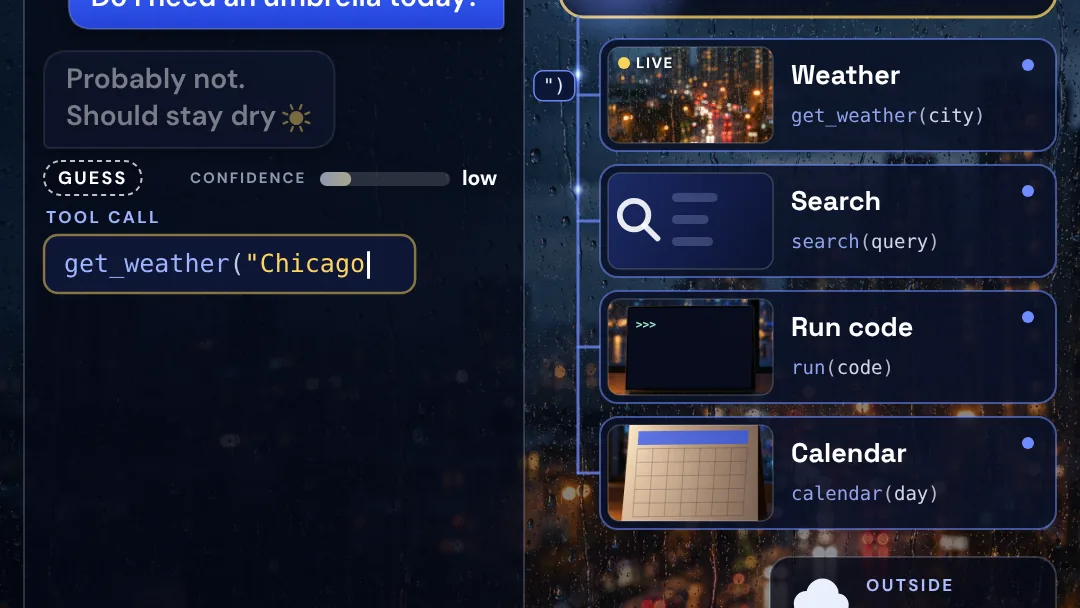
Left: everything the model sees. Right: the model, its tools and the loop. Pick a question, switch tools on or off, and watch it guess or look things up.
1 See
Ask an AI if you need an umbrella today and it might say “probably not” while it pours outside. Why can’t it just look?
2 Change
3 Understand
Model notes and sources
Model. A language model turns the text in front of it (the conversation, or context) into more text, one token (a word or part of a word) at a time, using patterns it learned from its training data. That data stops at a training cutoff, and the model has no live connection to the world, so on its own it can only answer “do I need an umbrella today?” with a plausible-sounding guess.
Tools. The app tells the model which tools exist: a name, a description and the inputs, like get_weather(city). When a tool would help, the model writes a structured request instead of an answer. The app, not the model, runs the tool and pastes the result into the conversation; the model reads it and either answers or writes another request. Repeating this think → act → check loop until the job is done is what people usually mean by an agent (in research it is often called ReAct, for reasoning plus acting).
Illustrative values. The weather (rain, 12 °C / 54 °F, 90% humidity), the forecast, the calendar events, the search results and the confidence percentages are made up to show the flow; they are not from a real model run or a real forecast. Assistants don’t show a calibrated confidence like this: the meter stands for how much the answer rests on evidence rather than memory. 1,234 × 5,678 = 7,006,652 is exact. The photos (a rainy window, a laptop and a desk calendar) are AI-generated illustrations; the screen text, the calendar grid, the chat and every number are drawn by the model.
Simplified. Real tool calls are usually JSON with named arguments; apps can run several tools at once; tools can fail or return errors; a model can still misread a result or pick the wrong tool; and many assistants now have search or code switched on by default. Without tools, today’s models often get 4-digit multiplication right, but they can’t check it. Tools also carry risks the tool doesn’t show: an agent that can act can also act wrongly, so real apps ask before sending, buying or deleting.
Sources: Large language model; Intelligent agent; S. Yao et al. (2022), ReAct: Synergizing Reasoning and Acting in Language Models; T. Schick et al. (2023), Toolformer: Language Models Can Teach Themselves to Use Tools.
An ExplainerTools Original.