Rockets · interactive
When should a falling rocket light its engine?
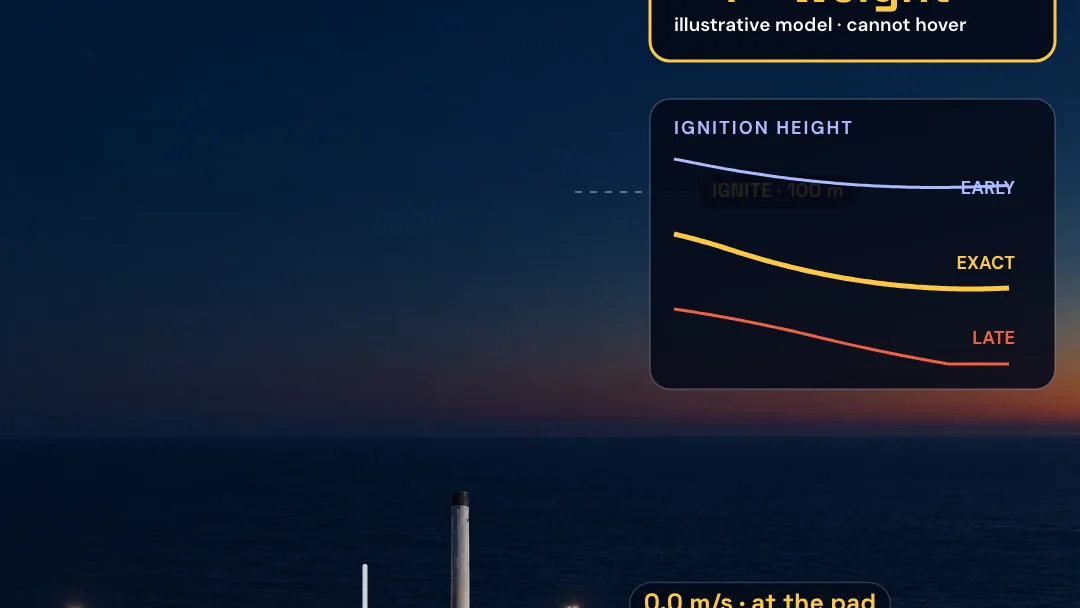
The model holds descent speed and minimum thrust fixed. Move the ignition height until the booster's altitude and speed reach zero at the pad together.
1 See
With the engine off the booster falls. With its minimum engine lit it accelerates upward. Where can those two motions meet at zero?
2 Change
3 Understand
Model notes and sources
Model. One-dimensional vertical motion begins 140 m above the pad at 28 m/s downward. The teaching burn uses constant thrust equal to 1.8 times weight, so its net upward acceleration is a = (1.8 − 1)g. After falling to the 100 m ignition point, the booster is moving about 39.6 m/s downward; in this model, v²/(2a) is then 100 m, so it reaches zero speed at the pad. Ignite higher and it reaches zero speed above the pad, then climbs if thrust stays on; ignite lower and it reaches the pad with speed left. All of these values are illustrative, not Falcon 9 flight telemetry.
Why no hover. Hover requires thrust equal to weight. A thrust-to-weight ratio above 1 gives upward acceleration even at minimum throttle. Falcon 9 lands on one of its nine Merlin engines, and public engineering explanations consistently describe its minimum single-engine thrust as greater than the light booster's landing weight. SpaceX publishes up to 845 kN sea-level thrust per Merlin in its user guide, but does not publish the landing mass, landing throttle schedule or minimum landing thrust needed to independently reconstruct the exact touchdown T/W. The tool's 1.8 ratio is illustrative and shows the mechanism without claiming those private values.
Not modeled. Changing mass as propellant burns, aerodynamic drag, horizontal motion, wind, throttle changes, engine start-up transients, guidance corrections, landing-leg compliance, sea motion and the real closed-loop controller. Real landings do not run a single constant-thrust equation from a fixed state. The booster and landing scene are AI-generated illustrations with no logos; every number and force arrow is drawn in code.
Sources: SpaceX, Falcon User's Guide (nine Merlin engines, 845 kN sea-level thrust each); NASA Glenn, Thrust-to-Weight Ratio; NASA Glenn, Practical Rocketry; SpaceX reusable launch system development program.
An ExplainerTools Original.