Space · interactive
Why don’t satellites fall down?
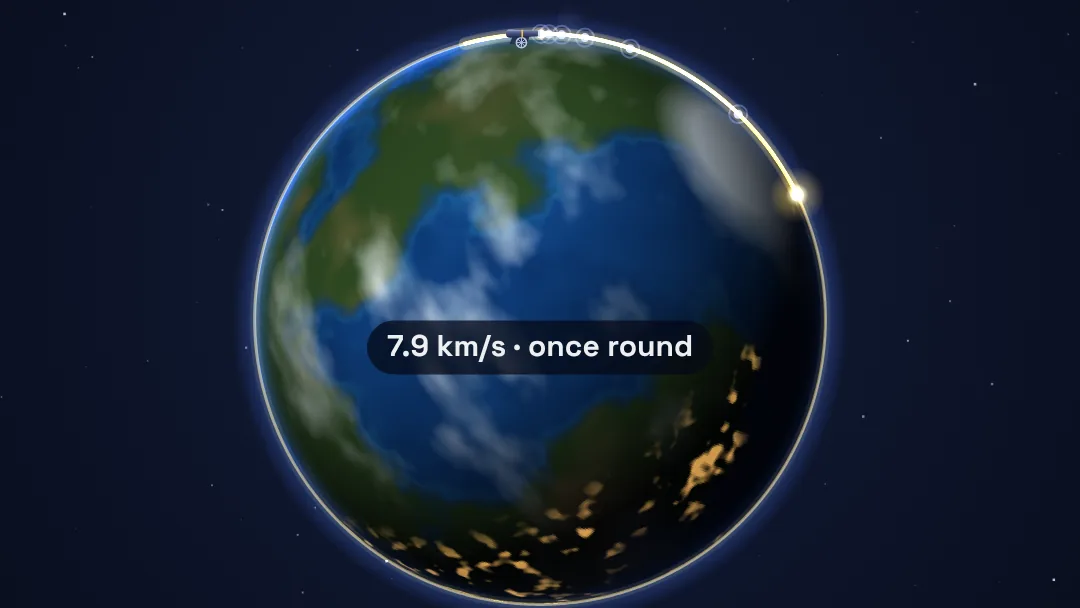
The view zooms to fit each shot. Earth, the mountain and the paths are to scale; the cannon, ball and station icons are not. Inset: the first second of flight.
1 See
Throw something sideways and it curves down to the ground. Throw it faster and it lands farther away. So how fast would it have to go to never land?
2 Change
3 Understand
Model notes and sources
Newton’s thought experiment, computed: a point-mass Earth (μ = 398,600 km³/s², mean radius R = 6,371 km) with no air and no spin. A ball fired sideways at speed v from height h (so r₀ = R + h) follows a Kepler conic. With k = r₀v²/μ, its distance from Earth’s centre after travelling an angle θ around it is r = r₀k / (1 + (k − 1) cos θ). It lands where r = R. It never lands if k ≥ 1, or if its lowest point, r₀k/(2 − k), clears the ground. It escapes when v ≥ √(2μ/r₀). Positions and flight times come from Kepler’s equation.
The first second, from the 8.8 km mountain: gravity there is g = μ/r₀² = 9.79 m/s², so the ball falls ½gt² = ½ × 9.79 m/s² × (1 s)² ≈ 4.9 m below a straight line. At 7.90 km/s it covers x = 7.9 km in that second, and a sphere of radius r curves away from a straight tangent by about x²/2r = (7.9 km)² ÷ (2 × 6,380 km) ≈ 4.9 m. The two match exactly when v² = μ/r₀, the circular-orbit speed: 7.90 km/s here, one lap every 84.5 minutes. Escape speed here is 11.18 km/s. The readouts measure the curve on the sphere through the cannon, which runs parallel to the ground.
Fixed values and simplifications: the mountain is Newton’s imaginary one, 8.8 km tall by default (Everest’s height), with a sheer cliff so no shot hits it. No real mountain reaches above the air. A real cannonball leaves the barrel at about 0.5 km/s, a fastball at about 40 m/s and a fast rifle bullet near 1 km/s. The Space Station preset is a 420 km circular orbit: 7.66 km/s, 92.8 minutes a lap, 15.5 laps a day (NASA rounds this to 16). Earth, the mountain and the paths are to scale. The cannon, ball and station icons are not, Earth’s surface is a stylized texture, and the motion is a time-lapse. Left out: air drag (which would quickly slow and heat a real ball at these speeds), Earth’s rotation (it adds up to 0.46 km/s to a shot fired east), Earth’s slight flattening, and the pull of the Moon and Sun.
Sources: Newton’s cannonball (from A Treatise of the System of the World, 1728); The Physics Classroom: Satellite motion; Escape velocity; NASA: Space Station facts and figures.
An ExplainerTools Original. Concept: Isaac Newton’s cannonball thought experiment.