Math · interactive
Why is paper so hard to fold more than seven times?
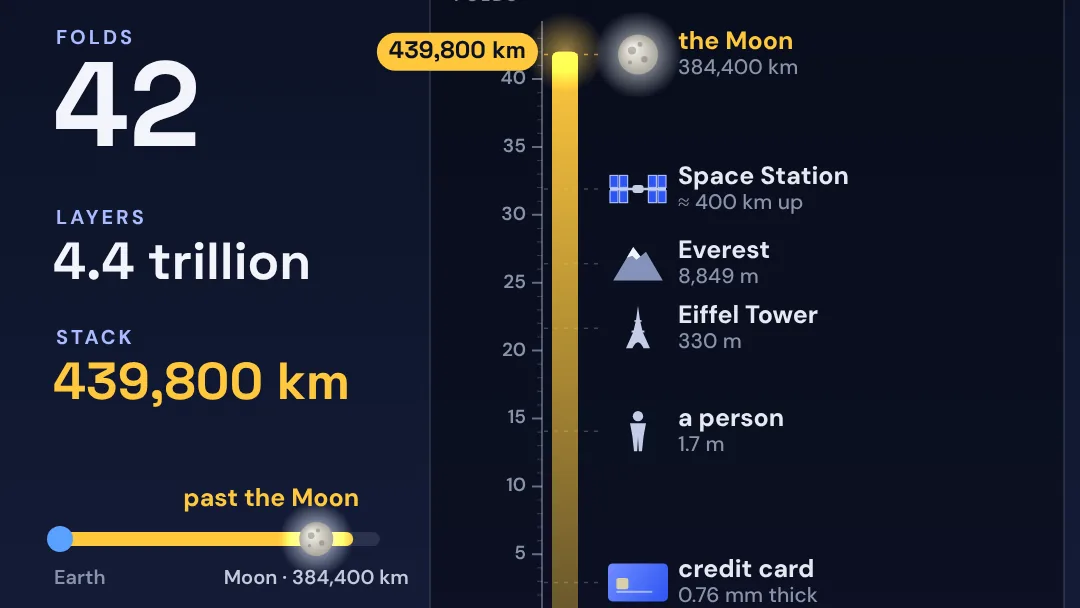
Left: the folded strip, side on, and where its length goes. Right: how thick the stack would be, one rung per fold.
1 See
Every fold doubles the stack. So why does a sheet of paper give up after about seven folds?
2 Change
3 Understand
Model notes and sources
Single-direction folding model from Britney Gallivan (2002). To fold a strip of thickness t in half n times, always in the same direction, it must be at least L = (πt/6)(2n + 4)(2n − 1) long. Fold i wraps the m = 2i−1 layers already stacked around one bend and uses πt·m(m + 1)/2 of paper, so each fold costs about four times the one before. The stack is t·2n thick. With t = 0.1 mm, 7 folds need 0.88 m of strip, 12 folds need 0.88 km, and 42 folds would stack 439,800 km high.
Assumptions: ideal paper that doesn’t stretch, squash or tear; uniform thickness (0.1 mm by default, about office paper); tight semicircular bends; no air between layers. Not modeled: folding in alternating directions (Gallivan’s second formula, which lets a letter-size sheet reach about 7 folds, while in one direction it allows 6), friction, and the force needed. The side view is to scale except that the first few folds draw layers thicker so you can see them; past 128 layers the stack is drawn as a solid block.
Records: Britney Gallivan, then a high-school junior in Pomona, California, folded a 4,000 ft (1,219 m) roll of toilet paper in half 12 times on 27 January 2002. In 2007 the MythBusters crew folded a sheet the size of a football field 11 times, alternating directions and using heavy machinery. In December 2011, St. Mark’s School students reported the equivalent of 13 folds with about 16 km (54,000 ft) of taped-together toilet paper in MIT’s Infinite Corridor; it is unofficial. The football-field preset is a 110 m strip folded one way.
Reference heights: credit card 0.76 mm thick (ISO/IEC 7810), person 1.7 m, Eiffel Tower 330 m, Everest 8,849 m, Space Station about 400 km up, Moon 384,400 km away on average (about 357,000–407,000 km), Sun 150 million km.
Sources: Mathematics of paper folding (Wikipedia); Folding (Wolfram MathWorld), which cites B. Gallivan, How to Fold Paper in Half Twelve Times: An “Impossible Challenge” Solved and Explained, Historical Society of Pomona Valley, 2002; Most times to fold a piece of paper (Guinness World Records); How many times can you fold a piece of paper? (Mental Floss); Record folders: 54,000 feet of paper, 13 folds (NPR, 2011); Moon fact sheet (NASA).
An ExplainerTools Original. Concept inspired by Britney Gallivan’s How to Fold Paper in Half Twelve Times (2002).