Passenger capacity starts with a simple multiplication: vehicles per hour times people in each vehicle. But vehicles must also stop somewhere to load.
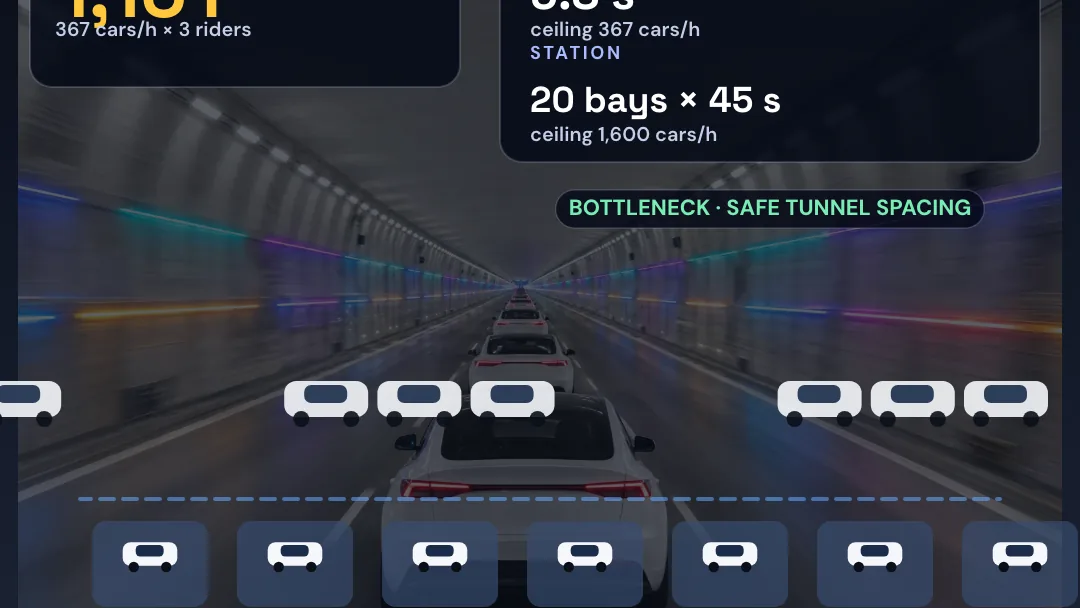
Try it yourself in Loop Lab: change headway, riders and station bays.
How does a bus reach 1,800 an hour?
A 60-rider bus every two minutes is 30 buses per hour, or 1,800 riders per hour.
What would cars need?
At three riders per car, 4,500 people per hour requires 1,500 cars per hour: one every 2.4 seconds. The Boring Company says its LVCC Loop has demonstrated peak capacity above 4,500 passengers per hour. That number is labeled as a company figure.
The tool takes the lower of tunnel headway and parallel-bay loading capacity. Its 45-second dwell is illustrative. It omits merges, unequal demand, empty vehicles, accessibility, failures and peak-to-average variation.
Source: The Boring Company, LVCC Loop.
Sources & further reading
Make the next question an experiment.
Browse independent creators who make big ideas visible.
Find an explainer