Transport · interactive
Can small cars move as many people as buses?
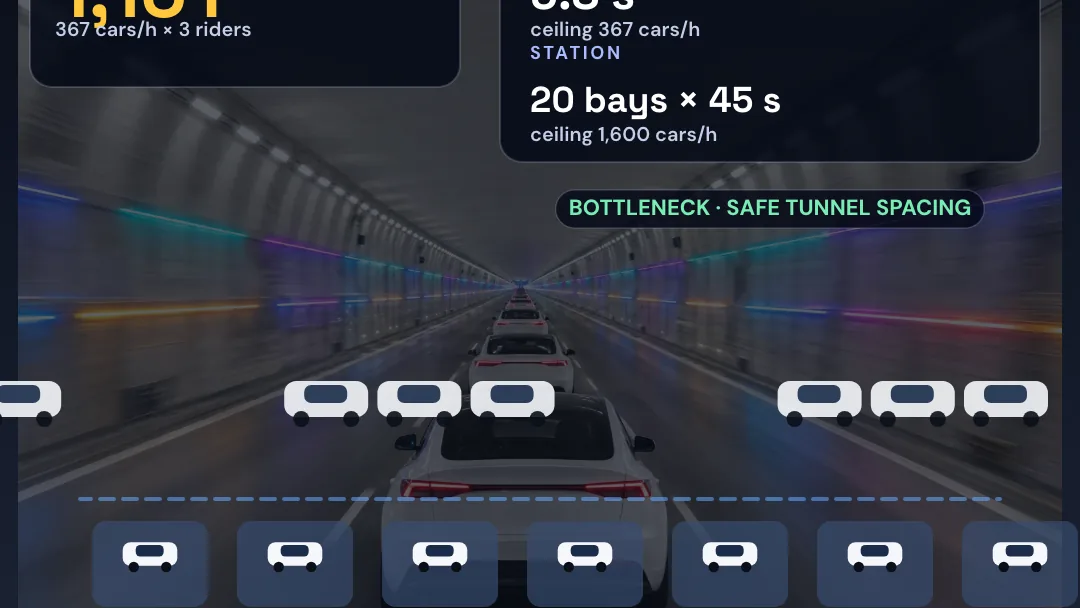
Capacity equals effective vehicles per hour times riders per vehicle. The lower of tunnel spacing and station loading throughput is the bottleneck.
1 See
Short headways can make tiny vehicles add up—but only if the station can load and release them just as quickly.
2 Change
3 Understand
Model notes and sources
Model. Tunnel capacity is 3,600/h vehicles per hour for headway h seconds. Station capacity is b × 3,600/d vehicles per hour for b parallel bays and illustrative dwell d = 45 s. Effective capacity is riders per car × min(tunnel capacity, station capacity). The tool exposes all three drivers and names the active bottleneck.
Comparisons. A hypothetical 60-rider bus every 2 minutes gives 60 × 30 = 1,800 people/h. The Boring Company says the Las Vegas Convention Center Loop has demonstrated peak capacity above 4,500 passengers/h; that is a company figure, not an independently reproduced measurement here. At 3 riders per car, 4,500/h corresponds to 1,500 cars/h, or one car every 2.4 s, before considering station operations.
Not modeled. Safe braking envelopes, merge conflicts, empty vehicles, unequal station demand, boarding accessibility, failures, evacuation, labor, energy, induced demand and peak-to-average variation. The 45 s dwell and bay diagram are illustrative. The tunnel and bus photos are AI-generated illustrations.
Source: The Boring Company, LVCC Loop (capacity statement, company claim).
An ExplainerTools Original.