Put on noise-cancelling headphones, and an airplane’s roar drops to a whisper. Nothing blocks your ears any harder. So where does the noise go? It meets a second wave that is the opposite of it.
Try it yourself in Noise Cancelling Lab: slide the anti-noise wave into place and watch the two cancel, then let the timing slip.
What is the sound doing?
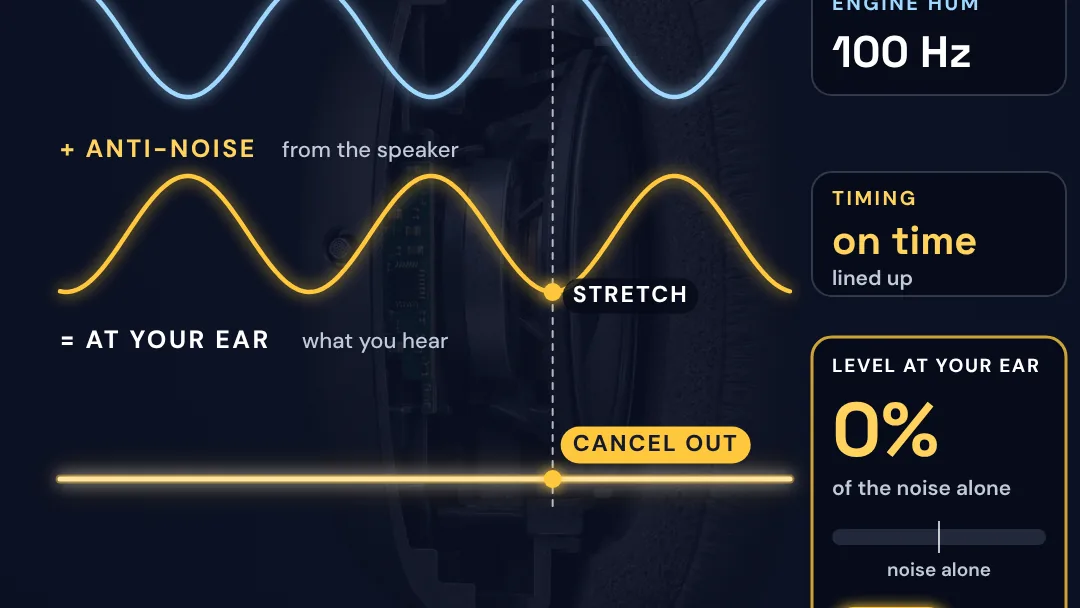
Sound is a wave of pressure. As it passes, the air is squeezed, then stretched, then squeezed again. A tiny microphone on the outside of the ear cup listens to the noise. The headphones’ circuit plays the opposite wave through the speaker.
Why does timing decide the result?
The model follows one pure tone at one point, your ear. If the anti-noise is exactly opposite and arrives on time, the two cancel completely. If it arrives late, the match slips. At 60 degrees of phase error there is no benefit at all. At 180 degrees, squeeze lands on squeeze, and the pressure swing doubles, an increase of 6 decibels.
The same delay is a small slice of a long, slow wave and a big slice of a short, fast one. In the model, 50 microseconds is 1.8 degrees of a 100 hertz hum, which leaves about 3 percent. It is 27 degrees of a 1.5 kilohertz tone, which leaves 47 percent.
The model sets the anti-noise to match the noise in strength exactly, so the only mismatch is timing. That isolates the one idea the tool is about: when the opposite wave arrives on time, the two cancel, and when it arrives late, the cancellation weakens.
Why do low, steady hums cancel best?
Steady, repeating sounds are predictable, so the circuit can keep matching them. Voices change pitch and loudness from moment to moment, so they are harder to match. The model’s voice-like sound keeps about 38 percent of its level after the same 50-microsecond error. That is why noise-cancelling works less well on voices.
What does the model leave out?
The model’s tag reads “one pure tone at one point.” Real noise mixes many frequencies at once. The model also leaves out:
- Passive blocking. The ear cushions block sound on their own, most of all at higher pitches.
- Adaptive filters. Real headphones keep retuning the anti-noise, and feedback microphones inside the cup are not modeled.
- Leaks. Sound that slips around the cushions is not modeled, and the model uses no manufacturer’s decibel rating.
- Real timing. The 50-microsecond delay is illustrative. Real designs work with delays of tens of microseconds, because the anti-noise must be ready in the time sound takes to cross a few centimeters.
Predict first, then try
Before you move anything, predict this: if the anti-noise arrives 60 degrees late, will it cancel most of the hum, a little of it, or none? The model says none. Check it in Noise Cancelling Lab by sliding the second wave into place.
Then let the timing slip further, toward 180 degrees, where the two waves line up squeeze on squeeze. Notice the pressure swing grows, rather than shrinking. Explain to yourself why a timing error can make the noise louder.
The waves are drawn in slow motion and not to scale. A 100 hertz wave in air is 3.4 meters long. The photos are AI-generated illustrations. Every wave and number comes from the model.
Sources: Wikipedia, Active noise control; Wikipedia, Noise-cancelling headphones; Wikipedia, Longitudinal wave; Wikipedia, Wave interference; Kuo and Morgan (1999), Active noise control: a tutorial review, Proceedings of the IEEE.

Sources & further reading
Make the next question an experiment.
Browse independent creators who make big ideas visible.
Find an explainer