Sound · interactive
How do noise-cancelling headphones work?
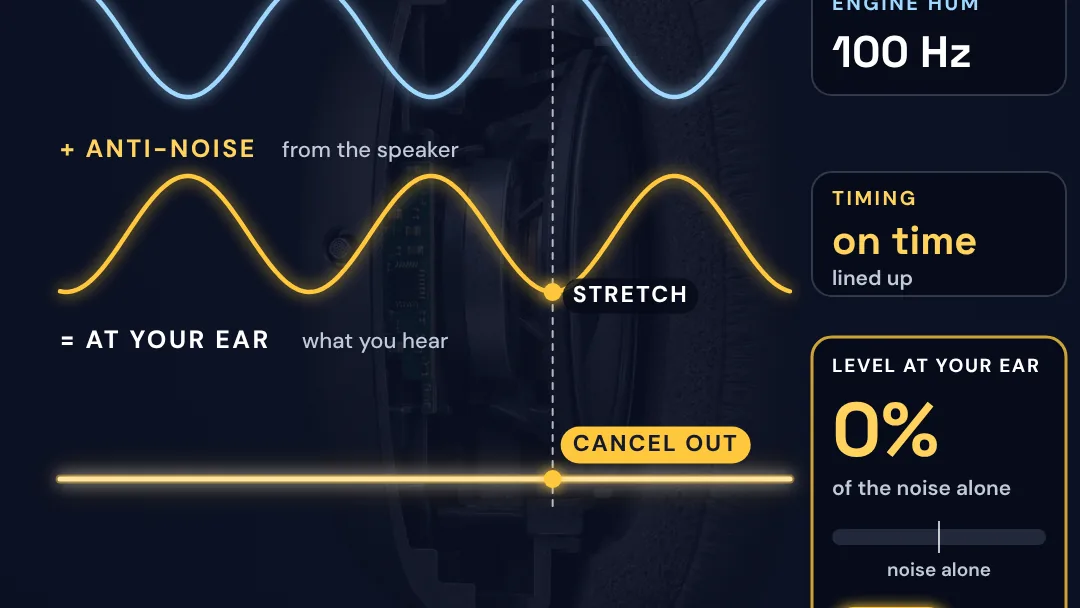
Top: the path through a real ear cup. Below: the noise, the anti-noise and what is left at your ear, three waves long at any pitch. Drag the yellow wave to make it late.
1 See
Put on noise-cancelling headphones and an airplane's roar drops to a whisper, yet nothing blocks your ears any harder. Where does the noise go?
2 Change
3 Understand
Model notes and sources
Model. Sound is a pressure wave: as it passes, the air is squeezed (a compression, slightly higher pressure) and stretched (a rarefaction, slightly lower pressure). The tool follows one pure tone of frequency f at one point by your ear: the noise is p(t) = sin(2πf t). A feedforward headphone hears it with a microphone on the outside of the ear cup, and its circuit plays the opposite wave through the speaker, with strength g and late by a delay τ: a(t) = −g·sin(2πf(t − τ)). The two pressures simply add. What is left is another sine whose size, relative to the noise alone, is r = √(1 + g² − 2g·cos φ), where φ = 360° × f × τ is the phase error. With g = 1 this is r = 2|sin(φ/2)|: complete cancellation when φ = 0, no benefit at all at 60°, and twice the pressure swing (+6 dB) at 180°, where squeeze lands on squeeze. The level change is 20·log10 r dB.
Why low, steady hums cancel best. The same delay is a small slice of a long, slow wave and a big slice of a short, fast one: 50 µs is 1.8° of a 100 Hz hum (about 3% left, −30 dB) but 27° of a 1.5 kHz tone (47% left, −7 dB). Steady, repeating sounds are also predictable, so the circuit can keep matching them, while voices change pitch and loudness from moment to moment. The film's voice is a synthetic voice-like sound (harmonics of a pitch gliding between about 135 and 215 Hz, shaped by peaks near 650, 1,750 and 2,700 Hz); with the same 50 µs error about 38% of it is left (root-mean-square).
Fixed values. The 50 µs delay is illustrative. The anti-noise has to be ready in about the time the noise takes to cross the few centimetres from the outside microphone to your ear (sound covers 1.7 cm in 50 µs at 343 m/s), so real designs work with delays of tens of microseconds. The film's 2.5 ms and 5 ms delays are deliberately huge, so the slip is easy to see, and its engine hum is a 100 Hz tone. The waves are drawn in slow motion and not to scale: a 100 Hz wave in air is 3.4 m long. The photos are AI-generated illustrations; every wave and number comes from the model.
Not modeled. Real noise mixes many frequencies at once. The model leaves out the passive blocking by the ear cushions (strongest at higher pitches), the speaker's and microphone's own responses, feedback microphones inside the cup, the adaptive filters that keep retuning the anti-noise, how the zone of cancellation shrinks at short wavelengths, and sound leaking around the cushions. It does not use any manufacturer's decibel rating.
Sources: Active noise control (an anti-phase wave of equal amplitude; best suited to low frequencies; periodic sounds are easier to cancel than random ones); Noise-cancelling headphones (feedforward microphones on the outside of the ear cups; most effective on constant low-frequency sound and less on voices; passive isolation for higher frequencies); Longitudinal wave (compressions and rarefactions); Wave interference; S. M. Kuo and D. R. Morgan, “Active noise control: a tutorial review”, Proceedings of the IEEE 87(6), 943–975 (1999).
An ExplainerTools Original.