A SCMaglev train reached 603 km/h without touching its guideway. Its magnets and the coils in the track do two related jobs: levitation and propulsion.
Try it yourself in Maglev Lab: change train speed and compare induced lift with weight.
How does the track push back?
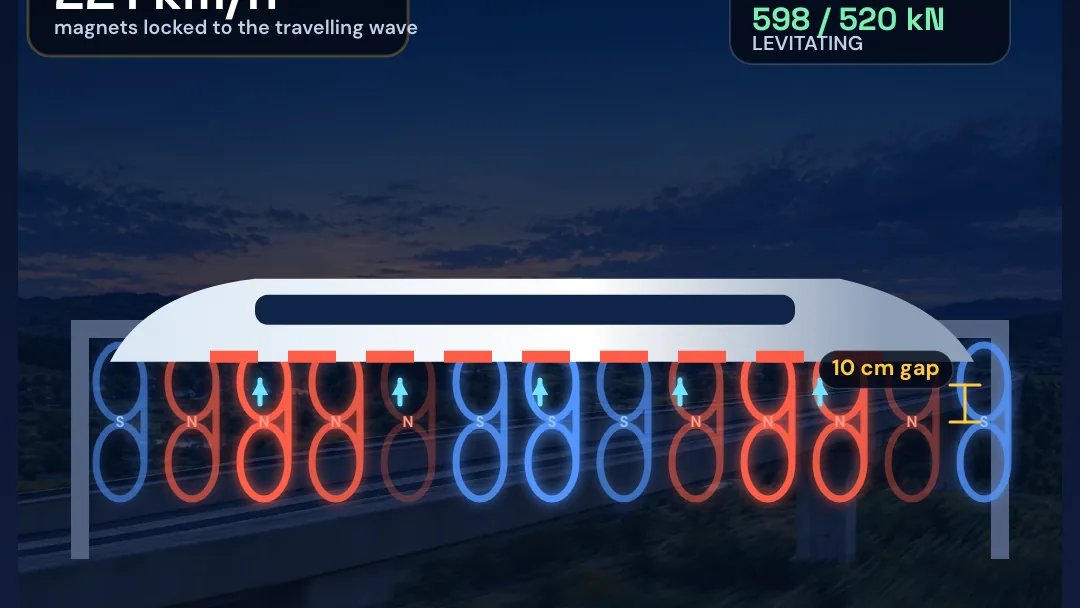
Superconducting magnets on the train sweep past figure-eight coils in the guideway. The changing field induces current, whose own field opposes the change and creates restoring lift and guidance. The operating gap is about 10 cm. Below about 150 km/h that effect is too weak, so rubber wheels carry the train.
What pulls it forward?
Separate propulsion coils switch in sequence as a linear synchronous motor. Their alternating poles make a travelling wave. The train’s magnets lock to it, so the wave and train move at the same speed.
The tool’s lift curve and train weight are illustrative, not specifications. It omits aerodynamics, active control, cryogenics and changing train mass. Photos are AI-generated illustrations.
Source: Central Japan Railway Company, SCMaglev.
Sources & further reading
Make the next question an experiment.
Browse independent creators who make big ideas visible.
Find an explainer