Trains · interactive
How does a 600 km/h train float?
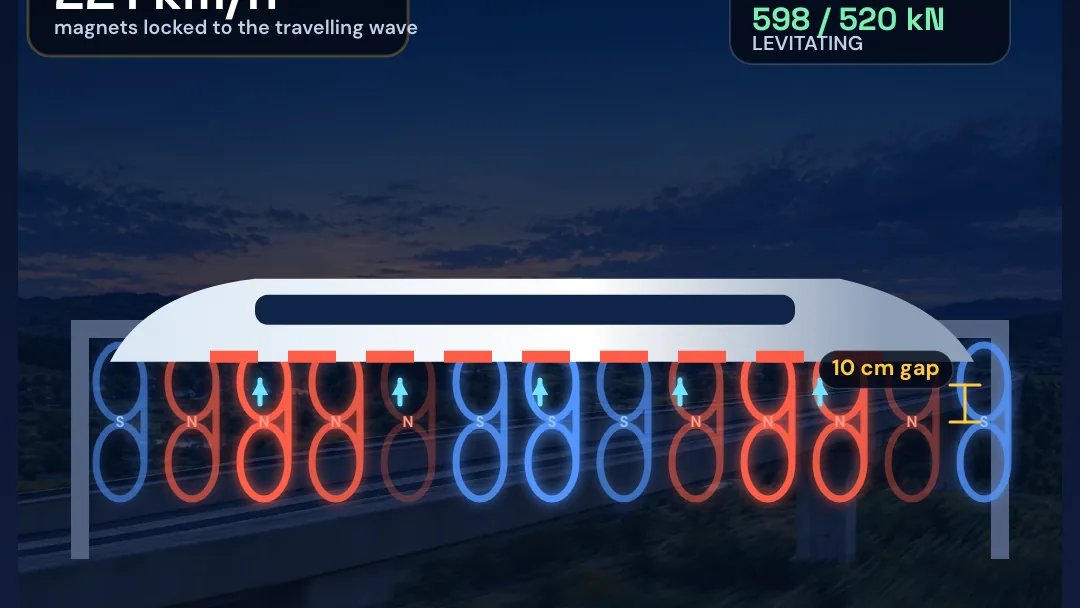
At 150 km/h illustrated lift equals the 520 kN weight and wheels remain down; levitation begins only when lift strictly exceeds weight.
1 See
The train has magnets but no engine turning its wheels at speed. Its guideway has two different jobs: lift the train, then pull it forward.
2 Change
3 Understand
Model notes and sources
Model. The levitation coils are drawn as the SCMaglev’s figure-eight coils. This tool uses the tuned illustrative saturation curve L(v) = 720[1 − exp(−max(0, v − 35)/89.87)] kN and an illustrative 520 kN train weight. The curve reaches 520 kN at 150 km/h; wheels remain down at equality, and takeoff occurs only for L > 520 kN. Above takeoff, the illustrative gap rises smoothly toward about 10.0 cm at 603 km/h.
Propulsion. Guideway propulsion coils switch in sequence as a linear synchronous motor. Their N/S pattern is a travelling magnetic wave; the train’s magnets lock to that wave, so wave speed equals train speed. The SCMaglev’s L0 series reached 603 km/h on 21 April 2015.
Not modeled. Coil geometry, active guidance, aerodynamics, banking, motor control, cryogenics, train length, and changing vehicle mass. The photos are AI-generated illustrations. The force curve, train weight, threshold and gap response are illustrative, rounded display values—not vehicle specifications or engineering predictions.
Sources: Central Japan Railway Company, SCMaglev and its system explanations; Central Japan Railway Company’s published L0 speed record and operating figures.
An ExplainerTools Original.