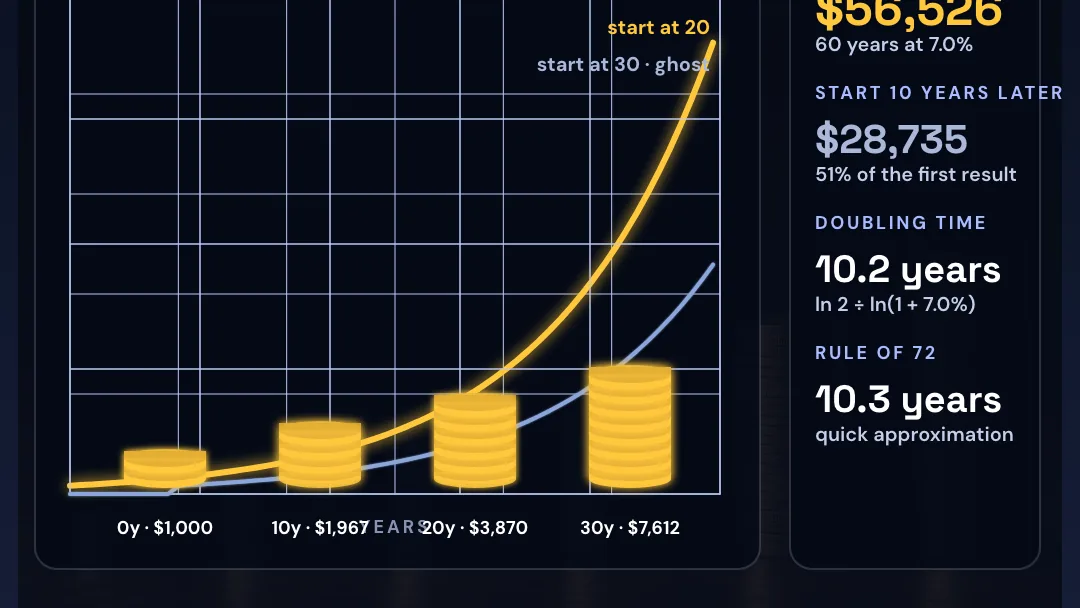
Compound growth follows $1,000(1 + r)n. At a constant 7%, starting at age 20 and ending at fixed age 80 gives 60 years of growth and $57,946.
Try it yourself in Compound Growth: change return and starting age while the ending age stays fixed at 80.
Where does the curve bend?
At 7%, the values are $1,967 after 10 years, $3,870 after 20, $7,612 after 30, $29,457 after 50 and $57,946 after 60. The final decade adds $28,489—about 49% of the ending value.
How long does a doubling take?
The exact time is ln 2 / ln(1 + r), or 10.24 years at 7%. The rule of 72 gives a quick approximation: 72 ÷ 7 = 10.29 years. At zero or negative returns, the balance does not double and both readouts are not applicable.
This is an illustrative constant return, not a forecast or financial advice. Real returns vary and can be negative. The model ignores inflation, fees, taxes, contributions and withdrawals. Photos are AI-generated illustrations.


Sources & further reading
Make the next question an experiment.
Browse independent creators who make big ideas visible.
Find an explainer