Money · interactive
How does $1,000 become $58,000?
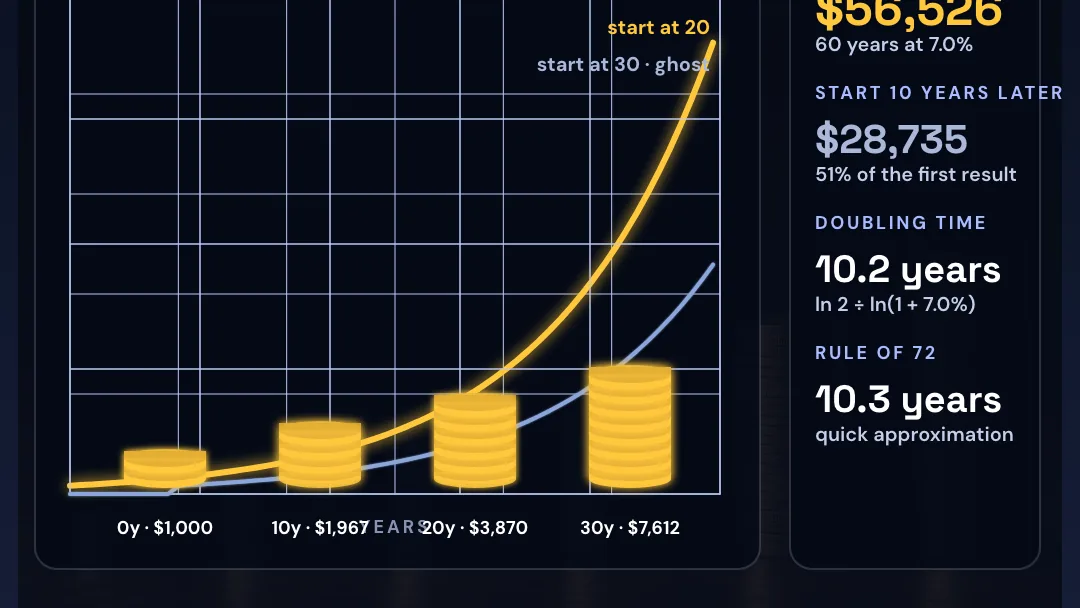
Growth compounds as $1,000 × (1 + r)ⁿ, where n is years from the selected start age to fixed age 80. Non-positive returns do not double.
1 See
The curve looks slow for decades, then steep. Starting later removes the largest doubling at the far end.
2 Change
3 Understand
Model notes and sources
Illustration. The selected start age sets n = max(0, 80 − start age), so every curve ends at fixed age 80. Value is $1,000(1 + r)n. At 7%, starting at 20 invests for 60 years and gives $57,946; starting at 30 invests for 50 years and gives $29,457. The delayed-start curve holds the same $1,000 aside as cash for the first 10 years, without growth, then invests it through age 80. The last decade adds $28,489, about 49% of the 60-year ending value. The spoken $2,000, $4,000, $8,000 and $58,000 are rounded.
Doubling. For positive returns, exact doubling time is ln 2/ln(1 + r), and the rule of 72 approximates it as 72/r. At zero or negative returns the balance does not double, so both are marked not applicable.
Limits. This is an illustrative constant return, not a prediction or investment recommendation. Real returns vary and can be negative. The model ignores inflation, taxes, fees, contributions, withdrawals, sequence risk and account rules. It is not financial advice. The coin photos are AI-generated illustrations.
Source: standard compound-interest identity and the values calculated directly from it.
An ExplainerTools Original.