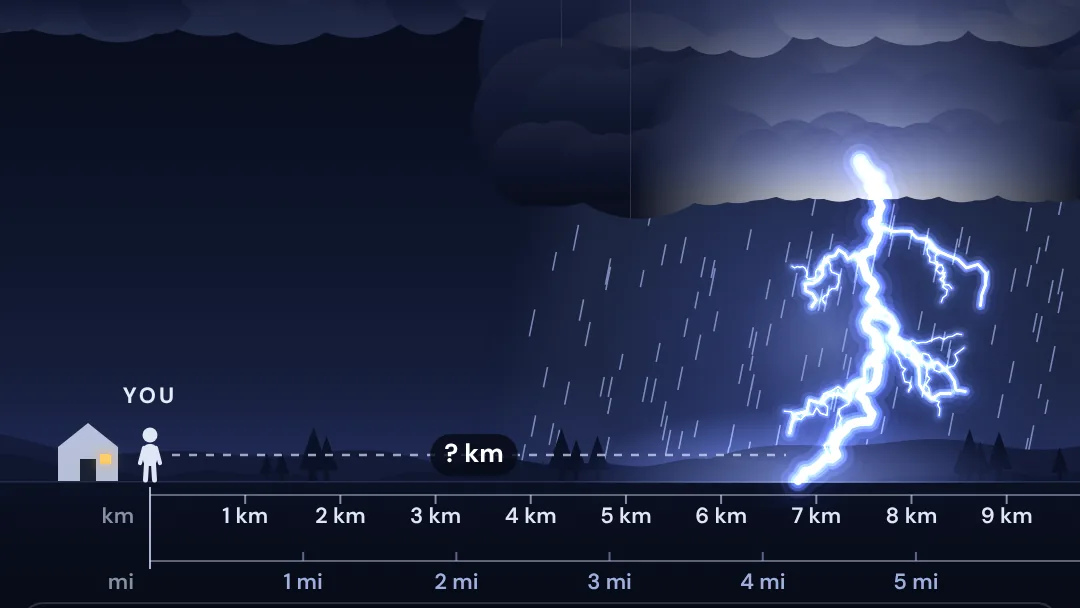
A flash lights up the window, and someone starts counting. One, two, three. The thunder rolls in at eight. Counting that gap tells you how far away the lightning struck. It works because the flash and the thunder start at the same moment, then travel at very different speeds.
Try it yourself in Thunder Timer: drag the strike closer and watch the count between flash and thunder shrink.
Why does the thunder come later?
Lightning heats the air in its channel very fast, to as much as 50,000 °F (about 28,000 °C). The air expands so suddenly that it sends out a sound wave. That sound is thunder. NWS: Understanding Lightning: Thunder.
The flash travels at the speed of light, about 300,000 km every second. From a strike 3 km away, it arrives in about a hundred-thousandth of a second. For counting, that is instant.
Sound is far slower. In air at 20 °C, it covers about 343 meters each second. Wikipedia: Speed of sound. So the seconds you count are almost entirely the thunder's trip to you.
How do you turn seconds into distance?
Multiply the count by the speed of sound. At 343 meters a second, sound needs about 2.9 seconds to cover a kilometer and about 4.7 seconds to cover a mile. Round those up and you get the familiar rules: about three seconds per kilometer, or five seconds per mile. Wikipedia: Thunder.
The National Weather Service gives the same advice. Count the seconds from flash to thunder, then divide by 5 for miles. NWS: Thunder. The rules are close, not exact. Dividing by 3 gives kilometers to within about 3%. Dividing by 5 gives miles about 6% short.
So a ten-second count puts the strike about 3.4 km away, a little over two miles.
The air's temperature nudges the count. Sound moves faster in warm air than in cold, gaining about 0.6 meters a second for every degree Celsius. Wikipedia: Speed of sound. At −10 °C, it slows to about 325 meters a second, so each kilometer takes about 3.1 seconds. On a 35 °C day, it speeds up to about 353.
Wind and layers of warm and cool air matter more for whether you hear thunder at all. They can bend sound up and away from the ground, or back down toward it.
Why does thunder rumble?
A lightning bolt is a long channel, not a single point. Sound from the nearest part reaches you first. Sound from parts farther and farther away keeps arriving for seconds afterward. So start the count at the flash and stop it at the first sound of thunder.
The sound itself is a clue. A sharp crack or click means the channel passed nearby. A long, low rumble means the lightning was at least several miles away. NWS: Understanding Lightning: Thunder.
If you can hear thunder, are you safe?
No. Lightning often strikes outside the area of heavy rain, as far as 10 miles (16 km) from any rainfall. NWS: Lightning Safety for You and Your Family. Thunder can usually be heard only about 10 miles away. NWS: Thunder. So if you can hear it, you are likely within striking distance. NWS: Lightning Safety.
A long count is not a reason to stay outside. The National Weather Service rule is short: when thunder roars, go indoors. A building with wiring and plumbing is best. A hard-topped metal vehicle with the windows closed is also safe. Stay in until 30 minutes after the last thunder. NWS: Lightning Tips.
What does the model leave out?
Thunder Timer is a flash-to-bang model. It assumes still air at one temperature, flat ground and sound that travels in straight lines. Distances along the ground are to scale. Cloud heights, the bolt and the house are not. It leaves out:
- Wind and air layers. They can hide thunder well inside 16 km, or carry it farther.
- Humidity. It nudges the speed of sound, by under 1%.
- The rumble and echoes. The model times the nearest point of the bolt, and ignores sound bouncing off hills and buildings.
The film uses 15 °C air, where sound travels about 340 meters a second, and shortens each gap to fit. The dashed 16 km dome is the safety rule of thumb. It is not a forecast of where lightning will land.
Can you track a storm from indoors?
The next time a storm rolls in, you can measure it without stepping outside. These steps are a suggestion, so adapt them to the child beside you. Stay indoors for the whole experiment.
Predict. Ask your child whether the storm is coming toward you or moving away. How could counting help you decide?
Try. When you see a flash, count steady seconds, or start a stopwatch. Stop at the first sound of thunder. Write the count down, and repeat for a few flashes over ten or fifteen minutes. Divide each count by 3 for kilometers, or by 5 for miles.
Explain. Shrinking counts mean the storm is getting closer. Growing counts mean it is moving away. Either way, if you can hear thunder, stay inside. Wait 30 minutes after the last rumble before going back out. NWS: Lightning Safety for You and Your Family.
Back in Thunder Timer, choose the ten-second count, then turn the air temperature from a hot day down to freezing. Predict whether the same thunder will take a little longer to reach you, or a lot.
Thunder Timer is an ExplainerTools Original.
Sources & further reading
Make the next question an experiment.
Browse independent creators who make big ideas visible.
Find an explainer