Weather · Sound · interactive
How far away was that lightning?
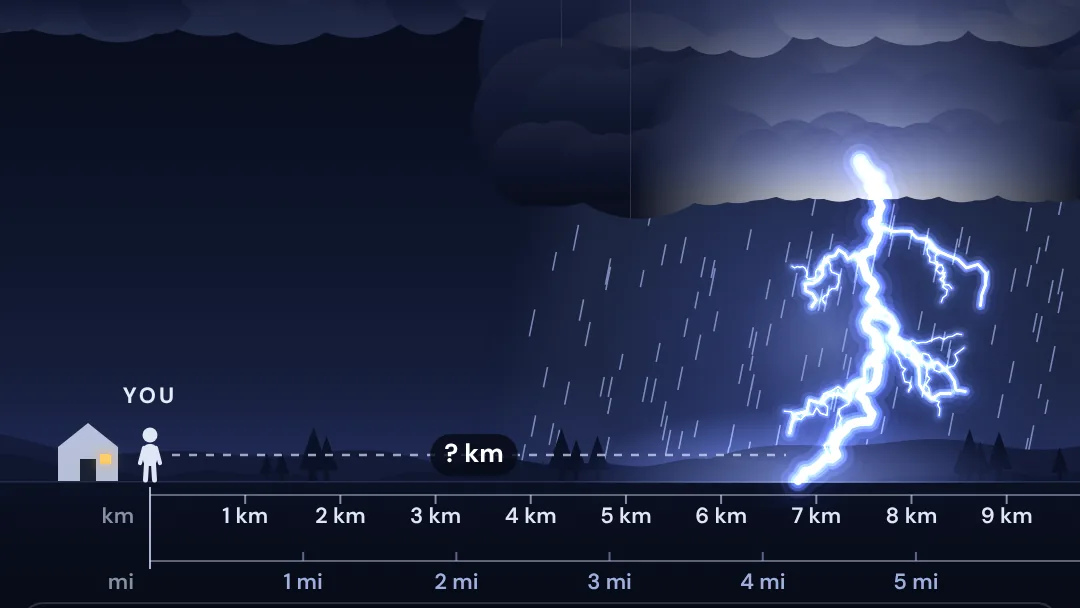
Side view, with distances along the ground to scale. The blue ring is the thunder on its way to you; the stopwatch counts from the flash. Tap the sky to strike somewhere new.
1 See
You see the flash at once, but the thunder takes its time. How does that gap tell you how far away the lightning was?
2 Change
3 Understand
Model notes and sources
Flash-to-bang model. The flash reaches you after D / clight, with clight ≈ 300,000 km/s: about 0.00001 s for a strike 3 km away, so it is effectively instant. The thunder travels at the speed of sound in air, c ≈ 331.3 + 0.606·T m/s (T in °C): 343 m/s at 20 °C, 340 m/s at 15 °C, 325 m/s at −10 °C. Counting the gap t gives the distance D = c · t: 1 km for every 2.9 s (the "3 seconds per kilometer" rule) and 1 mile for every 4.7 s (the "5 seconds per mile" rule) at 20 °C. Dividing a count by 3 gives kilometers to within about 3%; dividing by 5 gives miles, about 6% short.
Assumptions and fixed values. Still air at one temperature; sound travels in straight lines; flat ground. The thunder is timed from where the bolt meets the ground, and each bolt leans away from you so that point is the nearest part of the channel. The white and blue rings are the light and sound spreading from every point of the bolt at once. Distances along the ground are to scale (see the ruler); cloud heights, the bolt, the house and the person are not. The film uses 15 °C air (340 m/s) and shows each flash-to-thunder gap compressed; the badge under the stopwatch says by how much. In the tool, the gap plays in real time unless you turn on the 5× time-lapse.
Not modeled. Wind and temperature layers that bend sound upward or downward (they can hide thunder well inside 16 km, or carry it farther); humidity (it changes the speed of sound by under 1%); the long rumble from the farther parts of the channel; echoes from hills and buildings; and what the bolt does after it reaches the ground.
Safety. The US National Weather Service says lightning can strike about 10 miles (16 km) from a storm, so if you can hear thunder you are within striking distance: "When thunder roars, go indoors," and wait 30 minutes after the last thunder before going back out. The dashed 16 km dome is that rule of thumb, not a forecast of where lightning will land.
Sources: US National Weather Service, Lightning Safety; US National Weather Service, Understanding Lightning: Thunder; Speed of sound; Thunder.
An ExplainerTools Original.