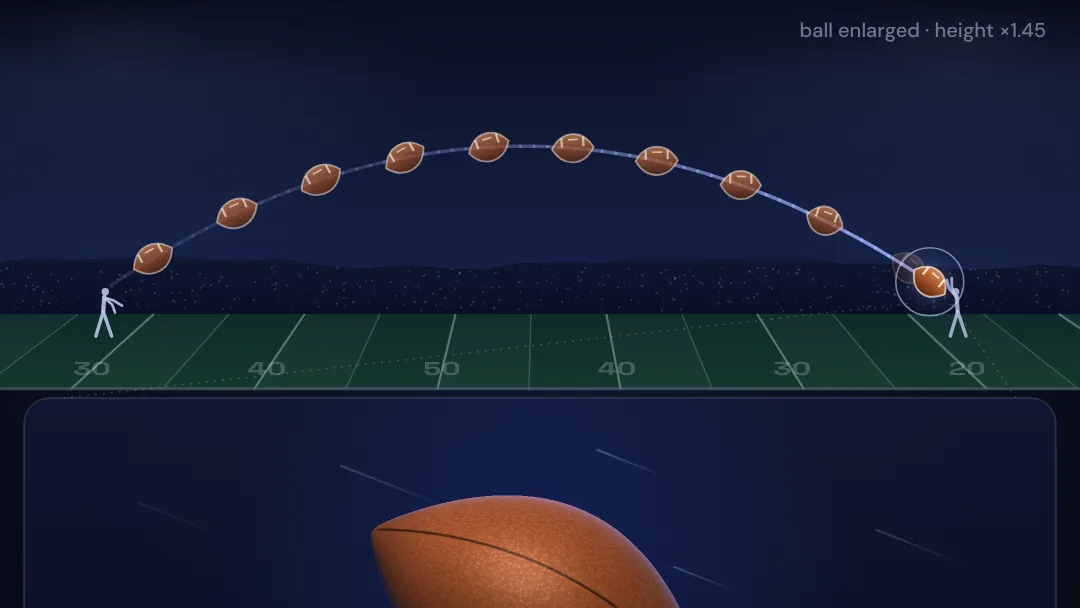
A good pass flies nose first, then tips down to meet the receiver's hands. A bad one wobbles the whole way there, and players call it a duck. Both can leave the hand at the same speed and angle. What separates them is mostly spin.
Try it yourself in Spiral Lab: crank the spin up to ten turns a second and watch the same shaky release tighten into a spiral.
Why does spin hold a football steady?
A football spinning around its long axis acts like a gyroscope. Its angular momentum points along that axis. Changing that direction takes a twist, and the faster the spin, the bigger the twist it takes. So a fast-spinning ball resists tipping. Wikipedia: Gyroscope.
No release is perfect. The hand always gives the nose a small sideways flick. On a spinning ball, that flick doesn't tumble it. Instead, the nose circles around a steady direction, tracing a small cone. That circling is the wobble you see. The physicist Peter Brancazio analyzed this wobble in 1987. Brancazio (1987), American Journal of Physics.
In Spiral Lab's model, doubling the spin roughly halves the wobble cone. A good spiral spins at about 600 rpm, ten turns a second. Rae (2003), Sports Engineering. At that rate, the nose circles about six times a second.
What turns a pass into a duck?
Air pushes on a football whenever its nose points off the flight path. That push tries to twist the nose even farther off. Spin can hold the nose steady only above a certain rate. For a 24 m/s throw, about 54 mph, the model puts that line near 270 rpm. That is four and a half turns a second.
Below that, the release wobble grows and the air shoves the nose around. Our film throws the ball twice, with the same small flick from the hand. At 3.5 turns a second, the nose swings about 30 degrees around the spin axis: a duck. At 10 turns a second, the same flick leaves only about 6 degrees. With no spin at all, the ball flips end over end.
How does the nose tip down to follow the arc?
Without air, a spinning ball's axis would point the same way for the whole flight. It would come down nose up, at the angle it was thrown. Yet a good spiral turns over and arrives nose first. That is the puzzle. LLNL: A simple explanation to paradox of a spiraling football.
The air turns it, though not in the obvious way. As gravity bends the path down, the nose ends up pointing a little above it. Air pressing on that raised nose tries to flip it farther up. On a spinning ball, that twist doesn't raise the nose. It swings the nose sideways, and then down.
So the nose circles slowly around the flight path, and the circle follows the path as it curves down. Physicists Richard Price, William Moss and Tim Gay worked this out in 2020, and Spiral Lab uses their equations. Even a well-thrown ball ends with a small sideways tilt, to the right as a right-handed thrower sees it. Price, Moss and Gay (2020), American Journal of Physics.
Can a ball spin too fast?
In the model, yes. The air steers the nose through that slow sideways swing. Its rate is the air's twist divided by the ball's angular momentum, so more spin means slower steering. Spin a 24 m/s pass at 15 turns a second, and the axis can't keep up. The nose trails the arc by up to about 26 degrees. A faster throw helps, because the air pushes harder at higher speed.
So a perfect spiral is a balance. It needs a clean release and enough spin to hold the axis, but not so much that the nose can't turn over.
What does the model leave out?
Spiral Lab is a teaching model of a rigid ball with a simplified air twist. It is not fitted to measured passes. It leaves out or simplifies:
- Drag on the flight. The ball flies a perfect parabola, so real passes land a few yards shorter.
- Other air effects. Lift, the Magnus force and the way air damps the wobble are not included.
- Sideways motion. Late in a pass, the nose also swings to the side, which the side view hides. The sideways drift that causes is not modeled.
- Drawing choices. Spin and wobble are drawn 8 times slower than real, and the flight is slowed. The ball is drawn enlarged, and the arc's height is stretched 1.45 times.
Can you count the spin in slow motion?
Your phone's slow-motion video can measure spin. These steps are a suggestion, so adapt them to the child beside you. You need a football, a thrower and a phone that films at 240 frames a second. A strip of bright tape from nose to tail makes each turn stand out.
Predict. Plan two throws: a lazy push, and a firm flick of the fingers on release. Ask your child which throw will spin faster, and which will wobble more.
Try. Film each throw from behind the thrower or from the side. Step through the video frame by frame. Count the frames between two moments when the tape faces the camera.
Explain. At 240 frames a second, 24 frames per turn means 10 turns a second, a tight-spiral pace. 60 frames per turn means 4 turns a second. In the model, that is a duck for a hard 24 m/s throw, though slower throws need less spin. Watch the nose, too: the faster the spin, the smaller its circle.
Then go back to Spiral Lab and drag the throw speed down to a lob. Keep the spin at ten turns a second, and predict whether the nose will still turn over in time.
Spiral Lab is an ExplainerTools Original.
Sources & further reading
- Price, Moss & Gay (2020), The paradox of the tight spiral pass in American football: A simple resolution, American Journal of Physics
- Lawrence Livermore National Laboratory (2020), A simple explanation to paradox of a spiraling football
- Rae (2003), Flight dynamics of an American football in a forward pass, Sports Engineering
- Brancazio (1987), Rigid-body dynamics of a football, American Journal of Physics
- Wikipedia, Gyroscope
Make the next question an experiment.
Browse independent creators who make big ideas visible.
Find an explainer