Sports · Motion · interactive
How do you throw a perfect spiral?
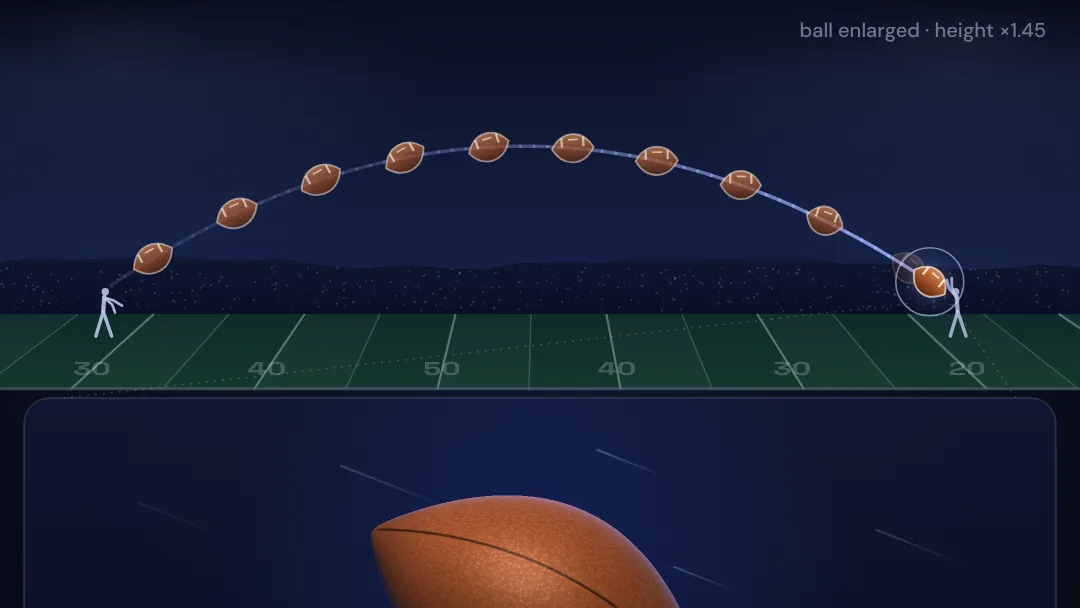
Top: the pass, with a snapshot of the ball every tenth of the flight. Bottom: the ball up close, with spin and wobble slowed 8×, and its nose seen head-on.
1 See
A tight spiral flies nose-first and tips down to meet the receiver. A duck wobbles all the way there. What makes the difference?
2 Change
3 Understand
Model notes and sources
A rigid, rotationally symmetric ball, 28 cm long and 17 cm wide, with moments of inertia It = 3.21 × 10⁻³ kg·m² across the ball and Il = 1.94 × 10⁻³ kg·m² about its long axis. Its axis ŝ and angular momentum L follow dL/dt = τ and dŝ/dt = (L × ŝ)/It, the equations Price, Moss and Gay use.
Wobble. A release that tips the nose at ω⊥ leaves the axis circling L in a cone of half-angle θ, with tan θ = Itω⊥ / (Ilωs), about Ilωs / (It cos θ) radians per second. At 600 rpm that is about 6 wobbles a second. Doubling the spin roughly halves the cone.
Air. When the nose points off the flight path by an angle α, the air applies an overturning torque σ sin α cos α (the sin 2α form Rae and Streit measured in a wind tunnel), with σ = 0.308 N·m at 27.4 m/s (Price, Moss and Gay, from Rae’s data), scaled with the square of the speed. On a spinning ball that torque does not flip the nose up. It swings the axis sideways and then down, so the axis precesses slowly around the flight path and the nose turns over to follow the arc. Spin can hold the axis only if (Ilωs)² > 4Itσ: about 270 rpm for a 24 m/s throw. Below that the ball wobbles wildly or tumbles. Far above it the axis turns too slowly and the nose lags behind the arc.
Fixed values. Released at 25° from 1.9 m and caught at 1.5 m. The film throws at 24 m/s (54 mph) with a release wobble of 3 rad/s (170°/s), first at 3.5 and then at 10 turns a second. A good spiral spins at about 600 rpm, 10 turns a second (Rae 2003, as cited by Price, Moss and Gay). In the tool the launch angle stays at 25°, so slower throws land shorter.
Not modeled. Drag on the ball’s path (it flies a parabola, so real passes land a few yards short), lift and Magnus forces, aerodynamic damping of the wobble, and the sideways drift that the nose’s yaw causes. Late in a pass the nose also swings as much as 30° to the thrower’s right, which the side view hides. This is a teaching model, not a fit to measured passes. Spin and wobble are drawn 8× slower than real, the flight is slowed, the ball is drawn enlarged, and the arc’s height is stretched 1.45×.
Sources: R. H. Price, W. C. Moss and T. J. Gay, “The paradox of the tight spiral pass in American football: A simple resolution”, Am. J. Phys. 88, 704–710 (2020); W. J. Rae, “Flight dynamics of an American football in a forward pass”, Sports Engineering 6, 149–163 (2003); P. J. Brancazio, “Rigid-body dynamics of a football”, Am. J. Phys. 55, 415–420 (1987); C. Horn and H. Fearn, “On the flight of the American football” (arXiv, 2007).
An ExplainerTools Original.