You do not need to know every answer before exploring a scientific idea with your child. You need a question you can investigate together, a model with understandable controls, and a willingness to pause. An interactive explainer gives you a shared object to point at while you work things out.
Here is one way to turn a few minutes at a screen into a small conversation about the world. The steps are an editorial suggestion, not a prescribed lesson plan or a promise about test scores. Adapt the language and pace to the child beside you.
Start with one question
Choose something connected to their day. Why is the background of that photograph blurry? Why did yesterday's Moon look different? Which playground swing might take longer to travel back and forth? A question that belongs to their life gives you a reason to investigate.
Keep the first question narrow. Instead of explaining all of gravity, compare two pendulum lengths. Instead of teaching every part of a camera, follow the light from one point to the sensor. You can always open another question later.
Let them make a prediction
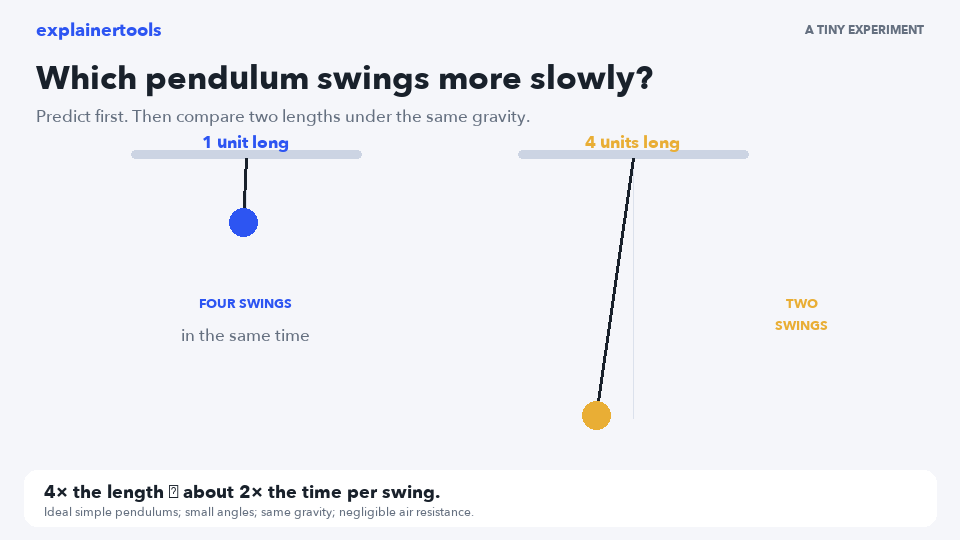
Before pressing play, ask: which pendulum do you think will swing more slowly? Give them a moment to decide. They can answer with a sentence, a finger pointing to the picture, or a quick sketch. Ask what made them choose it, without treating the prediction as a test they must pass.
Change one thing and watch closely
Use the length control above. Keep gravity the same. Compare one complete swing: from a starting point, across to the other side, and back to that starting point. Count several swings if a single one is hard to follow.
For an ideal simple pendulum at small angles, the period is proportional to the square root of its length. A pendulum four times as long therefore takes about twice as long per cycle. The model leaves out friction and treats the bob as a compact mass on a light support. These limits are part of the explanation. OpenStax: Pendulums.
Now try equal lengths. Ask what should happen before you move the control. This second comparison checks the emerging idea in a new situation, while keeping the experiment small enough to follow.
Help when the model gets confusing
If your child is clicking every control at once, pause and choose one together. If a term is unfamiliar, explain it briefly. Assisted discovery can include examples and feedback; a research review by Alfieri and colleagues distinguishes those supports from leaving learners to discover everything without help. Alfieri and colleagues, 2011.
You might say: “Let's watch the blue one first. When does it get back to where it started?” That kind of prompt gives attention a destination. If the page is too demanding today, choose a simpler view or return to it another time.
Bring the idea back into the room
Finish with an explanation in your child's own words. “The longer one takes more time” is a useful beginning. Ask what in the picture supports it. An older child might compare lengths and periods; a younger one might show the rhythm with a hand.
Then connect the model to something familiar: a swing, a clock, or a hanging decoration. Ask what differs between the simplified model and the real object. You are practicing how to use a model, including when to be cautious about it.
For your next session, explore Ryan Sael's Pendulum Rhythm Lab, or try Bartosz Ciechanowski's Moon. Let the next question choose the topic.
Sources & further reading
Make the next question an experiment.
Browse independent creators who make big ideas visible.
Find an explainer