Listen to a jet passing high overhead, and its roar seems to come from empty sky behind it. Look toward the sound, and the plane is already well ahead. A supersonic jet goes further. You hear nothing as it approaches. Then, after it has flown over, comes a sharp double bang.
Try it yourself in Sonic Boom Lab: drag the plane's speed past Mach 1 and watch its sound rings pile up into a cone.
Why does sound spread out in rings?
Sound is a pressure wave. It spreads out from wherever it was made, in every direction, at one speed. In dry air at 20 °C, that speed is about 343 meters a second, roughly a kilometer every three seconds. Wikipedia: Speed of sound.
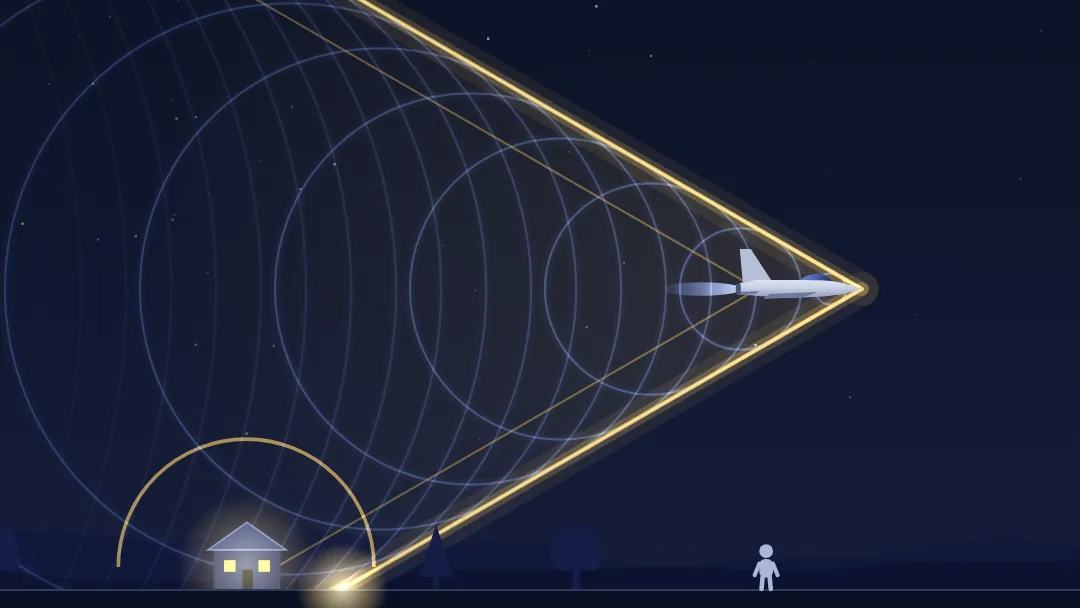
A moving plane makes new sound every moment. Each moment's sound grows into its own ring, centered where the plane was when it made it. A slow plane stays inside its own rings. They bunch up in front and spread out behind, but every ring gets out ahead.
That is why a high jet's roar seems to lag behind it. The sound you hear left the plane a while ago, from a spot it has since left behind.
What happens when a plane outruns its sound?
The Mach number compares a plane's speed with the speed of sound. Mach 1 is the speed of sound itself. Long-haul airliners cruise at about Mach 0.85, a little under it. Wikipedia: Boeing 787 Dreamliner.
At exactly Mach 1, the plane keeps pace with its own sound. Every new ring starts at the nose, and none can get ahead. They pile into a wall of pressure in front of the plane.
Past Mach 1, the plane outruns every ring it makes. Now the rings overlap along one surface only: a cone, with its tip at the plane, trailing behind. Along that cone the pressure jumps sharply. When the cone's edge reaches your ears, you hear the boom.
The faster the plane, the narrower the cone. At Concorde's top speed of Mach 2.04, the cone's edge sits about 29 degrees from the flight path. At Mach 3.2, the SR-71's speed, it closes to about 18 degrees. Wikipedia: Concorde; Wikipedia: Lockheed SR-71 Blackbird.
Does a sonic boom happen only once?
No. NASA calls this the most common misconception about sonic booms. The cone does not appear once, as the plane crosses Mach 1, and then vanish. It travels with the plane for as long as the plane flies faster than sound. NASA: Science of Sonic Booms.
Where the cone meets the ground, it sweeps along behind the plane. Everyone it passes hears the boom, one after another. The strip of ground it covers is called the boom carpet. Wikipedia: Sonic boom.
Because the cone trails behind, the boom arrives after the plane has passed. For Concorde at Mach 2.04 and 18 km, our model puts the cone's edge about 32 km behind the plane. You would hear the boom about 46 seconds after it flew straight overhead.
That sweep is why Concorde's booms kept it to routes across the ocean. In the United States, civil aircraft may not fly faster than sound without an authorization. 14 CFR 91.817.
Why is it a double boom?
A real plane is not a single point. Shock waves form at its nose, its tail and other parts. On the way down they merge, until usually two reach the ground. The pressure jumps up, falls steadily below normal, then jumps back. Drawn as a graph, that looks like the letter N, so it is called an N-wave. Each jump is one bang. NASA: Science of Sonic Booms.
What does the model leave out?
Sonic Boom Lab uses a single speed of sound, 343 m/s, in still air. Real air gets colder with height, so sound slows to about 295 m/s at airliner heights, around 11 km. Wikipedia: International Standard Atmosphere. That changes two things:
- Speeds. The model reads Concorde's Mach 2.04 as 2,519 km/h. In the cold air where it flew, Mach 2.04 was about 2,180 km/h.
- Bending. The changing temperature bends a boom upward. Booms from planes a little past Mach 1 often never reach the ground. The bending also limits how wide the carpet is. A rule of thumb gives about 1 mile of carpet for every 1,000 feet of altitude.
The model also ignores wind, turbulence, terrain and the plane's shape. The double boom is drawn schematically. The stage is a time-lapse, and the plane icon is not to scale. The cone's angle, and where it lands, are to scale.
Can you hear where a jet used to be?
The crack of a bullwhip is a tiny sonic boom: its tip moves faster than sound. A jet high overhead is a safer way to hear the rings at work. These steps are a suggestion, so adapt them to the child beside you. Pick a quiet spot outdoors on a clear, calm day.
Predict. When you hear a jet high overhead, ask your child where the plane will be. Right where the sound seems to come from, ahead of it, or behind it?
Try. Close your eyes and point toward the roar. Then open your eyes, find the plane, and compare. Try it with a few planes.
Explain. From about 11 km up, the sound took more than half a minute to reach you. An airliner at Mach 0.85 flies roughly 8 to 9 km in that time. So the plane is well ahead of where its sound seems to come from. A supersonic jet outruns its sound entirely, which is why it arrives in silence. Wikipedia: Speed of sound.
Back in Sonic Boom Lab, pick Concorde, then drag the altitude down. Predict first: will the boom arrive sooner or later after the plane passes over?
Sonic Boom Lab is an ExplainerTools Original.

Sources & further reading
- Wikipedia, Sonic boom
- NASA (2026), NASA X-59 Explainer: Science of Sonic Booms
- Wikipedia, Speed of sound
- Wikipedia, International Standard Atmosphere
- Wikipedia, Concorde
- Wikipedia, Lockheed SR-71 Blackbird
- Wikipedia, Boeing 787 Dreamliner
- Electronic Code of Federal Regulations, 14 CFR 91.817: Civil aircraft sonic boom
Make the next question an experiment.
Browse independent creators who make big ideas visible.
Find an explainer