Sound · interactive
What makes a sonic boom?
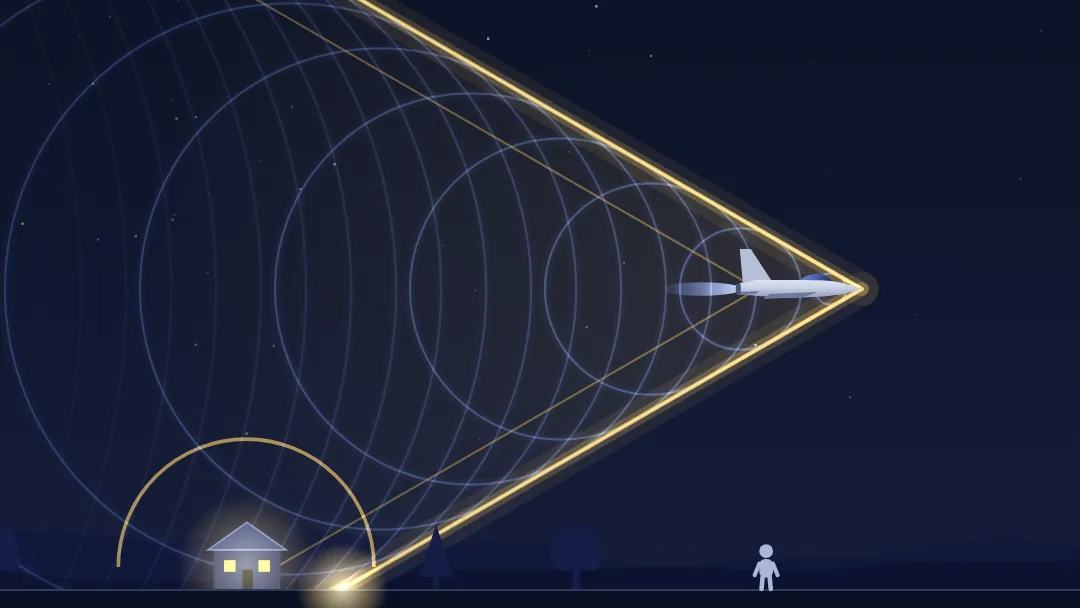
Each ring is sound the jet made a moment ago, growing from where the jet was at the time. Bright lines: the cone where the rings pile up. Gold strip: ground the boom has already swept.
1 See
A slow jet just roars past. A supersonic one hits the ground with a sharp double bang, and only after it has already flown over. Where does the bang come from?
2 Change
3 Understand
Model notes and sources
Each ring is one wavefront. It grows at a single speed of sound, c = 343 m/s (still, dry air at 20 °C), from the point where the plane was when it made it. The Mach number is M = v/c. Below Mach 1 every ring gets out ahead of the plane. Above Mach 1 the rings overlap only along their envelope: a cone that travels with the plane, with half-angle μ = arcsin(1/M). The bright lines are that envelope, computed from the rings themselves, so they also show the cone forming while the plane speeds up.
When a plane at altitude h passes straight over you, the cone's edge meets the ground h·√(M² − 1) behind it. The plane covers that distance in Δt = h·√(M² − 1) / (M·c) = (h/c)·√(1 − 1/M²). That is the “boom after overhead” readout: about 46 s for Concorde at Mach 2.04 and 18 km. The boom is not a one-time event at Mach 1. The cone keeps sweeping the ground for as long as the plane stays supersonic.
What the model leaves out: real air gets colder with height, so sound slows to about 295 m/s at airliner altitudes (11 km). Speeds in km/h here use 343 m/s, so Concorde’s Mach 2.04 reads 2,519 km/h; in the cold air at its cruise height it was about 2,180 km/h. The changing sound speed also bends (refracts) the boom upward. That is why booms from planes just above Mach 1 often never reach the ground, and why the band of ground that hears a boom, the “boom carpet”, has a limited width. The width grows with altitude: a common rule of thumb is about one mile of carpet for every 1,000 feet of altitude. Wind, turbulence, terrain and the plane’s shape are ignored. Real aircraft make a shock at the nose and another at the tail; the pressure jumps up, falls steadily, then jumps back (an “N-wave”), heard as a double boom. The faint second line and the pressure card show this schematically. The stage is a time-lapse and the plane icon is not to scale; the cone angle and where the cone lands are to scale.
Presets: airliner at Mach 0.85 and 11 km (a typical long-haul cruise, e.g. the Boeing 787); Concorde at Mach 2.04 and 18 km (it cruised near 18,300 m, or 60,000 ft); SR-71 at Mach 3.2 and 24 km (it flew above Mach 3 at about 24–26 km).
Sources: Sonic boom; Mach wave; Speed of sound; International Standard Atmosphere; Concorde; Lockheed SR-71 Blackbird; Boeing 787.
An ExplainerTools Original.