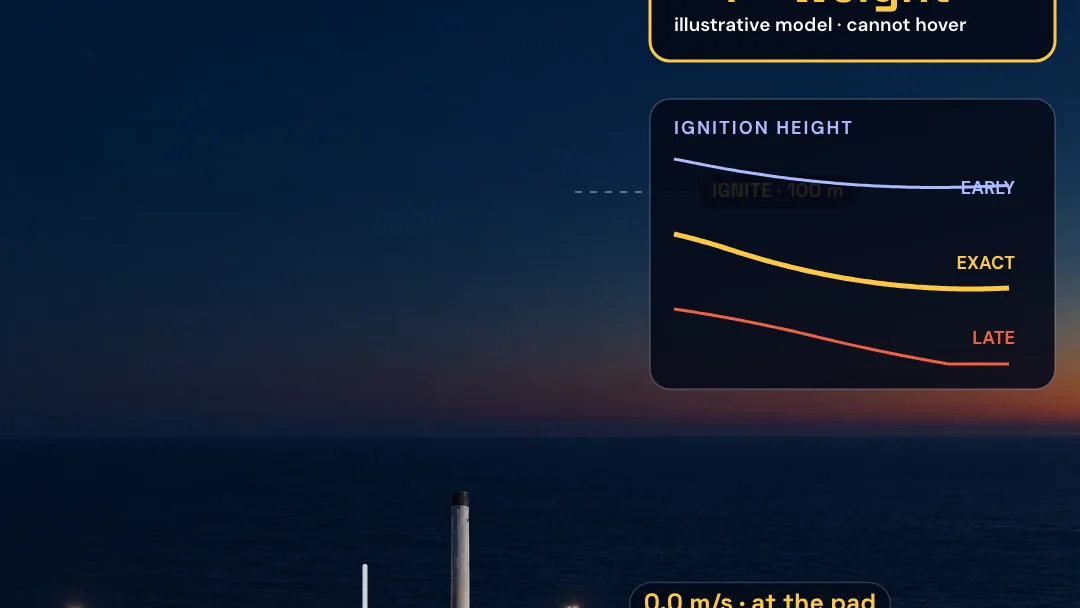
A returning booster has to erase its downward speed exactly as its altitude reaches zero. When even minimum thrust exceeds its landing weight, it cannot simply stop and hover.
Try it yourself: move ignition height and find the model’s zero-speed landing.
Why is there only one height?
The teaching model begins at 140 m and 28 m/s downward. Its constant burn is 1.8 times weight. At the 100 m ignition point, the falling booster has reached about 39.6 m/s downward, and the model’s upward acceleration removes that speed in exactly 100 m.
Ignite higher and it reaches zero speed above the pad, then climbs if thrust stays on. Ignite lower and it reaches the pad with downward speed left.
What is illustrative?
The initial state and 1.8 thrust-to-weight ratio are teaching values, not Falcon 9 telemetry. Public SpaceX material gives Merlin’s maximum sea-level thrust but not the landing mass, minimum landing thrust or throttle schedule needed to reconstruct touchdown thrust-to-weight independently.
The model leaves out changing mass, drag, horizontal motion, wind, throttle changes, startup transients, guidance corrections, landing legs and the real closed-loop controller.
Sources: SpaceX, Falcon User’s Guide; NASA Glenn, Thrust-to-Weight Ratio; NASA Glenn, Practical Rocketry.
Sources & further reading
Make the next question an experiment.
Browse independent creators who make big ideas visible.
Find an explainer