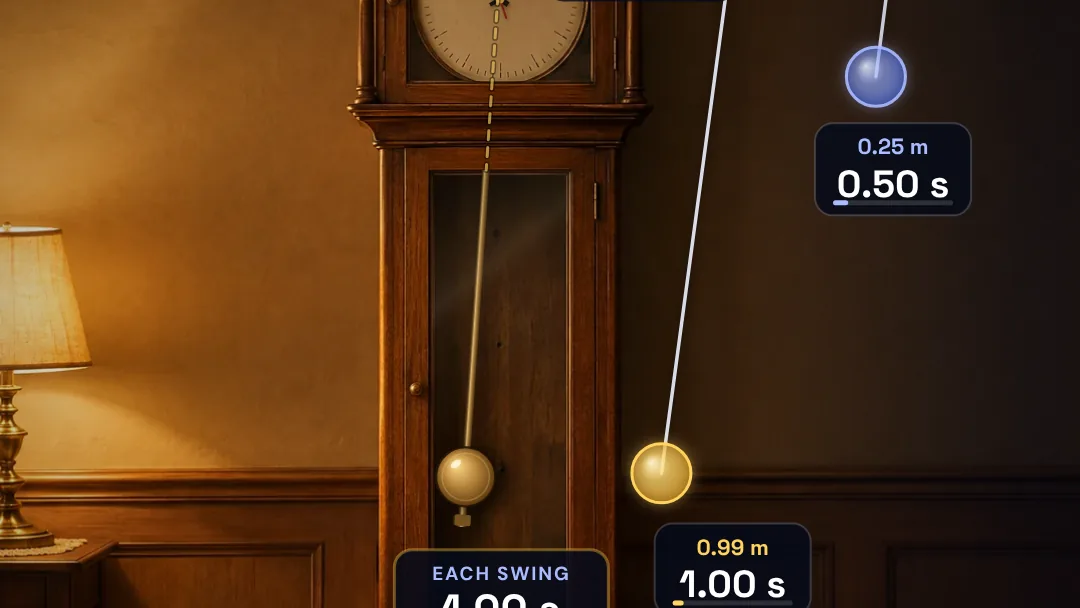
A grandfather clock’s pendulum hangs about a meter from its pivot, and each swing takes one second. Make the bob heavier, and the swing does not change. Make the pendulum longer, and the clock slows down. Why does length alone set the time?
Try it yourself in Pendulum Lab: drag the pendulum longer and watch the swing slow, then make the bob heavier and watch nothing change.
Why does length set the time?
For small swings, the time for one swing, one way across, is t = π√(L/g). Here L is the length from pivot to the center of the bob, and g is gravity, 9.80665 meters per second squared. The full back-and-forth period is twice that.
Mass does not appear in the formula. A heavier bob needs more force to speed up, and gravity pulls it harder by exactly the same factor. Length enters as a square root, so four times the length gives twice the time.
Length does the work because the swing time depends on the square root of length. Double the length, and the time grows by about 1.41 times. Quadruple it, and the time for each swing doubles.
Why is the clock so tall?
A seconds pendulum, whose swing takes exactly one second, is 0.9936 meters long. That is about one meter, right for ticking a clock’s second hand. It is a big reason the case is so tall.
Longcase clocks are typically 1.8 to 2.4 meters tall. The model’s case is 2.05 meters tall, which sets the scale for the drawing. The pendulum hangs from a pivot behind the dial.
Does a wider swing change the time?
Only a little, as long as the swing stays small. The exact time grows with the swing width: about 0.03 percent more at plus or minus 4 degrees, 0.43 percent at 15 degrees, 1.7 percent at 30 degrees and 7.3 percent at 60 degrees. Real anchor-escapement clocks swing a few degrees each side, so the small-angle rule fits them well.
What does the model leave out?
The model is an ideal simple pendulum, and its tag says so. It leaves out several things that matter in a real clock:
- Friction and air drag. A real clock’s escapement gives the pendulum a small push each swing to replace those losses.
- The rod and bob. A real physical pendulum is slightly slower than a point mass on the same length.
- Temperature. The rod stretches as it warms, which is why precision clocks used compensated pendulums.
- Earth’s rotation. The model’s Foucault preset uses the 67-meter wire Léon Foucault hung in the Panthéon in Paris in 1851. Its slow turning, caused by Earth’s rotation, is not modeled.
Predict first, then try
Before you touch the model, ask a simple question: which pendulum swings faster, one a meter long or one a quarter of a meter long? Make your prediction, then check it in Pendulum Lab.
Next, set the mantel-clock preset, which is 0.248 meters long and takes half a second per swing. Compare it with the seconds pendulum at 0.9936 meters. The shorter one swings twice as fast, because its time scales with the square root of its length.
Then drag the bob heavier and watch the swing time hold steady. Explain to yourself why weight cannot change it, using the idea that gravity pulls harder on a heavier bob by the same factor.
The photos are AI-generated illustrations. The pendulum, the hands and every number come from the model.
Sources: Wikipedia, Pendulum (mechanics); Wikipedia, Seconds pendulum; Wikipedia, Grandfather clock; Wikipedia, Foucault pendulum; HyperPhysics, Large amplitude pendulum.

Sources & further reading
Make the next question an experiment.
Browse independent creators who make big ideas visible.
Find an explainer