Physics · interactive
Why do grandfather clocks have such long pendulums?
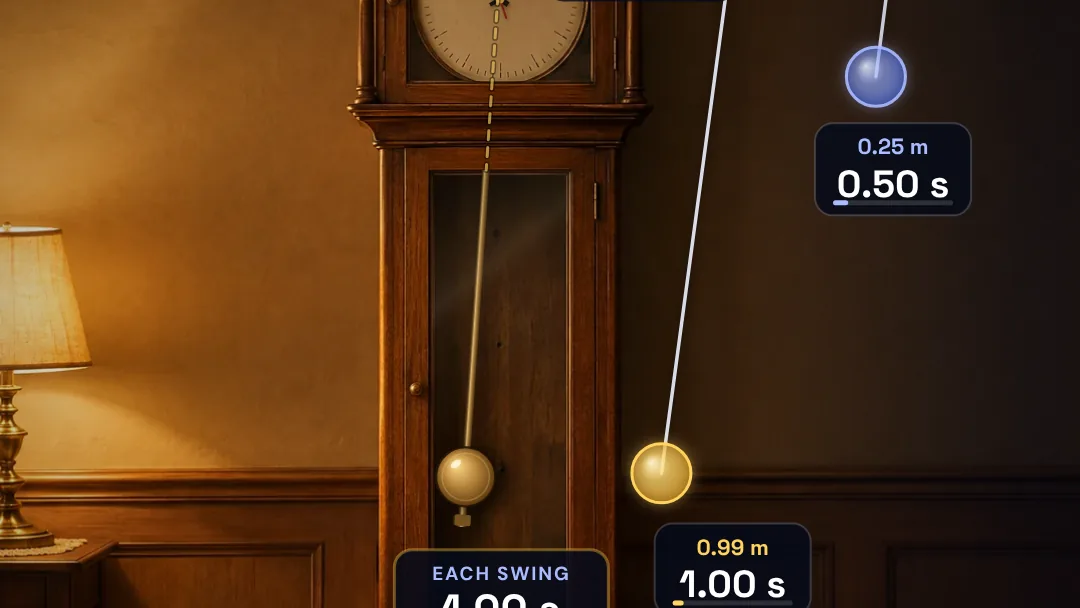
Left: a longcase clock with a seconds pendulum. Right: your pendulum, to scale; the dashed bob follows the small-angle formula. Drag the bob to set its length and swing.
1 See
A grandfather clock’s pendulum hangs about a metre from its pivot, and each swing takes one second. What sets that time, and why so long?
2 Change
3 Understand
Model notes and sources
Model. An ideal simple pendulum: a point mass on a light, rigid rod, swinging without friction or air drag, with g = 9.80665 m/s². For small swings the time for one swing (one way, half a period) is t = π√(L/g), so the period is T = 2π√(L/g). Mass does not appear: a heavier bob needs more force to speed up, and gravity pulls it harder by exactly the same factor. Length enters as a square root, so 4× the length gives 2× the time. For any swing angle ±A the exact time is t = 2√(L/g)·K(sin(A/2)), where K is the complete elliptic integral of the first kind; the bob’s motion uses the exact solution θ(t) = 2·asin(k·sn(K − ω₀t, k)). That is 1 + A²/16 + … times the small-angle value: +0.03 % at ±4°, +0.43 % at ±15°, +1.7 % at ±30° and +7.3 % at ±60°. The dashed bob in the tool follows the small-angle formula, so you can watch it pull ahead at wide swings.
Fixed values. A seconds pendulum, whose swing takes exactly 1 s (period 2 s), is L = g/π² = 0.9936 m long, measured from the pivot to the centre of the bob. The clock in the film and the tool swings ±4°; real anchor-escapement clocks swing a few degrees each side. The film’s lab pendulums swing ±8° and ±15° so you can see them move. The clock case is taken to be 2.05 m tall (longcase clocks are typically 1.8–2.4 m), which sets the scale; its pivot sits behind the dial. The mantel-clock preset is 0.248 m (a half-second swing); the Foucault preset uses the 67 m wire Léon Foucault hung in the Panthéon in Paris in 1851, with its 28 kg bob. The bob is drawn as a solid brass sphere for its size only.
Not modeled. Friction and air drag (a real clock’s escapement gives the pendulum a tiny push each swing to replace those losses), the mass and size of the rod and bob (a real “physical pendulum” is slightly slower than a point mass on the same length), the rod stretching with temperature (why precision clocks used compensated pendulums), the small variation of g with latitude and altitude, and the slow turning of a Foucault pendulum’s swing caused by Earth’s rotation. The photos (the hallway, the clock and its dial) are AI-generated illustrations; the pendulum, the hands and every number are drawn from the model.
Sources: Pendulum (mechanics) (small-angle and exact periods); Seconds pendulum (0.994 m, 2 s period); Grandfather clock (seconds pendulum about 1 m, cases 1.8–2.4 m, swing of a few degrees); Foucault pendulum (67 m, Panthéon, 1851); HyperPhysics, Large amplitude pendulum.
An ExplainerTools Original.