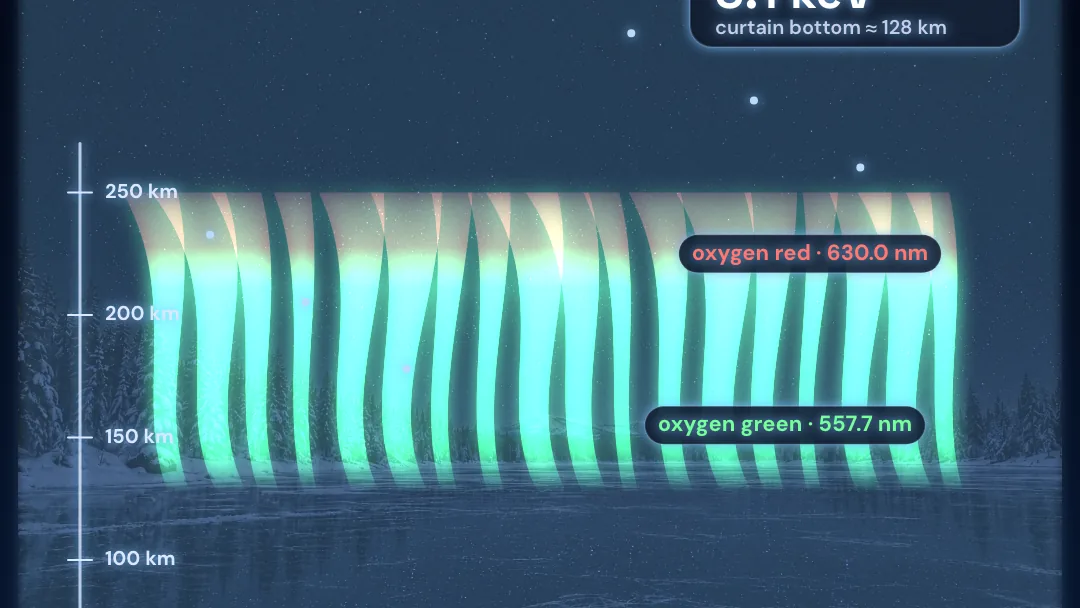
Charged particles guided along Earth’s magnetic field collide with the upper atmosphere. The colors record which atoms or molecules were excited and how high the collision happened.
Try it yourself in Aurora Chamber: raise electron energy and watch the curtain extend lower.
Why green in the middle?
Atomic oxygen’s 557.7 nm transition makes familiar green light around roughly 100–250 km.
Why red above and pink below?
Oxygen’s 630.0 nm red emission is more easily collisionally quenched in denser air and is prominent higher up. More energetic electrons can penetrate deeper, where molecular nitrogen and its ions add blue, purple and pink.
The control’s energy-to-altitude relation is illustrative, not a measured conversion. The model omits atmospheric profiles, particle distributions, camera exposure and rapidly changing magnetic geometry. Photos are AI-generated illustrations.
Source: NOAA Space Weather Prediction Center, Aurora.
Sources & further reading
Make the next question an experiment.
Browse independent creators who make big ideas visible.
Find an explainer