Space · interactive
Why are the northern lights green?
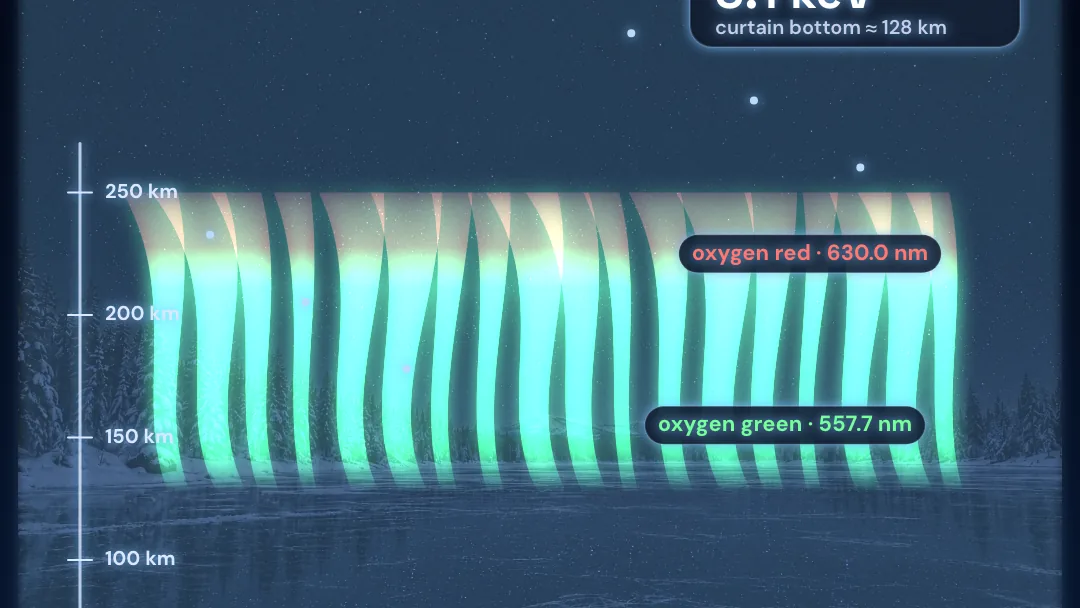
Higher-energy electrons penetrate deeper. Oxygen gives the familiar green and high red; nitrogen adds purple and pink at the lower edge.
1 See
The colors stack by height because each glow needs a particular atom, collision energy and enough time before another collision interrupts it.
2 Change
3 Understand
Model notes and sources
Model. Incoming electrons follow magnetic field lines into the polar upper atmosphere and excite atoms and molecules. Atomic oxygen’s 557.7 nm green line is common around roughly 100–250 km. Atomic oxygen’s 630.0 nm red emission is more easily collisionally quenched in denser air and is prominent at higher altitudes, while molecular nitrogen and ionized nitrogen add blue, purple and pink toward energetic curtains’ lower edges.
Energy control. Curtain-bottom altitude is an illustrative visual mapping from 145 km at 1 keV to 90 km at 10 keV, not an inversion of measured particle energy. Higher-energy precipitation can penetrate deeper, but real precipitation contains a distribution of energies and pitch angles.
Not modeled. Atmospheric composition profiles, electron transport and scattering, exact radiative lifetimes, emission rates, magnetic geometry, camera exposure, human night vision and auroral dynamics. The sky and aurora photos are AI-generated illustrations; the physically placed curtains are drawn in code.
Source: NOAA Space Weather Prediction Center, aurora tutorials and published oxygen/nitrogen emission explanations.
An ExplainerTools Original.