During the 1985 Mexico City earthquake, damage was not uniform. Many mid-height buildings on soft former-lake sediments responded strongly, but effects varied by site, structural period and construction. There is no universal story range or damage prediction from height alone.
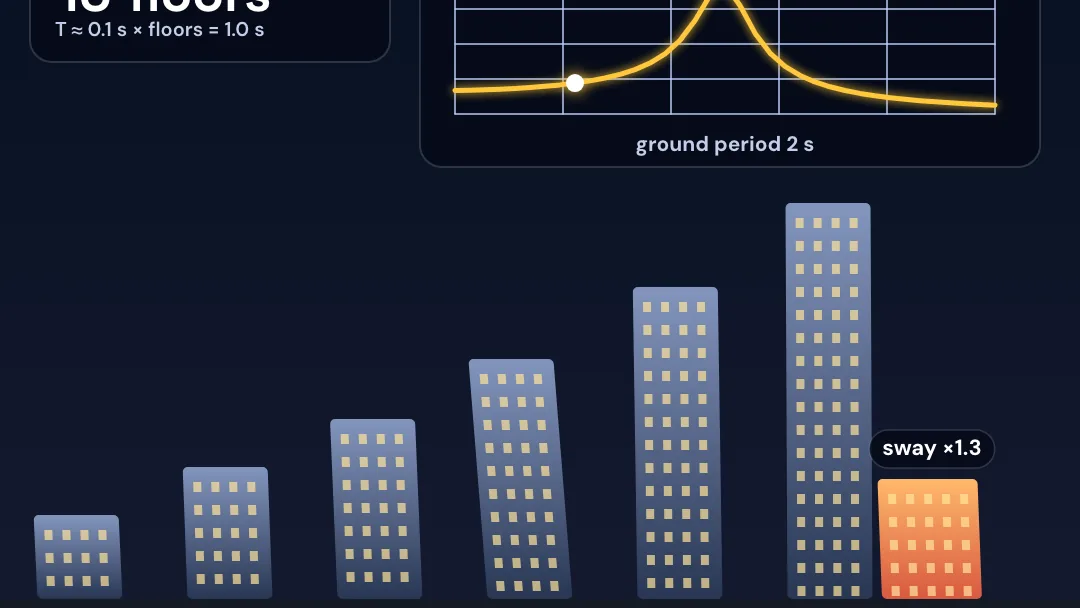
Try it yourself in Quake Tower: change floor count and find the two-second match.
What is resonance?
A rule of thumb puts a building’s period near 0.1 seconds per floor. The soft ground moved back and forth about every two seconds. When those periods approach one another, repeated shaking arrives in step and sway is amplified.
How can a damper help?
Taipei 101 carries a 660-ton tuned mass damper. Its large steel ball moves opposite the tower’s sway, absorbing some motion from wind and earthquakes.
The tool is a single-mode damped oscillator, not a safety calculator. It leaves out structural system, code era, damage, soil-structure interaction and the full earthquake spectrum. The buildings are abstract; photos are AI-generated illustrations.
Sources: U.S. Geological Survey educational material on the 1985 Mexico City earthquake; Taipei 101 published tuned-mass-damper specifications.

Sources & further reading
Make the next question an experiment.
Browse independent creators who make big ideas visible.
Find an explainer