Earthquakes · interactive
Why did the middle-height buildings fall?
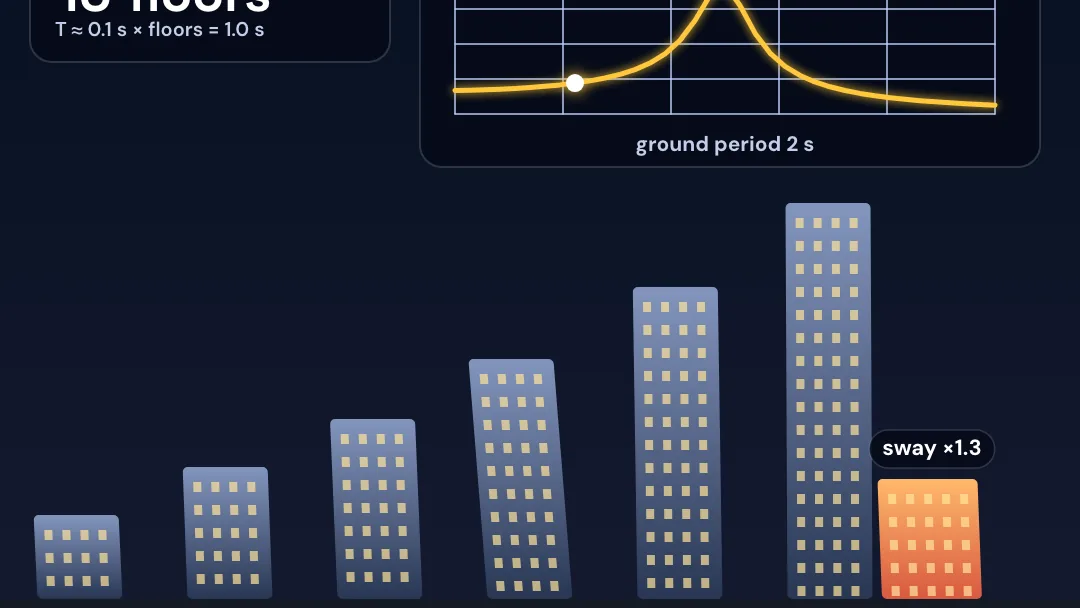
The floor-count rule of thumb sets each tower's natural period. Sway peaks when it approaches the ground's two-second rhythm.
1 See
During one earthquake, neighboring buildings did not all respond alike. Height changed the rhythm each building preferred.
2 Change
3 Understand
Model notes and sources
Model. Building period uses the explicit rule of thumb T ≈ 0.1 s × number of floors. Ground motion is a sinusoid with period 2 s. The plotted steady-state amplification is 1/√[(1 − r²)² + (2ζr)²], where r = T/2 s and illustrative damping ζ = 0.09. Floor count is not a structural safety rating.
Context. During the 1985 Mexico City earthquake, many mid-height buildings on soft former-lake sediments responded strongly, but effects varied by site, structural period and construction. This history does not establish a universal story range or predict damage from height alone. The abstract buildings avoid depicting victims or real collapses. Taipei 101’s 660-ton tuned mass damper is designed to move out of phase with tower motion from wind and earthquakes.
Not modeled. Building materials, irregularity, soil-structure interaction, nonlinear damage, earthquake direction and duration, code era, retrofit quality, and the broad spectrum of real ground motion. The city and damper photos are AI-generated illustrations.
Sources: U.S. Geological Survey material on the 1985 Mexico City earthquake and site amplification; Taipei 101, published tuned mass damper specifications.
An ExplainerTools Original.