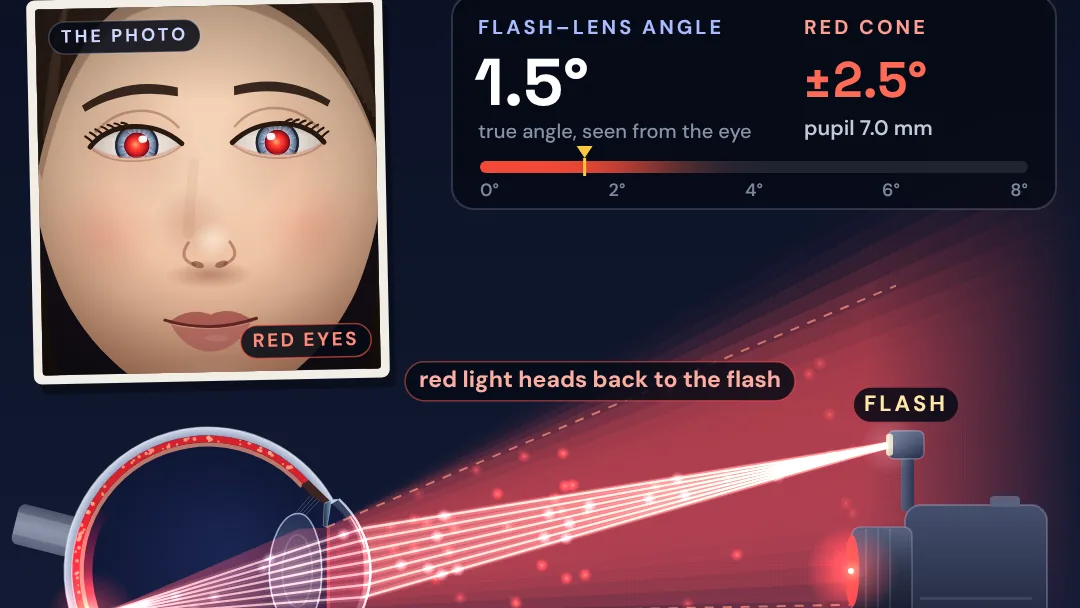
At a birthday party, someone takes a flash photo. The faces look fine, except for the eyes. Pupils that should look black glow red. Take the same photo outdoors at noon, and the red is gone. The camera is not adding the color. It is photographing the inside of the eye.
Try it yourself in Red-Eye Lab: drag the flash away from the lens and watch the red glow miss the camera.
What is the camera actually seeing?
The pupil is a hole into the eye. Light that goes in usually stays in, so the pupil looks black. A flash is bright enough to change that. Its light passes through the pupil. The cornea and lens focus it onto a small patch at the back of the eye.
A little of that light reflects back out. Behind the retina lies the choroid, a layer rich in blood vessels. Its blood colors the returning light red. Wikipedia: Red-eye effect.
That light does not spray back out in every direction. The eye's optics send it back the way it came, toward the flash. A road reflector does the same with headlights. Wikipedia: Retroreflector. So the red leaves the eye in a narrow cone. If the camera's lens sits inside that cone, the photo shows red eyes. Outside it, the lens looks into retina the flash never lit, and the pupils stay dark.
Why doesn't the pupil shrink in time?
Pupils open wide in dim light, to let more light in. In a dark room, a pupil can open as wide as about 8 mm. In bright light, it narrows to a few millimeters. Wikipedia: Pupil.
Shrinking takes time. The pupil starts to react about 0.2 seconds after bright light reaches it. A camera flash at full power is over in about a thousandth of a second. So the photo is taken while the pupil is still wide open from the dim room. Espinosa et al. (2015): pupil reflex timing; ScanTips: flash duration.
How far from the lens does the flash need to be?
What matters is the angle between the flash and the lens, seen from the subject's eyes. A guide to one Nikon camera, hosted by Michigan Technological University, gives a rule of thumb. If that angle is under about 2.5 degrees, expect red eyes. Michigan Tech: Red-Eye Reduction.
In our model, a compact camera's flash sits 4 cm from its lens. From 1.5 meters away, that is only 1.5 degrees, and a dim room gives strong red eyes. Move the flash up an 18 cm bracket, and the angle grows to nearly 7 degrees. The red cone misses the lens entirely.
A phone's flash sits even closer, about 1 cm from the lens in the model. Distance matters too. Step back, and the angle shrinks. In a dim room, from 5 meters away, even the 18 cm bracket brings the red back.
How does red-eye reduction work?
Some cameras shine a bright light first. On that Nikon, a lamp glows for about a second before the real flash fires. The pupils react to the first light and shrink, so the red cone narrows. Michigan Tech: Red-Eye Reduction.
In our model, the pre-light shrinks a dim-room pupil from about 6.3 mm to 3.1 mm. With the flash 4 cm from the lens, that turns red eyes dark. With the flash right beside the lens, the red spots get smaller, not gone. Turning on more lights helps for the same reason. A brighter room means smaller pupils.
What does the model leave out?
Red-Eye Lab is a simplified model of the eye's optics. The eye is drawn to scale. The distance to the camera is drawn shorter and the angles larger than life. The readouts give the true angles. The pupil curve and the width of the red cone are illustrative, tuned to match the 2.5-degree rule of thumb. The model leaves out:
- Focus and gaze. How well the eye is focused on the flash, and where the person is looking.
- Real eyes. The eye's optical flaws, light scattering inside it, and differences between people, ages and eye colors.
- Phones. Phone LED flashes stay lit longer than a camera flash, and software can remove red eyes after the photo.
- Animal eyeshine. Cats, dogs and many other animals have a mirror-like layer behind the retina, the tapetum lucidum. It makes their eyes shine yellow, green or blue in photos. Humans don't have one. Wikipedia: Tapetum lucidum.
The model also can't tell a healthy eye from an unhealthy one. Sometimes a flash photo shows a pupil glowing white or gray instead of red. That can come from a normal part of the eye, the optic nerve. It can also signal eye disease, such as a cataract or retinoblastoma, a rare eye cancer. Pediatric eye doctors advise a full eye exam, so show the photos to your child's doctor. American Academy of Pediatrics (2025).
Can you watch a pupil shrink?
These steps are a suggestion, so adapt them to the child beside you. Use ordinary room light. Never look at the sun, or shine a flashlight into anyone's eyes.
Predict. Stand together at a mirror in a well-lit room. Ask your child what their pupils will do after their eyes have been covered for a while. Bigger or smaller? Instantly, or slowly?
Try. Cover both eyes with cupped hands for about 30 seconds. Then drop your hands and watch the black circles in the mirror. Watching each other's eyes works even better.
Explain. Under your hands, the pupils opened wide. Back in the light, they shrink, and you can see it happen. A flash is over long before the pupil starts to move. A pre-light works because it gives the pupil time. Wikipedia: Pupil.
Back in Red-Eye Lab, put the flash on its 18 cm bracket, then drag the subject across the room. Predict first: will the red come back before the far wall?
Red-Eye Lab is an ExplainerTools Original.

Sources & further reading
- Wikipedia, Red-eye effect
- Wikipedia, Pupil
- Espinosa et al. (2015), A high-resolution binocular video-oculography system: assessment of pupillary light reflex and detection of an early incomplete blink and an upward eye movement, BioMedical Engineering OnLine 14:22
- ScanTips, Speed of flash for high speed photography, Part 2
- C.-K. Shene, Michigan Technological University, Red-Eye Reduction (Nikon Coolpix 4500 guide)
- Wikipedia, Retroreflector
- Wikipedia, Tapetum lucidum
- American Academy of Pediatrics (2025), White (Instead of Red) Reflexes on Family Smartphone Photographs Can Be Worrisome, but Also Normal
Make the next question an experiment.
Browse independent creators who make big ideas visible.
Find an explainer