Light · Photography · interactive
Why do eyes glow red in flash photos?
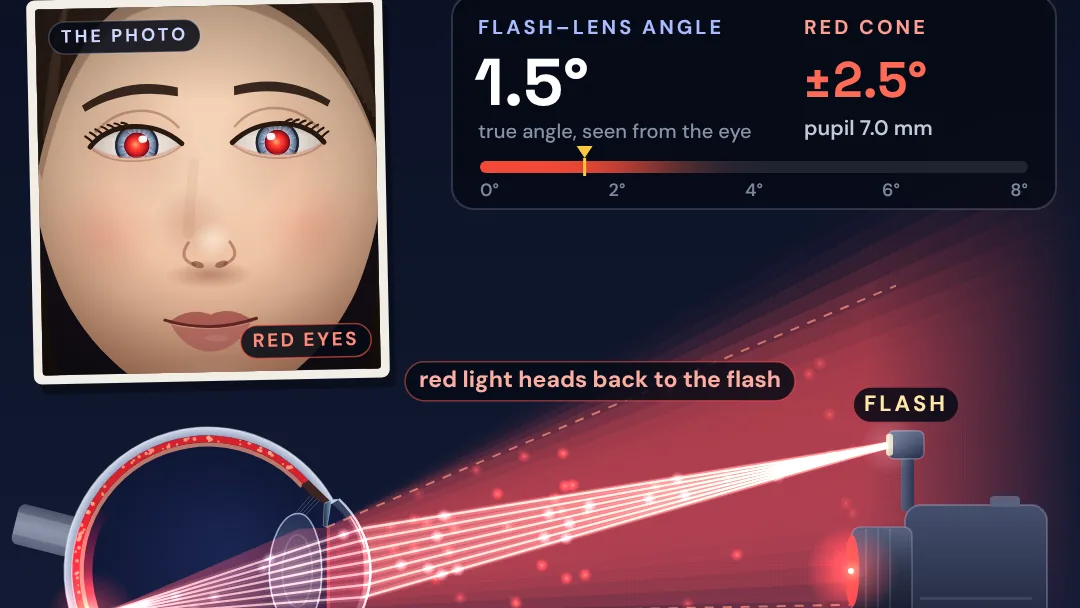
Left: the photo, and the eye in cross-section, to scale. Right: the camera and its flash. The distance between them is drawn shorter and the angles larger than life; the panel gives the true angles. Drag the flash up and down.
1 See
In a flash photo, pupils that should look black can glow red. What is the camera actually seeing?
2 Change
3 Understand
Model notes and sources
Why the red. A camera flash is over in about a millisecond (a speedlight at full power lasts about 1/1000 s), but the pupil light reflex only starts about 0.2 s after the light arrives. A pupil that opened wide in dim light is still wide open when the picture is taken. The flash light that gets through the pupil is focused by the cornea and lens onto a small patch of retina. The back of the eye reflects a little of it, colored red by the blood in the choroid, and the eye’s own optics send that light back out toward where it came from, the way a road reflector sends headlights back to the car. If the camera lens sits inside that narrow returning cone, the photo shows red pupils.
Model. Flash–lens angle seen from the subject: θ = arctan(s / D), where s is the flash-to-lens distance and D the subject distance. Pupil diameter from room light E in lux: p = 5 − 3·tanh(0.45·(log10E − 1)) mm, an illustrative smooth curve giving about 7.2 mm at 0.1 lux, 5 mm at 10 lux and 2.4 mm in 10,000-lux daylight, inside the usual ranges (about 2–4 mm in bright light, 3–8 mm in the dark). The returning cone’s half-strength half-angle grows with the pupil, ψ = 2.5° × p / 7 mm, so a dark-adapted 7 mm pupil matches photographers’ rule of thumb that red-eye appears when the flash–lens angle is under about 2.5°. The share of the cone’s peak glow that reaches the lens is F = 2−(θ/ψ)⁴ (one half at θ = ψ), and the red light the camera catches is R = (p / 8 mm)² · F. The photo draws each pupil at its true size against an iris about 12 mm across and makes its red as bright as F. Red-eye levels: Strong for R ≥ 0.35, Moderate ≥ 0.12, Faint ≥ 0.03, otherwise None.
Pre-flash. Red-eye reduction fires a bright light first (one camera runs a lamp for about one second) so the pupils shrink before the real flash. The model holds the pupil for 0.2 s, then shrinks it toward 3 mm as p(t) = 3 mm + (p0 − 3 mm)·e−(t − 0.2 s)/0.25 s, and fires the main flash at 1 s. The 0.25 s time constant is illustrative. The tool and the film play this sequence 3× slower.
Drawing. The eye is drawn to scale, about 24 mm front to back. The eye-to-camera distance is drawn shorter and every angle outside the eye larger, using one smooth map for the flash, the lens and the cone, so the lens sits inside the drawn cone exactly when θ < ψ in the model. The panel, its gauge and the readouts use true angles.
Not modeled. How well the eye is focused on the flash, the eye’s aberrations, light scattering inside the eye, differences between people, ages and eye colors, where the subject is looking, the size of the flash, software red-eye removal, phone LED flashes (which stay lit longer than a xenon flash), and animal eyeshine from a reflective layer behind the retina.
Sources: Red-eye effect; Pupil; C.-K. Shene, Michigan Technological University, Red-eye reduction (Nikon Coolpix 4500 guide: the 2.5° rule of thumb and the one-second lamp); Espinosa et al. (2015), A high-resolution binocular video-oculography system: assessment of pupillary light reflex…, BioMedical Engineering OnLine 14:22 (reflex latency about 200 ms); ScanTips, Speedlight flash duration (about 1/1000 s at full power).
An ExplainerTools Original.