Look down on hurricanes over the Gulf of Mexico, and every one turns the same way: counterclockwise. Cyclones off the coast of Australia turn clockwise. And almost none form right on the equator. Something about where a storm sits on Earth sets which way it spins.
Try it yourself in Storm Spin: drag the storm south of the equator and watch its spin flip.
Why doesn't the air flow straight in?
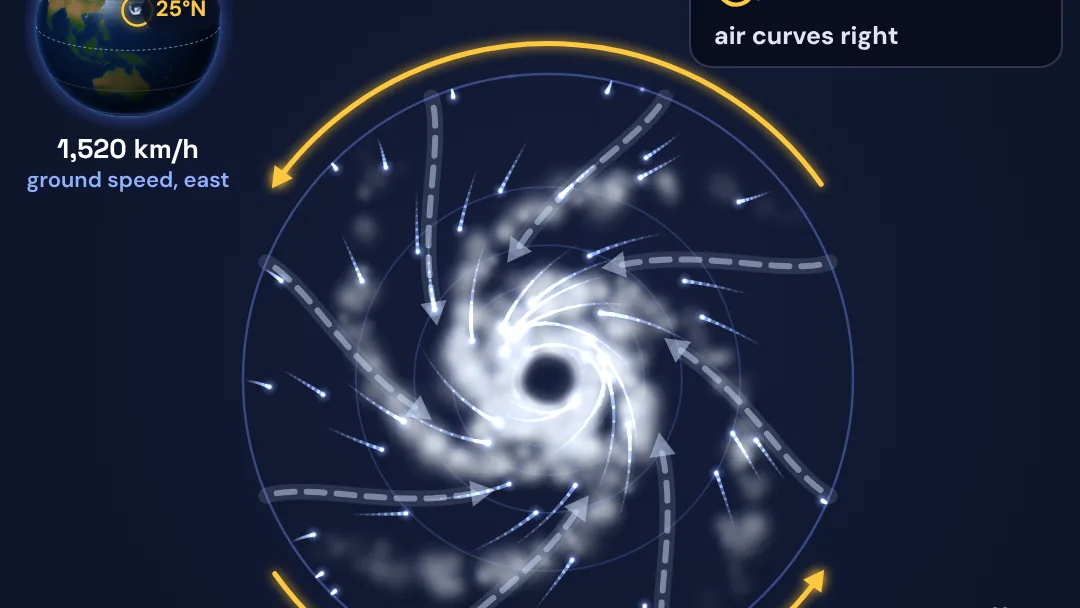
A hurricane is built around a center of low pressure. Air flows from high pressure toward low, so it pours in toward the center from every side. On an Earth that did not turn, it would flow straight in. Nothing would spin.
But Earth turns once a day, and not every place moves at the same speed. The ground at the equator has the longest circle to travel. It moves east at about 1,670 km/h, or about 1,040 mph. At 30 degrees north, the ground moves about 1,450 km/h. At 60 degrees, about 840 km/h. NOAA SciJinks: A Powerful “Force”.
Now send air north, away from the equator. It carries the faster eastward speed of the ground it left. It outruns the ground beneath it and drifts east, which is to its right. Air heading south does the opposite. It reaches faster ground, lags behind and drifts west. Facing south, west is on its right too.
That picture covers air moving north or south. The full effect, called the Coriolis effect, bends air moving in any direction. North of the equator, moving air always curves to its right. Wikipedia: Coriolis force.
If the air curves right, why does the storm turn counterclockwise?
Picture air flowing in from the south, heading north toward the center. It curves right, to the east. So it misses the center and passes on the east side, still heading north. Air from the north curves right too. It passes on the west side, heading south.
Now look from above. Air streams north on the east side and south on the west side. That is a counterclockwise turn. Every stream curves the same way, so the whole storm winds up in one direction. NOAA Hurricane Research Division: Hurricane FAQ.
Why do storms south of the equator spin the other way?
South of the equator, everything flips. Moving air curves to its left, and storms turn clockwise. The model sets the strength of the effect with the Coriolis parameter, f = 2Ω sin φ. Here Ω is Earth's spin rate and φ is the latitude. North of the equator, f is positive. South of it, f is negative. Wikipedia: Coriolis frequency.
Hurricane, typhoon and cyclone are regional names for the same kind of storm. NOAA: What is the difference between a hurricane and a typhoon? A cyclone off Queensland and a hurricane in the Gulf spin as mirror images.
Why don't hurricanes form at the equator?
On the equator, sin φ is zero, so f is zero. Air flowing in from north and south is not pushed sideways at all. It goes straight in, and nothing spins. Close to the equator, the push is too weak to organize a storm.
NOAA's Hurricane Research Division puts the limit at about 300 miles. A storm must be at least that far from the equator for the Coriolis force to create the spin. That is a little over 4 degrees of latitude. The band is often quoted as about 5 degrees. So hurricanes almost never form there. The record exception is Tropical Storm Vamei, which formed at 1.4 degrees north in 2001. Wikipedia: Tropical Storm Vamei.
What does the model leave out?
Storm Spin shows one thing: how Earth's spin turns the inflow. It is sped up and not to scale. A real storm takes hours to turn air inward. Here a puff of air spirals in within seconds. Distances, wind speeds and the eye are not to scale, and the spiral cloud bands are illustrative, not computed. The readouts give the real f and ground speed.
Spin alone does not make a hurricane. A real storm also needs:
- Warm water. An ocean at least about 26.5 °C (80 °F). Wikipedia: Tropical cyclogenesis.
- Moist air and low wind shear. Shear is how much the wind changes with height.
- A starting disturbance. Something for the storm to grow from.
The model also leaves out the storm's drift, Earth's curve across the storm, and friction that changes with height.
Does your sink know which hemisphere it's in?
A popular story says sinks drain one way north of the equator and the other way south of it. You can test it at home. These steps are a suggestion, so adapt them to the child beside you.
Predict. Fill a sink or bathtub, and let the water settle for a minute. Ask your child which way it will swirl when you pull the plug. Will it swirl the same way every time?
Try. Pull the plug and watch the swirl. A few flakes of pepper on the surface make it easier to see. Fill it again, give the water a gentle stir clockwise, and drain it. Then try a counterclockwise stir.
Explain. The swirl follows the stir, and the shape of the basin. A sink is far too small, and drains far too quickly, for Earth's spin to matter. NOAA calls the hemisphere story a myth. In 1962, Ascher Shapiro at MIT did detect Earth's spin in a draining tank 2 meters across. He let the water settle for at least a day first. Wikipedia: Coriolis force.
Back in Storm Spin, turn Earth's spin up to twice its real rate. Predict first: will the spiral wind tighter or looser?
Storm Spin is an ExplainerTools Original.
Sources & further reading
Make the next question an experiment.
Browse independent creators who make big ideas visible.
Find an explainer