Weather · interactive
Why do hurricanes spin?
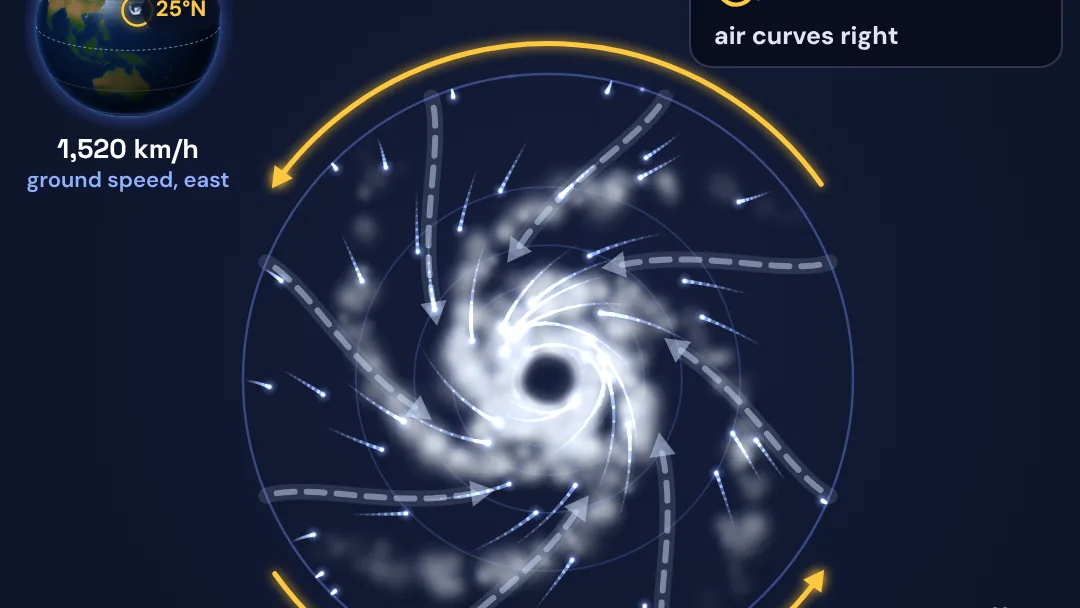
Left: Earth, with your storm marked and arrows for how fast the ground moves east. Right: the storm from above, north up. Tap the storm to release a puff of air; tap or drag the globe to move the storm.
1 See
Hurricanes north of the equator all turn counterclockwise, and those south of it turn clockwise. What sets the direction?
2 Change
3 Understand
Model notes and sources
Model. Air parcels in the storm move in a frame that turns with Earth: dv/dt = −P(r) r̂ − f k̂×v − κv, with the Coriolis parameter f = 2Ω sin φ and Ω = 7.292 × 10⁻⁵ s⁻¹. The pressure pull P(r) comes from a smooth, round low (isobars from an illustrative 960 hPa center inside 1008 hPa surroundings); κ is a simple linear friction that lets air cross the isobars. Each parcel starts at rest on the outer isobar and fades out when it reaches the eyewall at a tenth of that radius, where real air rises. North of the equator f > 0 and the −f k̂×v term pushes moving air to its right; south of it f < 0 and the push is to the left; on the equator f = 0.
Sped up, not to scale. A real storm takes hours to turn air inward; here time and f are scaled together so a parcel spirals in within a few seconds (25° latitude at Earth’s real spin is f = 1.25 per model time unit, about one unit per second on screen). Distances, wind speeds and the eye size are not to scale. The readouts give the real f and ground speed; Earth turns once relative to the stars every 23.93 hours. The spiral cloud bands are illustrative, not computed: logarithmic spirals that wind tighter, and a cloud field that organizes more, as |f| grows. On this page the globe is drawn turning with Earth, so it holds still while the stars drift west; in the film the globe itself turns.
Why air drifts sideways. Ground speed is ΩR cos φ with R = 6,378 km: about 1,674 km/h at the equator (often rounded to 1,670), 1,450 km/h at 30° and 840 km/h at 60°. Air heading north carries the faster eastward motion of the latitude it left (conserving its angular momentum about Earth’s axis, it even speeds up a little), outruns the ground below and drifts east, which is to its right. Air heading south lags the faster ground and drifts west, also to its right. That picture (angular momentum about Earth’s axis) covers north–south motion. The full Coriolis effect also deflects east–west motion, so air moving in any direction curves the same way. The tracks drawn on the globe are schematic and exaggerated.
Not modeled. Warm ocean water (at least about 26.5 °C), moist air, low wind shear and a starting disturbance, which a real storm also needs; the storm’s drift; Earth’s curvature across the storm; and friction that varies with height. Hurricane, typhoon and cyclone are regional names for the same kind of storm. Sinks and toilets are far too small and short-lived for the Coriolis effect to matter: the way they’re filled and shaped decides their swirl.
Near the equator. NOAA’s Hurricane Research Division says a storm must be at least about 300 miles (480 km, a little over 4° of latitude) from the equator for the Coriolis force to create the spin; the band is often quoted as about 5°. So hurricanes almost never form there. The record exception is Tropical Storm Vamei, which formed at 1.4°N in 2001.
Sources: NOAA AOML Hurricane Research Division, Hurricane FAQ: How do tropical cyclones form?; Coriolis frequency; Tropical cyclogenesis; Tropical Storm Vamei. Coastlines: Natural Earth (public domain).
An ExplainerTools Original.