Satellites do not make visible light. They shine by reflecting sunlight. Just after sunset, your ground can be dark while a satellite hundreds of kilometers overhead is still in the Sun.
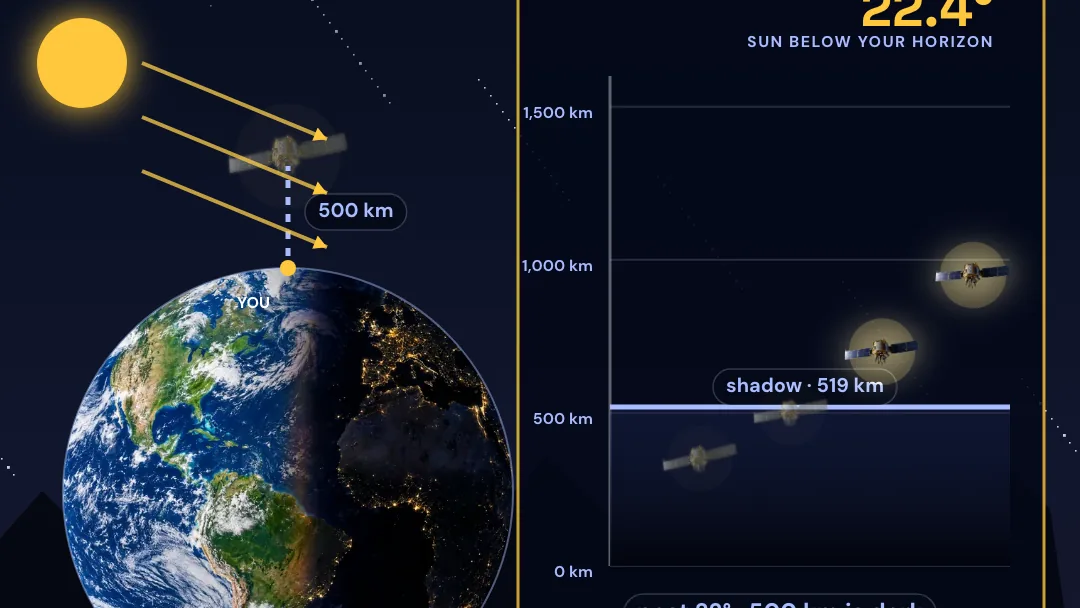
Try it yourself: move the Sun below your horizon and watch Earth’s shadow rise.
When does a 500 km satellite enter shadow?
For an overhead satellite in this spherical-Earth model, shadow begins when the Sun’s depression reaches arccos(R/(R + h)). With Earth radius 6,371 km and altitude 500 km, that is 21.98°, shown as about 22°.
As the Sun moves lower, the shadow reaches higher. Around local midnight most ordinary low-orbit satellites are usually dark; the geometry reverses before dawn.
Does sunlit mean visible?
No. Brightness also depends on size, attitude, distance, phase angle, atmosphere and sky glow. Season, latitude, orbit plane and the satellite’s position also change the real timing.
The model leaves out penumbra, refraction, the Sun’s angular size, non-overhead passes and orbital motion during the night. Its altitude chart is exaggerated for clarity.
Sources: The Aerospace Corporation, Satellite Light Pollution; NASA Earth Observatory, Satellite Orbits; NOAA, Understanding Orbits.

Sources & further reading
Make the next question an experiment.
Browse independent creators who make big ideas visible.
Find an explainer