Space · interactive
Why do satellites shine after sunset?
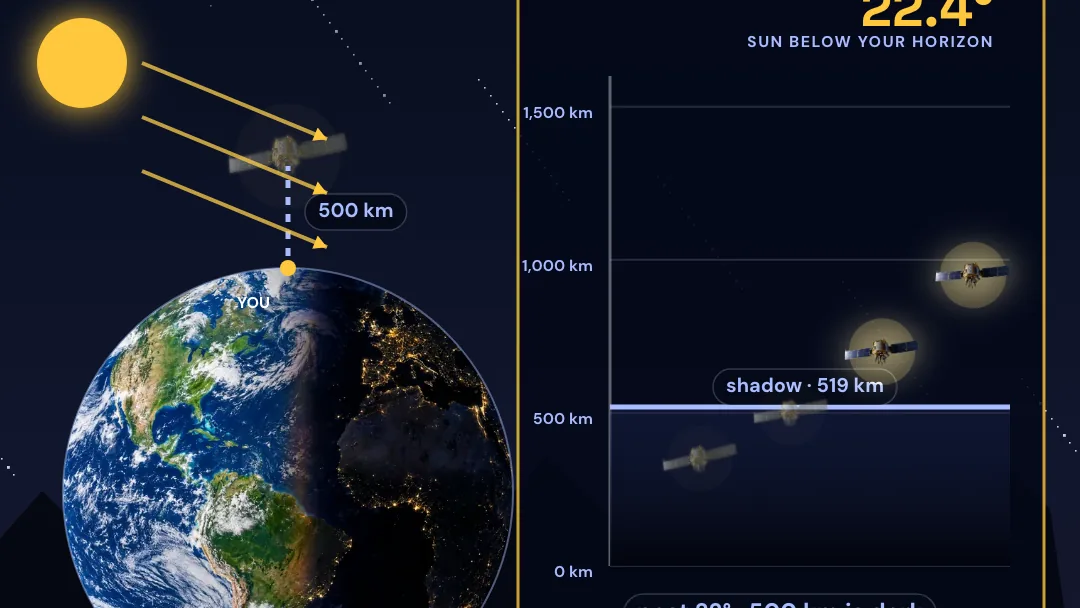
Satellites reflect sunlight. Move the Sun deeper below your horizon and watch Earth's shadow rise through low orbit.
1 See
Your ground can be dark while a satellite hundreds of kilometers above you still sees the Sun and reflects it back.
2 Change
3 Understand
Model notes and sources
Geometry. Earth is a sphere of radius 6,371 km and the model satellite is directly above the observer at altitude h. Ignoring the Sun's size and atmosphere, it enters Earth's cylindrical shadow when the Sun's depression reaches arccos(R/(R + h)). At 500 km that is 21.98°, shown as about 22°.
Night. As the Sun moves farther below the local horizon, Earth's shadow reaches higher above the observer, so successively higher lines of sight go dark. Around local midnight most ordinary low-orbit satellites are usually in shadow; season, latitude, orbit plane and where the satellite is along its orbit can change that. The before-dawn geometry mirrors dusk.
Visibility. Sunlit does not guarantee visible. Brightness also depends on size, attitude, distance, phase angle, atmosphere and sky glow. “Starlink about 500 km up” is a rounded example; shells and operational altitudes vary.
Not modeled. Earth's penumbra, atmospheric refraction, the Sun's angular diameter, non-overhead passes, orbital motion during the night, latitude and seasonal geometry, satellite attitude and apparent magnitude. The Earth and satellite art are reused AI-generated illustrations from GPS Lab; the dusk sky, rays, shadow, altitude chart and numbers are drawn in code. The chart's altitude scale is exaggerated for clarity.
Sources: The Aerospace Corporation, Satellite Light Pollution; NASA Earth Observatory, Catalog of Earth Satellite Orbits; NOAA, Understanding Orbits.
An ExplainerTools Original.