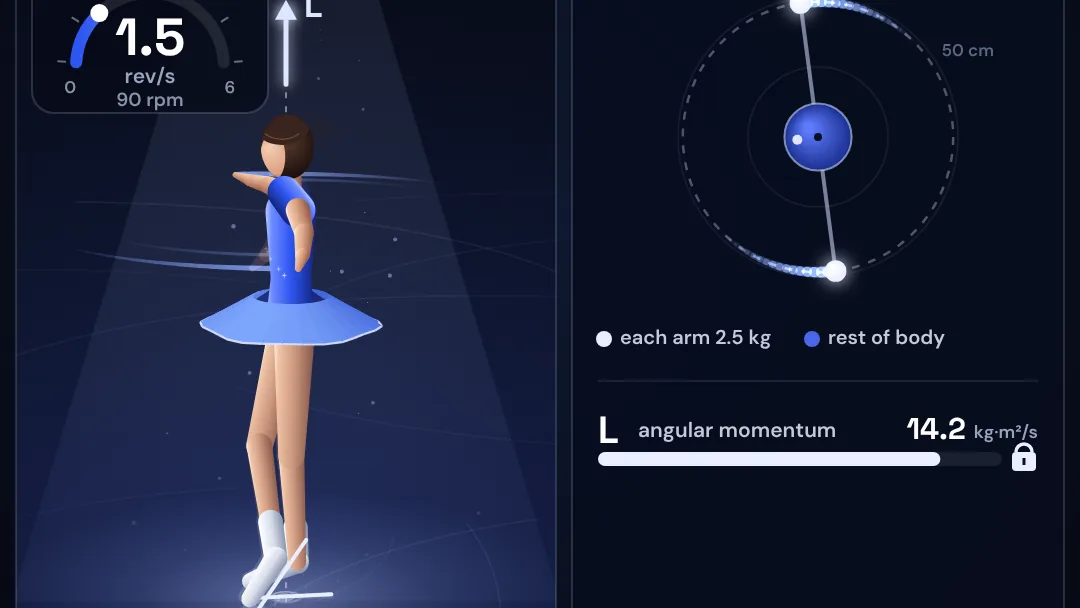
At the end of a figure-skating program, a skater often enters a spin with her arms held wide. Then she pulls them in, and she blurs. Nobody pushed her, and nothing on the ice sped her up. All she changed was where her arms were.
Try it yourself in Spin Lab: drag her arms in and watch her spin rate climb while her angular momentum stays locked.
If nothing pushes her, where does the speed come from?
A spinning body carries what physicists call angular momentum. It depends on two things: how fast the body turns, and how far its mass sits from the axis. Written out, it is L = I × ω. Here ω is the spin rate. I, the moment of inertia, measures how far out the mass is spread.
Only an outside twist can change angular momentum. Skates on smooth ice feel very little friction, so a spinning skater gets almost no outside twist. Her angular momentum stays nearly constant. When her moment of inertia drops, her spin rate has to rise to make up for it. OpenStax: Angular Momentum and Its Conservation.
Why do her arms matter so much?
Each bit of mass counts by the square of its distance from the axis. Move it twice as far out, and it counts four times as much. So a little mass far from the middle can outweigh a lot of mass close in.
Spin Lab builds a 55 kg skater from body segments, using average segment masses from a 1996 biomechanics study. Each arm is about 2.5 kg, less than a twentieth of her mass. Held out wide, that mass sits about 48 cm from the axis. There, her two arms make up about three quarters of her moment of inertia. de Leva (1996), Journal of Biomechanics.
Hug them in to about 19 cm, and her moment of inertia falls from 1.51 to 0.55 kg·m². That is 2.8 times less, so she spins 2.8 times faster.
How fast can a skater really spin?
In our film and in Spin Lab, she enters the spin at 1.5 turns a second with her arms wide. Hugging in takes her to about 4.1 turns a second, or 249 rpm. With her arms straight overhead, her mass sits even closer to the axis, and she reaches 5.5 turns a second. These are the model's estimates, not measurements.
Real skaters reach the same range. The best upright spinners have managed up to about five revolutions a second. Wikipedia: Figure skating spins. The Guinness record is 342 rpm, about 5.7 turns a second. Canada's Olivia Oliver set it in Warsaw in 2015. Guinness World Records: Fastest spin on ice skates.
It works in reverse too. In a camel spin, the torso and free leg stretch out level with the ice. That raises her moment of inertia to about 6.7 kg·m², more than four times the arms-wide pose. With the same angular momentum, she slows to about a third of a turn a second. To spin fast in a camel, a skater has to push into it much harder.
Where does the extra energy come from?
A faster spin carries more energy of motion. In the model, her spin energy rises from 67 to 185 joules when she hugs her arms in. Her angular momentum stays the same, but her energy does not.
The extra comes from her own muscles. Pulling her arms in against the spin takes work, and that work becomes spin. When she opens her arms again, the energy flows back out of the spin, and she slows to where she started. OpenStax: Conservation of Angular Momentum.
What does the model leave out?
Spin Lab treats the skater as rigid body segments on ideal ice. Its numbers describe one modeled skater, not any real athlete. It leaves out or simplifies:
- Friction. Real ice and air slowly drain a spin. The model switches friction off by default. Its Friction knob adds a steady opposing twist. When the spin has nearly died, the skater pushes off the ice again. That push is an outside twist, the only way she can gain angular momentum.
- Real movement. Real arms sweep in along a curve rather than jumping into place. Real skaters also wobble and drift across the ice.
- Smaller details. The skates' mass and the way muscles move the arms are left out. The skater is drawn in a stylized way, though her spin plays in real time.
Can you feel it on an office chair?
This experiment comes from the Exploratorium's Momentum Machine activity. These steps are a suggestion, so adapt them to the child beside you. You need a chair that swivels freely, two full water bottles and a partner. Clear some space, keep the pushes gentle and stop if anyone feels dizzy.
Predict. Sit with a bottle in each hand and your arms stretched out. Ask your child what will happen when you pull the bottles to your chest. Will you speed up, slow down or stay the same?
Try. Lift your feet. Have your partner start you turning slowly, then step back. Pull the bottles in, then push them out again. Then swap places.
Explain. A good swivel chair has little friction, so your angular momentum stays nearly constant. Pulling the bottles in brings their mass close to the axis, so you turn faster to make up for it. The bottles play the part of the skater's arms. Exploratorium: Momentum Machine.
Then go back to Spin Lab with one more question. How hard would the skater have to push off to beat the 342 rpm record? Drag her arms overhead, then turn up the entry spin a little at a time and find out.
Spin Lab is an ExplainerTools Original.
Sources & further reading
- OpenStax, College Physics 2e, §10.5 Angular Momentum and Its Conservation
- OpenStax, University Physics Volume 1, §11.3 Conservation of Angular Momentum
- de Leva (1996), Adjustments to Zatsiorsky–Seluyanov's segment inertia parameters, Journal of Biomechanics
- Wikipedia, Figure skating spins
- Guinness World Records, Fastest spin on ice skates
- Exploratorium, Momentum Machine (Science Snack)
Make the next question an experiment.
Browse independent creators who make big ideas visible.
Find an explainer