Motion · interactive
Why do skaters spin faster with their arms in?
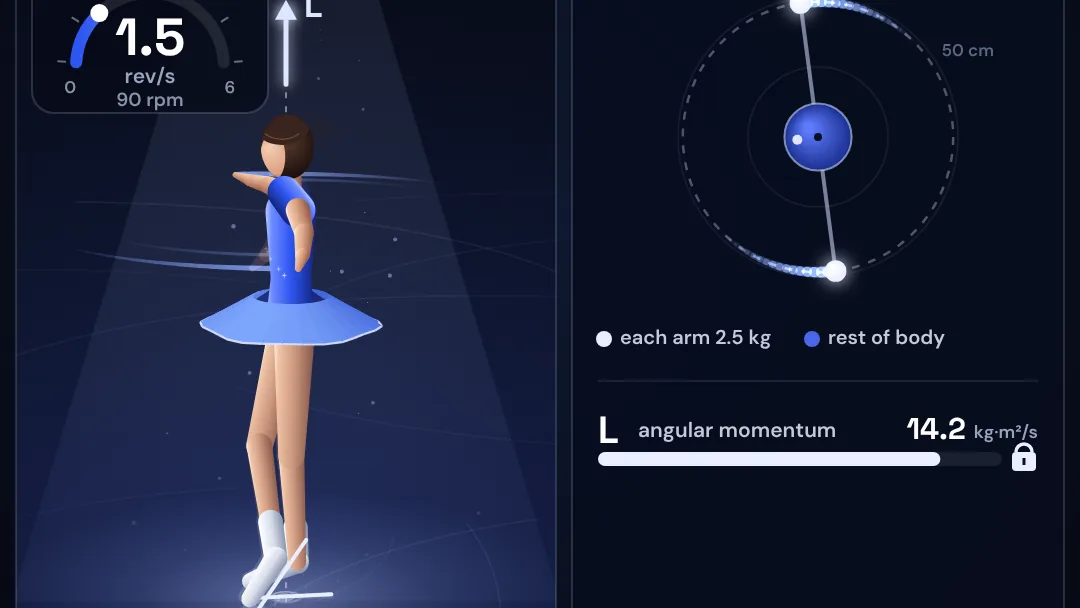
Left: the skater, spinning in real time. Right: the same spin from above, with each arm as one lump of mass at radius r, and the three numbers that are linked by L = I × ω.
1 See
A skater pulls her arms in and suddenly blurs. Nothing outside pushed her. So where does the extra speed come from?
2 Change
3 Understand
Model notes and sources
Model. A 55 kg, 1.65 m skater built from rigid segments: head, trunk, upper arms, forearms, hands, thighs, shanks and feet, with de Leva’s (1996) average female segment masses. Each arm is 2.5 kg, about 4.5% of her mass. Limb segments are uniform rods, the head is a sphere and the trunk an elliptical cylinder 30 × 20 cm. Her moment of inertia about the vertical axis through her center of mass is I = Σ m r², summed over the segments, so the drawing and the numbers come from the same body. The top view shows each arm as one lump at its radius of gyration, r = √(Iarm / marm).
Equations. With no outside twist (no net external torque), angular momentum L = I ω stays constant, so ω2 = ω1 · I1 / I2. Spin energy is K = ½ I ω² = L² / 2I, so it rises by the same factor I1 / I2. The extra energy is work her arm muscles do pulling the arms in against the spin. Putting the arms back out returns it, and the spin slows to where it started.
Fixed values. Arms out wide: I = 1.51 kg·m², with the arm mass at r ≈ 48 cm. Hugged in: I = 0.55 kg·m² (r ≈ 19 cm), 2.8× less. Arms overhead: I = 0.41 kg·m². Camel, with the torso and free leg level and the arms out: I ≈ 6.7 kg·m². The film and the default entry spin at 1.5 rev/s with the arms wide (L = 14.2 kg·m²/s), so hugging in takes her to 4.1 rev/s (249 rpm) and arms overhead to 5.5 rev/s (329 rpm). Her spin energy goes from 67 J to 185 J when she hugs in. These are this model’s estimates, not measurements. For comparison, the best upright spinners have reached up to about five revolutions a second, and the Guinness record is 342 rpm (5.7 rev/s), set by Olivia Oliver in Warsaw in 2015. The OpenStax textbook example is more generous: 2.34 → 0.363 kg·m², taking a 60 kg skater from 0.80 to 5.16 rev/s.
Not modeled. Ice friction and air drag are off by default. The Friction knob adds a constant opposing torque that drains L; when the spin has nearly died, the skater pushes off the ice again, an outside twist and the only way to gain L. Also left out: wobble and drift across the ice, the skates’ mass, how muscles move the arms, and the fact that real arms spiral in rather than moving instantly. The skirt flares at the conical-pendulum angle tan φ = ω² r / g. The skater is stylized, and the spin is shown in real time.
Sources: OpenStax, University Physics Volume 1, §11.3 Conservation of Angular Momentum; OpenStax, College Physics 2e, §10.5, Example 10.14; P. de Leva, “Adjustments to Zatsiorsky–Seluyanov’s segment inertia parameters”, Journal of Biomechanics 29, 1223–1230 (1996); Figure skating spins (Wikipedia); Fastest ice skating spin (Guinness World Records).
An ExplainerTools Original.