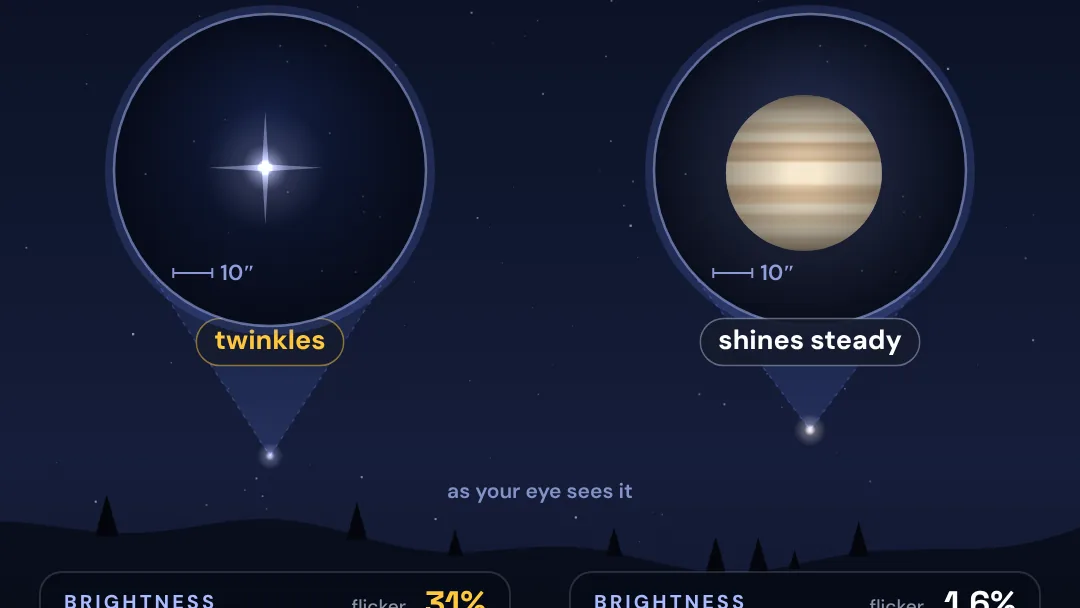
On a clear night, a bright star low in the sky looks restless. It flickers, flares and sometimes flashes red or blue. A planet at the same height shines with a calm, steady light. Both shine through the same air. The difference is how big each one looks.
Try it yourself in Twinkle Lab: grow the dot from a star into Jupiter's disk and watch the flicker average away.
What makes starlight flicker?
Air is never perfectly still. Pockets of warm and cool air drift and churn all the way up. Warm air bends light a little less than cool air, so each pocket acts like a weak lens. Hong Kong Observatory: Why do stars twinkle?.
Wind carries these lenses across the path of the starlight. One moment a pocket gathers a little extra light into your eye. The next, it spreads some away. The star seems to brighten and dim many times a second. Astronomers call this scintillation. Most of us call it twinkling. Wikipedia: Twinkling.
Stars are suns, but extremely far away. Sirius, the brightest star in the night sky, spans about 0.006 arcseconds. An arcsecond is 1/3,600 of a degree. The full Moon spans about half a degree, so it looks about 300,000 times wider than Sirius. Wikipedia: Angular diameter.
All the light from such a tiny point crosses the same pockets of air on its way to you. When a pocket shifts, it shifts all of the star's light at once. Nothing smooths out the change, so the whole star flickers together.
Why do planets shine steady?
Planets are much closer, so they are tiny disks instead of points. Jupiter spans 30 to 50 arcseconds, depending on where it and Earth are in their orbits. NASA: Jupiter Fact Sheet. To your eyes alone it still looks like a point. To the air, it is several thousand times wider than Sirius.
Each small patch of that disk sends its own light through its own pockets of air. Each patch twinkles, but in its own way. When one brightens, another dims. Added together, the flickers mostly cancel. Hong Kong Observatory.
Twinkle Lab assumes that air bends light the same way across a patch of sky about 2 arcseconds wide. Jupiter's 40-arcsecond disk covers about 400 such patches. Averaging 400 independent flickers shrinks them about twenty times. At 30 degrees up, the model's star flickers by about 31%, and Jupiter by under 2%. Those values are illustrative, not measurements.
Why do stars twinkle more near the horizon?
Overhead, starlight takes the shortest path through the air. Lower down, it comes in at a slant and crosses far more. Astronomers call this amount the air mass. It is about 2 at 30 degrees above the horizon and about 38 at the horizon itself. Wikipedia: Air mass.
More air means more pockets to cross, so low stars twinkle harder. Low in the sky, the air also acts as a weak prism. It bends blue light a little more than red, spreading a star into a tiny spectrum. Wikipedia: Atmospheric refraction. Its red and blue light then cross slightly different pockets and flicker separately. Those are the color flashes.
Can a planet twinkle?
Yes. "Stars twinkle, planets don't" is a good rule of thumb, but it can fail. Very low near the horizon, a planet's light crosses so much air that even a disk can shimmer. Mars can twinkle too. At its farthest from Earth, it spans only about 3.5 arcseconds. NASA: Mars Fact Sheet.
In the model, a disk that small covers only about four patches of air. That is too few to average out, so far-off Mars flickers almost like a star. Near its closest, Mars grows to about 25 arcseconds and settles down.
What does the model leave out?
Twinkle Lab is a simplified model of scintillation. Its numbers are illustrative, not measurements of any real night. It leaves out:
- Changing air. Real turbulence sits at different heights and strengths, and it changes from night to night. The model fixes the patch size at 2 arcseconds and a star's flicker overhead at 12%.
- Phases. Venus and Mars are drawn as full disks.
- Telescopes. A wide telescope collects light through more of the air at once, which averages twinkling further.
- Your eye. How the eye and brain respond to fast flicker is not modeled.
The brightness traces are slowed down, because real twinkling is too quick to follow. The side view is not to scale. Real bending is only a few arcseconds, so the drawing exaggerates it hugely.
Can you spot a planet by its steady light?
All you need is a clear night and a spot away from bright lights. These steps are a suggestion, so adapt them to the child beside you. NASA's monthly What's Up video points out planets worth looking for.
Predict. Find two bright points, one high in the sky and one low. Ask your child which will twinkle more. Then ask how you might tell a planet from a star.
Try. Watch each point for a full minute. Look for flickers, color flashes and tiny jumps. A bright point that barely flickers, especially one well above the horizon, is likely a planet. If you have binoculars, brace them against a wall or fence. A planet shows a small disk, while a star stays a point.
Explain. The low star's light crosses more churning air, so it twinkles harder. The planet's disk sends light through many different pockets, and their flickers cancel. The star's light crosses one set of pockets, so every wobble shows.
Back in Twinkle Lab, keep Jupiter's disk and drag its light down toward the horizon in the side view. Predict the height where even a planet starts to shimmer, then watch for it.
Twinkle Lab is an ExplainerTools Original.
Sources & further reading
Make the next question an experiment.
Browse independent creators who make big ideas visible.
Find an explainer