Sky · interactive
Why do stars twinkle but planets don’t?
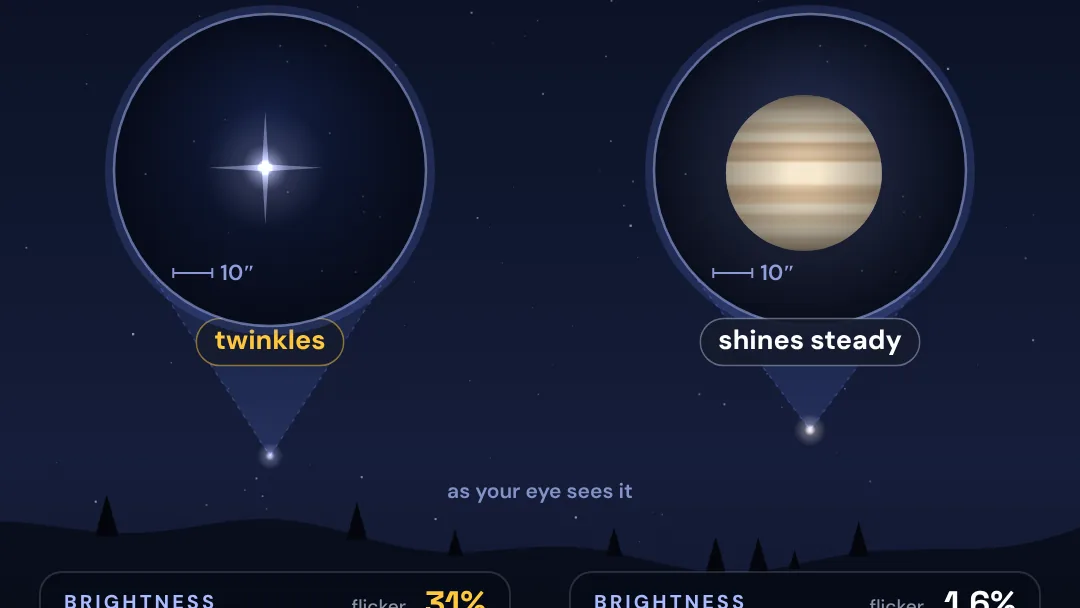
Top: a star and your object, magnified, with their brightness over time. Bottom: your object’s light crossing drifting pockets of warm and cool air. Drag in the side view to change its height.
1 See
Same sky, same air. So why does a star flicker and flash while Jupiter shines steady?
2 Change
3 Understand
Model notes and sources
Model. Pockets of warm and cool air bend light like weak, moving lenses. All the light from a single point crosses the same pockets, so its brightness at your eye rises and falls together. We treat a point’s brightness as log-normal noise with rms flicker σpt. A source of angular size α covers about N ≈ 1 + (α/θ₀)² independent patches, and each twinkles on its own, so their sum flickers by σ = σpt / √N. The noise is deterministic: three layers of seeded value noise, each carried sideways by its own wind and slowly churning. A point’s flicker comes from how strongly the pockets along its line of sight focus or spread its light; each extra point of a disk samples its own independent patch of sky.
Fixed values. θ₀ = 2″, a typical isoplanatic angle (the patch of sky over which turbulence bends light the same way). Real values change with how high the turbulence sits and from night to night; here θ₀ is the same at every height. σpt = 12% straight overhead. That is an illustrative naked-eye value, not a measurement. It grows with the air crossed X as X1.5 (the classic small-aperture result, scintillation variance ∝ X³) and saturates near 80% at the horizon. X comes from the Kasten–Young air-mass formula: 1 overhead, about 2 at 30°, about 10 at 5° and about 38 at the horizon. Color flashes (the air spreads low starlight into a tiny spectrum, so red and blue cross slightly different pockets) and position wobble use their own noise and grow toward the horizon. In the magnified views the wobble is drawn 3× larger than the model.
Sizes. Jupiter 30–50″ across; Venus about 10–66″; Mars 3.5–25.6″ (NASA fact sheets). Sirius is about 0.006″ and Betelgeuse, one of the largest-looking stars, about 0.05″; Vega is about 0.003″ (from its measured radius, 2.7 solar radii, and its distance). Every star is far smaller than θ₀, so every star is a point here. The presets put Sirius 15° up, Vega 88° up, Jupiter 40° up, Mars 35° up and Venus 8° up.
Planets can twinkle too. Very low near the horizon, a planet’s light crosses so much air that even a disk can shimmer; and Mars twinkles when it is far from Earth and only about 3.5″ across. The model shows both. Real twinkling changes many times a second, so the traces are slowed down. The side view is not to scale: the bending is hugely exaggerated (real angles are a few arcseconds), and so is the fan of bundles from a disk, so you can see each one cross different pockets. Each bundle is the light that reaches your eye; it is drawn wider when its pockets gather light into your pupil and narrower when they spread it. The film keeps the light 30° above the horizon and grows the dot from 0.006″ to 40″.
Not modeled. How turbulence height and strength change θ₀ and σpt; the phases of Venus and Mars (disks are drawn full); telescopes, whose wide apertures average twinkling further; and how the eye itself responds to fast flicker.
Sources: Twinkling; Angular diameter; NASA, Jupiter fact sheet (also the Mars and Venus fact sheets); Astronomical seeing; Air mass (astronomy); A. T. Young (1967), Photometric error analysis VI: confirmation of Reiger’s theory of scintillation, Astronomical Journal 72, 747.
An ExplainerTools Original.