Pour a glass of ice water on a muggy afternoon, and soon its outside turns cloudy. Then drops gather and run down to the table. It looks as if the glass is leaking. It isn't. Look closely and the fog stops at the waterline, right where the cold stops. The water is coming out of the air.
Try it yourself in Dew Point Lab: drag the humidity down and watch the droplets on the glass dry up.
Where does the water come from?
Air carries water as an invisible gas, called water vapor. When air cools, less of that vapor can stay a gas. Cool it enough, and the extra vapor turns back into liquid water. That's what coasters are for. USGS: Condensation and the Water Cycle.
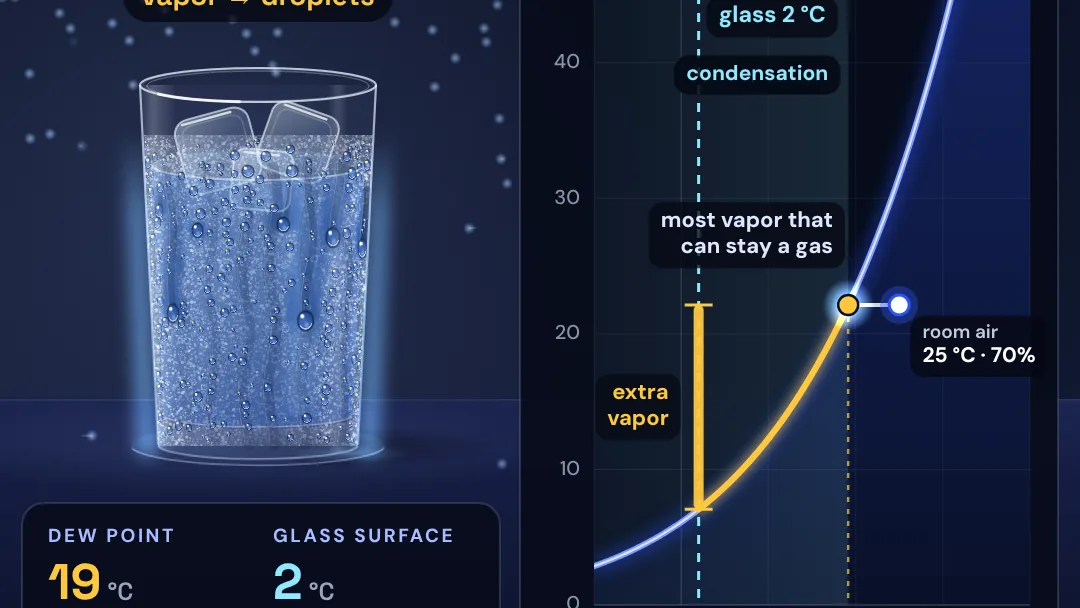
Your glass does the cooling. The thin layer of air touching it chills to nearly the temperature of the glass. If that's cold enough, droplets form right on the surface. Water that condenses onto a cold surface this way is called dew. Wikipedia: Dew point.
What is the dew point?
The dew point is the temperature air must be cooled to, at constant pressure, before it is saturated. Saturated air holds all the vapor it can keep as a gas. Cool it further, and vapor must condense. National Weather Service: Dew Point vs Humidity.
How much vapor air can keep rises steeply with temperature, by about 7% for each degree Celsius. Wikipedia: Clausius–Clapeyron relation. So warm, humid air has a high dew point, and dry air has a low one.
Take a 25 °C (77 °F) room at 70% humidity, as in our film. Its dew point is about 19 °C (66 °F). The outside of an ice-water glass sits near 2 °C (36 °F). Air at 2 °C can keep only about a third of the vapor that the room air carries. The rest condenses on the glass.
Why does a glass sweat only on some days?
On a dry day, the dew point drops. It can fall below the temperature of the glass. Then the chilled air never reaches saturation, and the glass stays dry. In the film, the humidity drops to 15%. The dew point falls to about −3 °C (27 °F), colder than the glass, so nothing condenses.
In Dew Point Lab's model, an ice-water glass in a 25 °C room starts to sweat once the humidity tops about 22%. A heated room in winter can be drier than that. At 21 °C and 20% humidity, the dew point is about −3 °C, and the glass stays dry.
This is why weather reports often give the dew point. Relative humidity depends on the air temperature too. With the same moisture, it peaks in the early morning and dips in the afternoon. The dew point tracks the moisture itself. National Weather Service: Discussion on Humidity.
It is also a good guide to how sticky a summer day feels. The National Weather Service in La Crosse, Wisconsin, calls a dew point of 55 °F (13 °C) or lower dry and comfortable. At 65 °F (18 °C) or higher, the air becomes oppressive. Our film's room, with a dew point of 66 °F, crosses that line.
Where else does the air leave water behind?
The same thing fogs a bathroom mirror after a hot shower. In Dew Point Lab's steamy-bathroom preset, the dew point is about 29 °C. Even a glass of tap water at 18 °C fogs up. Eyeglasses fog the same way when you walk into a warm room from the cold.
People have studied it with a cold glass for a long time. In the 18th century, Charles Le Roy tried to measure the dew point by pouring cold water into a glass container. Wikipedia: Dew point.
What does the model leave out?
Dew Point Lab's biggest assumption is the temperature of the glass. The model sets its outside a little warmer than the drink. For ice water, that's about 0 to 3 °C. Real glasses vary with wall thickness, ice and stirring. The model also leaves out:
- The heat of condensing. Vapor releases heat as it condenses, which warms the glass slightly.
- Moving air. Drafts around the glass, and the drink warming as its ice melts.
- The glass itself. A greasy or coated glass fogs as a film instead of beads.
- Frost. Below 0 °C, frost forms instead of dew. The model's glass never gets that cold.
The droplets are shown in time-lapse and are illustrative. The vapor dots are a picture of an invisible gas, not a count of molecules.
Can you find the dew point in your kitchen?
A metal can, some ice and a thermometer are enough. This version comes from the University of Wisconsin–Madison's Wonders of Physics. These steps are a suggestion, so adapt them to the child beside you.
Predict. Fill a metal can about three-quarters full with room-temperature water. Ask your child how cold the water must get before the outside of the can fogs. Write the guess down.
Try. Put a thermometer in the water. Stir in ice a little at a time, and watch the outside of the can. Read the thermometer the moment the shiny side first turns cloudy.
Explain. That reading is the dew point of the air in your kitchen. Compare it with the dew point in your local weather report. On a dry winter day, it may not work. The dew point can be below freezing, and the water can't get that cold. Try a steamy bathroom instead. UW–Madison Wonders of Physics: Home Meteorology.
Back in Dew Point Lab, try the desert-afternoon preset: 40 °C, with only 10% humidity. Predict first: will an ice-water glass sweat in the desert? Then drag the humidity up a notch at a time, and watch for the first fog.
Dew Point Lab is an ExplainerTools Original.
Sources & further reading
- National Weather Service, La Crosse: Dew Point vs Humidity
- National Weather Service, Louisville: Discussion on Humidity
- USGS Water Science School, Condensation and the Water Cycle
- Wikipedia, Dew point
- Wikipedia, Clausius–Clapeyron relation
- University of Wisconsin–Madison, The Wonders of Physics: Home Meteorology
Make the next question an experiment.
Browse independent creators who make big ideas visible.
Find an explainer