Weather · Water · interactive
Why does a cold glass sweat?
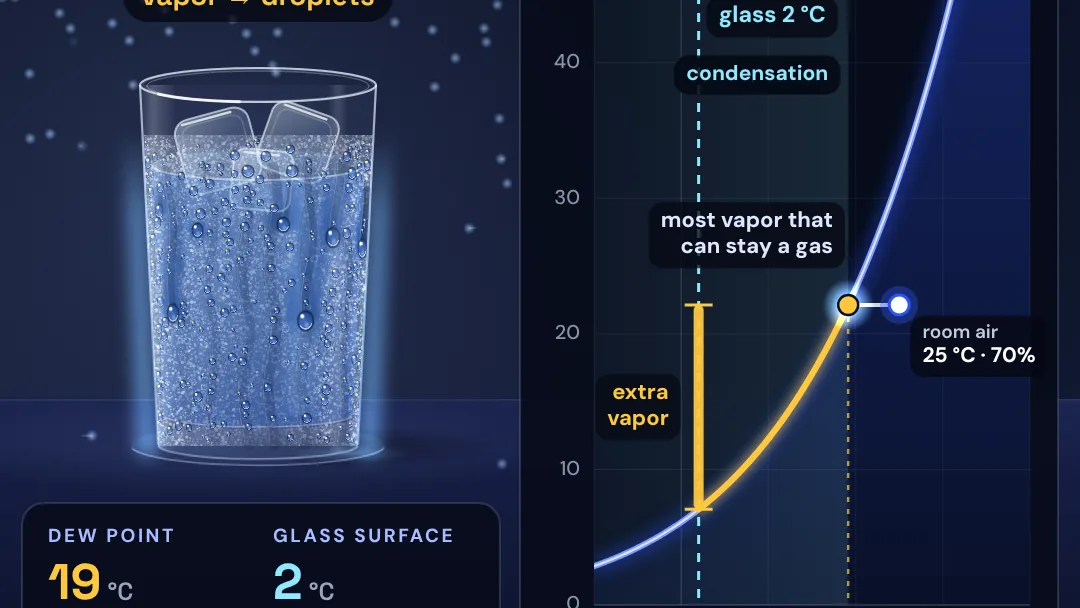
Left: the glass, in time-lapse. Right: the air touching it, cooled from room temperature toward the glass. Drag the room-air dot or the dashed glass line on the chart.
1 See
Nothing leaks through the glass, yet its outside gets wet. Where does that water come from, and why only on some days?
2 Change
3 Understand
Model notes and sources
Dew point. Air at temperature T (°C) and relative humidity RH carries water vapor at a partial pressure e = (RH/100)·es(T), where es is the saturation vapor pressure over water, from the Magnus formula with the Alduchov & Eskridge (1996) coefficients: es(T) = 6.1094·exp(17.625·T / (243.04 + T)) hPa. That curve is the most vapor that can stay a gas at each temperature. Cooling air at constant pressure keeps e fixed, so on the chart it moves straight left until it meets the curve at the dew point, Td = bγ / (a − γ) with γ = ln(RH/100) + aT / (b + T), a = 17.625 and b = 243.04 °C. Air cooled further must shed the extra vapor (e − es) as liquid. The coefficients were fitted for −40 to 50 °C. Worked examples: 30 °C at 70% → 23.9 °C; 25 °C at 50% → 13.9 °C; 22 °C at 30% → 3.6 °C; 25 °C at 20% → 0.5 °C; 21 °C at 20% → −2.8 °C; 40 °C at 10% → 2.6 °C.
The glass. The glass sweats when its outside surface is colder than the dew point. The surface temperature is a model assumption: drink temperature + 8% of the room–drink difference, which keeps the outside of an ice-water glass at about 0–3 °C (2 °C in a 25 °C room), in line with the roughly 0–5 °C usually assumed for it. Real glasses vary with wall thickness, ice and stirring. Only the part below the waterline is cold, so that is where the fog forms. In the 30-second film the room is 25 °C with an ice-water glass, and the humidity drops from 70% (dew point 19 °C) to 15% (dew point −3 °C).
Droplets. The droplets are illustrative and shown in time-lapse, faster when the vapor difference is small. They nucleate and grow at a rate proportional to e − es(Tglass) (shrinking when it is negative), merge when they touch, and run down once they are a few millimeters across, as in dropwise condensation. The faint fog is droplets too small to draw one by one. The vapor dots are a picture of an invisible gas: their number follows the vapor pressure, not real molecule counts.
Not modeled. The heat released by condensation, which warms the glass slightly; drafts and air flow around the glass; the drink warming as the ice melts; how clean the glass is (a greasy or coated glass fogs as a film rather than beads); and frost. Below 0 °C the frost point over ice applies, but here the glass never goes below 0 °C. Dew points below 0 °C use the curve over supercooled water.
Sources: Dew point (Wikipedia, Magnus formula and coefficients); Clausius–Clapeyron relation (Wikipedia, August–Roche–Magnus formula); O. A. Alduchov and R. E. Eskridge, Improved Magnus form approximation of saturation vapor pressure, Journal of Applied Meteorology 35, 601–609 (1996); US National Weather Service, Dew point vs. humidity and A discussion of water vapor, humidity and dewpoint.
An ExplainerTools Original.