Pass a slower car on the highway, and watch it against the hills beyond. For a moment, it seems to slide backward, though it is still driving forward. Mars does the same thing in the night sky. Most nights, it drifts slowly east against the stars. But every two years or so, it stops, loops back west for two or three months, then carries on.
Try it yourself in Mars Loop: drag the date to February 19, 2027 and watch Earth pass Mars on the inside track.
Is Mars really moving backward?
No. Mars never stops moving forward around the Sun. We are overtaking it. Earth is on the inside track, closer to the Sun, and it moves faster. On average, Earth covers 29.78 km every second and Mars 24.08 km. Earth's lap is shorter, too. NASA: Mars Fact Sheet.
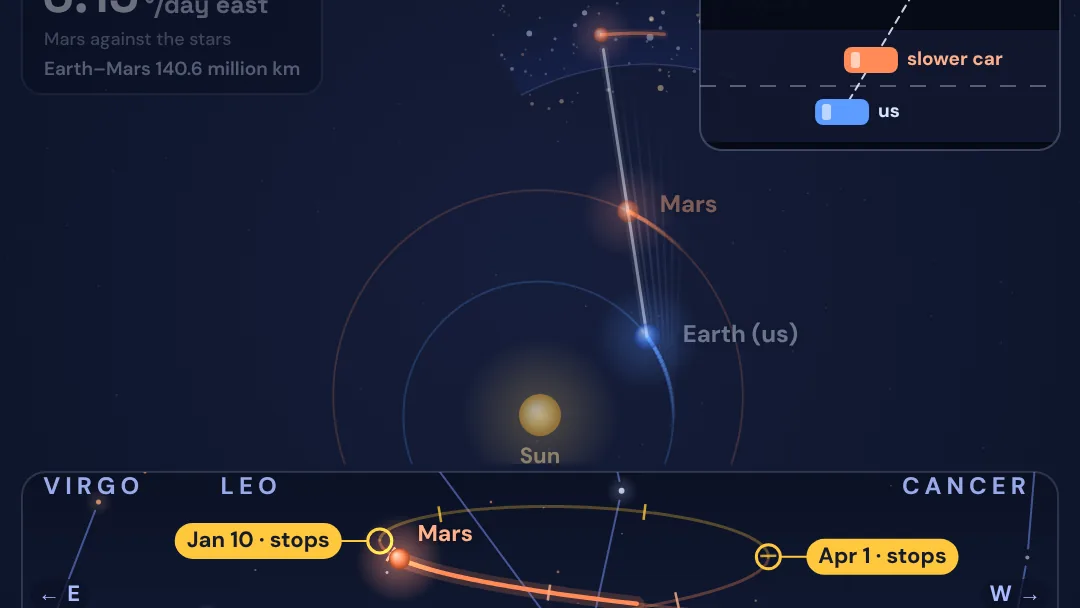
We see Mars along a line of sight, from Earth through Mars to the distant stars. Most of the time, that line swings east as Mars moves along. As Earth catches up and passes, our own motion swings the line back west. Mars seems to slip backward. Once we pull ahead, it drifts east again. Astronomers call this apparent retrograde motion. Wikipedia: Apparent retrograde motion.
Tunc Tezel caught one of these loops in 2003, by stacking sky photos so the stars line up. NASA APOD: Retrograde Mars.
For centuries, Earth-centered models explained the loops with circles riding on circles, called epicycles. The loops were not understood as an illusion until Copernicus, in the 1500s.
Why does it happen every two years or so?
Earth goes around the Sun once a year. Mars takes 687 days. So Earth gains on Mars slowly, and laps it about every 780 days, a little over two years. Each time we pass, Mars makes another backward loop. NASA: Mars Fact Sheet.
By then, Mars has moved on along its orbit. So each loop lands in a different part of the sky. The 2027 loop sits entirely inside the constellation Leo.
When is the 2027 loop?
All dates and times here are in UTC. Mars spends late 2026 in the morning sky, drifting east into Leo. ALPO: The 2026–2027 Aphelic Apparition of Mars. Its drift slows, and on January 10, 2027, it stands still against the stars. Then it slides west for 81 days, about 19.5 degrees in all. On April 1, it stands still again and turns back east.
The loop sits a few degrees north of Regulus, the brightest star in Leo, and stretches past it to the east and west. That makes Regulus a handy marker. Sketch Mars beside it once a week from January to April, and your sketches will trace the loop. Wikipedia: Regulus.
Earth passes Mars at opposition, on February 19, 2027, at about 15:40 UTC. The Sun, Earth and Mars line up, with Mars opposite the Sun. Around then, Mars rises near sunset and stays up all night. It is also in the middle of its loop, slipping west at its fastest. Wikipedia: Opposition (astronomy).
The two planets come closest about eight and a half hours later, early on February 20. Mars is then 101.4 million km away. That is a distant pass. Mars is near the far point of its orbit, moving at only 22.0 km/s, while Earth moves at 30.1. On the best passes, Mars comes within about 55 million km. ALPO; NASA: Mars Fact Sheet.
What does the model leave out?
Mars Loop computes both orbits from the orbital elements JPL publishes for the years 1800 to 2050. Its dates agree with JPL's full ephemeris to within about an hour. Mars's position stays within about an arcminute, far finer than your eye can see. JPL: Approximate Positions of the Planets. Every star on its sky strip is real, from the Yale Bright Star Catalogue. Still, the model simplifies:
- Sizes. The orbits are drawn to scale. The Sun and the planet dots are not.
- A stretched sky. The sky strip is stretched to twice its real height so the loop's shape shows. The real loop is much flatter. East is on the left, as when you face south from the northern hemisphere.
- Small effects. The slow wobble of Earth's axis, the Moon's tug on Earth and the stars' own motions are left out.
- Your local sky. It shows where Mars sits among the stars, not how high it climbs above your horizon. That depends on where you live and the time of night.
Can you act out the loop?
You can stage a backward loop in a park or an empty field. These steps are a suggestion, so adapt them to the child beside you. Put a ball or a backpack in the middle to be the Sun. Pick a spot with a distant row of trees or buildings to stand in for the stars.
Predict. Your child is Mars and walks slowly around a big circle centered on the Sun. You are Earth, walking a smaller circle inside theirs, a little faster. Ask: when you pass Mars, which way will Mars seem to move against the trees?
Try. Walk your circle and keep your eyes on your child. Call out which tree is behind them as you go. Then swap roles.
Explain. Most of the time, Mars drifts one way past the trees. As you overtake on the inside, Mars slides back the other way, though your child never stops walking forward. The trees are the stars, and the farther away they are, the cleaner the effect.
Then open Mars Loop again and drag the date back to September 2026. Before you turn up the time-lapse, make one more prediction. How many times will Mars pass Regulus before the end of June 2027? Count them as the loop forms.
Mars Loop is an ExplainerTools Original.
Sources & further reading
Make the next question an experiment.
Browse independent creators who make big ideas visible.
Find an explainer