Sky · interactive
Why does Mars seem to move backward?
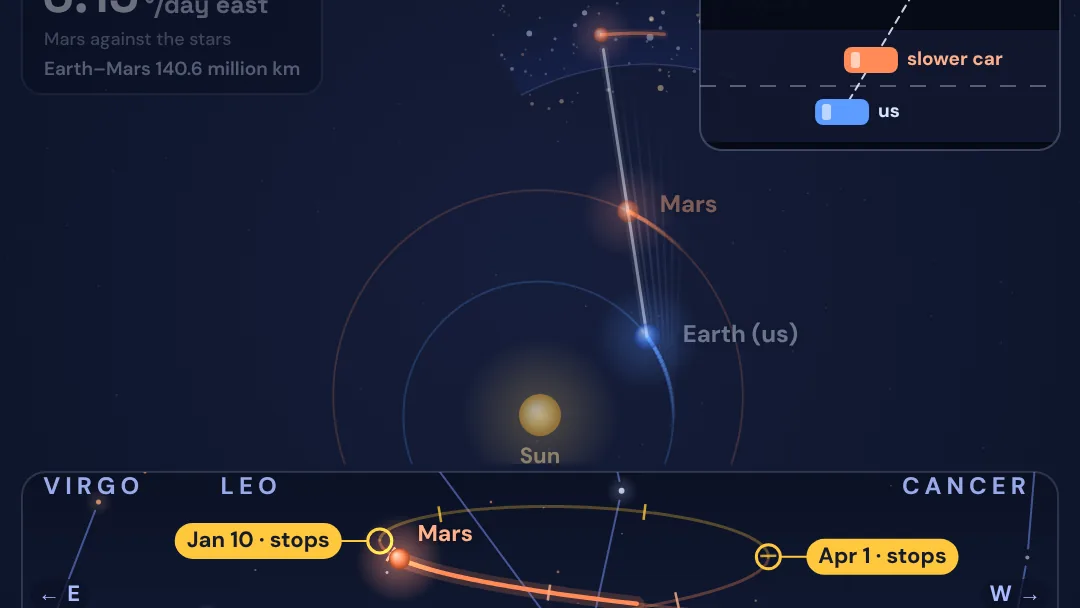
Top: the solar system from above, orbits to scale (the dots are not). The star ring travels with Earth, because distant stars keep the same directions. Bottom: the sky from Earth, east on the left, latitude stretched 2×. Drag Earth or the sky strip to move the date.
1 See
Most nights Mars drifts east against the stars. But every two years or so it stops, loops back west for a couple of months, then carries on. Is Mars really reversing?
2 Change
3 Understand
Model notes and sources
Orbits. Earth (strictly, the Earth–Moon barycenter) and Mars follow the Keplerian elements of JPL’s Approximate Positions of the Planets (E. M. Standish, Table 1, valid 1800–2050): semi-major axis a, eccentricity e, inclination I, mean longitude L, longitude of perihelion ϖ and of the ascending node Ω, each with its linear rate per century. For each date the model solves Kepler’s equation M = E − e sin E (with M = L − ϖ), places both planets in the J2000 ecliptic frame, and takes Mars minus Earth, corrected for light-time. Mars’s position against the stars is then λ = atan2(Δy, Δx), β = asin(Δz/Δ). Its apparent motion is the day-to-day change in λ.
What it finds. Mars stands still against the stars on Jan 10, 2027 (13:35 UTC, λ = 160.0°), slides west for 81 days, and stands still again on Apr 1 (13:06 UTC, λ = 140.5°): a loop 19.5° wide, all inside Leo, about 4° north of Regulus. Opposition, when the Sun, Earth and Mars line up, falls on Feb 19 at 15:39 UTC, and the closest approach on Feb 20 at 00:20 UTC, at 0.678 AU (101.4 million km). These agree with JPL’s DE421 ephemeris to within about an hour, and with ALPO’s predictions (stations Jan 10 and Apr 1; opposition 15:44 UTC; closest 00:14 UTC at 101.4 million km). All dates and times are UTC. The Short is timed to publish ahead of the February 19, 2027 opposition.
Stars. Every star is real: the 1,159 stars brighter than magnitude 6.5 in this part of the sky, from the Yale Bright Star Catalogue (J2000 RA α, Dec δ), turned into ecliptic coordinates with obliquity ε = 23.439°: λ = atan2(sin α cos ε + tan δ sin ε, cos α), β = asin(sin δ cos ε − cos δ sin ε sin α). The constellation readout uses the IAU boundaries. The sky strip puts east on the left, as when you face south from the northern hemisphere, and stretches latitude 2× so the shape of the loop shows; the loop is really only about 2.4° tall.
Drawing choices. The top view is to scale for the orbits; the Sun and planet dots are not. The ring of stars is drawn around Earth and travels with it, because real stars are so far away that each lies in the same direction from anywhere on Earth’s orbit. A ring fixed around the Sun at this size would bend those directions and hide the loop. Earth’s average orbital speed is 29.78 km/s and Mars’s is 24.08 km/s (the film shows these). The tool shows each planet’s speed on the day, from v = 29.78 km/s × √(2/r − 1/a): in February 2027 Mars is near its farthest from the Sun (1.66 AU) and moves at only 22.0 km/s, while Earth moves at 30.1 km/s. Earth laps Mars every 780 days on average, so a backward loop comes every two years or so, each time in a different part of the sky.
Left out. Precession and nutation (everything is in the fixed J2000 frame), aberration, the Moon’s tug on Earth, planetary perturbations beyond the elements’ linear rates, the stars’ proper motions, and the 69 s between UTC and the dynamical time the elements use. Mars’s computed position stays within about an arcminute of JPL’s full ephemeris, far finer than you can see.
Sources: JPL Solar System Dynamics, Approximate Positions of the Planets; ALPO, The 2026–2027 Aphelic Apparition of Mars; NASA, Mars Fact Sheet; Apparent retrograde motion; Hoffleit & Warren, Yale Bright Star Catalogue, 5th ed.; IAU constellation boundaries.
An ExplainerTools Original.