A car does not start braking the instant a hazard appears. It first travels through a reaction delay, then gives its motion to the tires and road during braking.
Try it yourself: change speed, reaction time and braking grip.
What are the two distances?
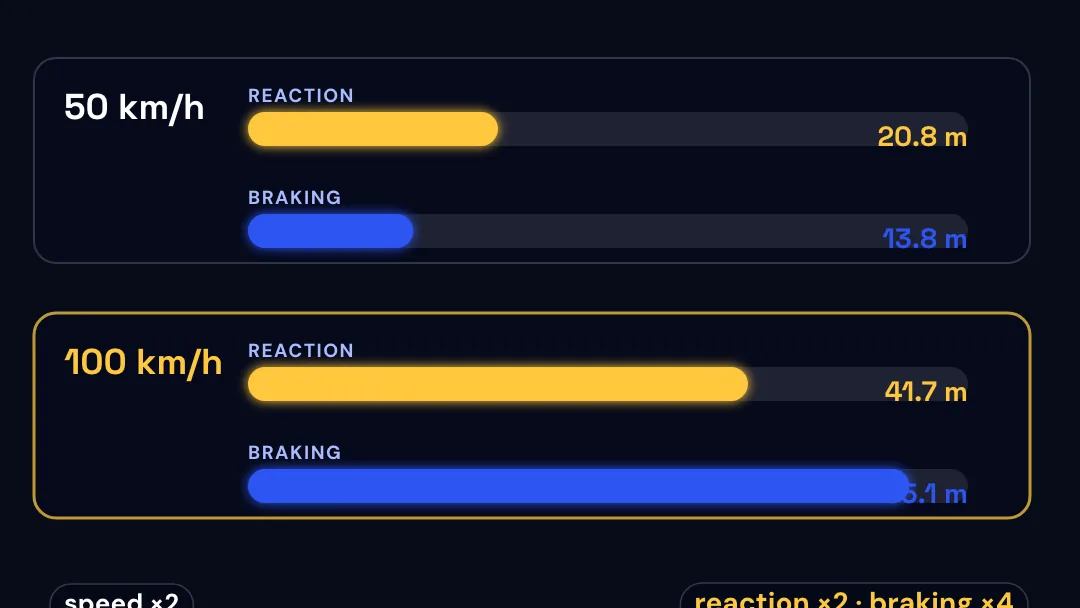
Total distance is v tr + v²/(2a). The film uses 1.5 seconds of reaction and 7 m/s² braking. At 50 km/h, that is 20.8 m plus 13.8 m. At 100 km/h, it is 41.7 m plus 55.1 m.
Doubling speed doubles the reaction part and quadruples the braking part. Faster automated detection can shrink the first part, but it does not remove the same-speed braking term.
What does the model leave out?
This is not a following-distance recommendation. Real stops vary with attention, visibility, brake buildup, tires, ABS, temperature, road surface, grade, weather and detection. The 7 m/s² value is illustrative, not a promise for any car or road.
Sources: NHTSA, Stopping Distance Worksheet; FHWA, Stopping Sight Distance; NHTSA, Minimum Stopping Distance Equations.
Sources & further reading
Make the next question an experiment.
Browse independent creators who make big ideas visible.
Find an explainer