Driving · interactive
Twice as fast, four times as far to stop?
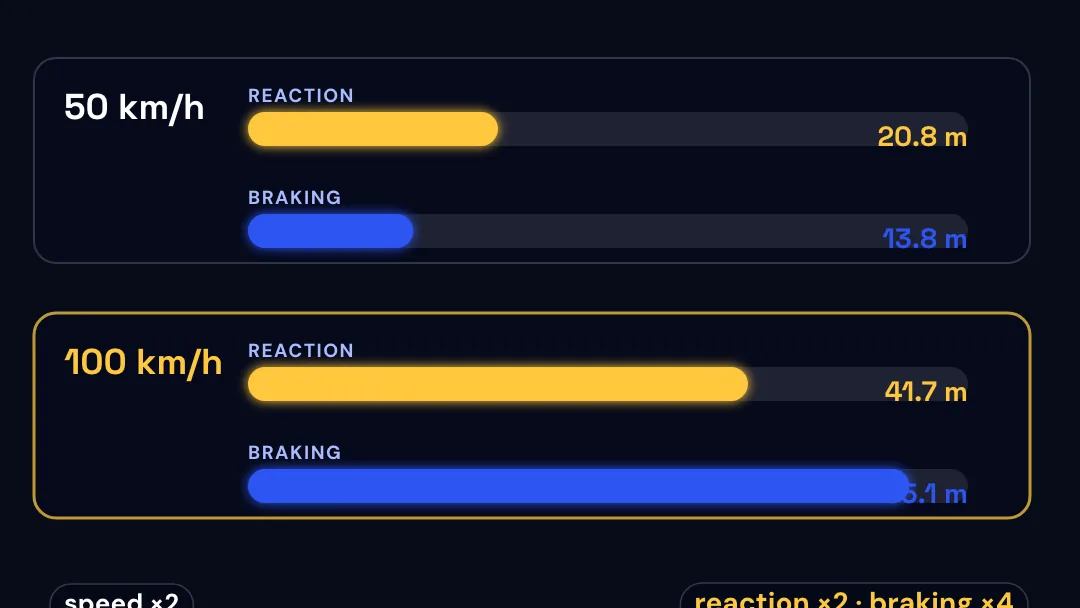
Yellow is the distance before braking begins. Blue is the distance while constant braking removes the car's speed. Change either part.
1 See
The brake pedal does nothing during the driver's reaction, then the tires must remove motion whose energy rises with speed squared.
2 Change
3 Understand
Model notes and sources
Model. Total stopping distance is reaction plus braking: d = v tr + v²/(2a). The film fixes reaction time at 1.5 s and braking deceleration at 7 m/s² on a straight, level road. At 50 km/h those parts are 20.8 m + 13.8 m = 34.6 m. At 100 km/h they are 41.7 m + 55.1 m = 96.8 m. Doubling speed doubles v tr and quadruples v²/(2a).
Automation. The automated preset uses 0.2 s only to isolate the reaction term; it is not a claim about any particular self-driving system. Faster sensing and control can reduce detection and actuation delay, but once the same car begins the same tire-limited stop at the same speed, the energy and braking-distance term remain. Real systems may also brake differently or earlier.
Not a safety forecast. Real stopping distance varies with attention, visibility, brake build-up, tires, vehicle mass distribution, ABS, temperature, road surface, grade, weather and obstacle detection. The constant 7 m/s² is an illustrative dry-road value, not a promise for any car or road. Do not use this tool to choose a following distance. The road and driving photos are AI-generated illustrations; every distance and label is drawn from the equation.
Sources: NHTSA, Stopping Distance Worksheet (approximately 1.5 s perception and reaction); Federal Highway Administration, Stopping Sight Distance (reaction distance plus v²/[2g(f+G)]); NHTSA, Minimum Stopping Distance Equations.
An ExplainerTools Original.