Throw a ball sideways, and it curves down to the ground. Throw it harder, and it lands farther away. The Space Station feels the same gravity, yet it has stayed up for decades. It has not stopped falling. It falls the whole time, and it keeps missing the ground.
Try it yourself in Newton's Cannon: turn up the launch speed and watch the ball land farther and farther away, until it never lands.
Is there gravity where satellites fly?
Yes, nearly as much as down here. The Space Station flies about 420 km up. At that height, Earth's gravity is about 90 percent as strong as at the surface. NASA: What Is Microgravity?
So why do astronauts float? Because they are falling too. The station, the crew and every loose pen fall together, at the same rate. Nothing presses on anything else, so nothing feels heavy. This is free fall. The station is also racing sideways, and that sideways speed is the whole trick.
How fast would a cannonball have to go?
Isaac Newton pictured a cannon on top of a very tall mountain, firing sideways. A slow shot curves down and lands nearby. A faster shot lands farther away. Fire fast enough, and the ball falls all the way around Earth, back to the mountain. The idea appeared in A Treatise of the System of the World, published in 1728. Wikipedia: Newton's cannonball.
Newton's Cannon puts the cannon on Newton's imaginary mountain, 8.8 km tall, about the height of Everest. With no air in the way, a 40 m/s fastball lands about 1.7 km from the cliff. A rifle bullet at 1 km/s lands about 43 km away. At 7 km/s, the ball covers more than 600 km before it comes down.
Why does the ball stop landing at about 8 km/s?
Watch the first second of flight. In that second, the ball falls about 4.9 meters below a straight line. That is true whatever its sideways speed. Gravity pulls a fast shot down exactly as hard as a slow one.
But the ground is not a straight line. Earth's surface curves away beneath the ball, about 5 meters for every 8 km. The Physics Classroom: Satellite Motion.
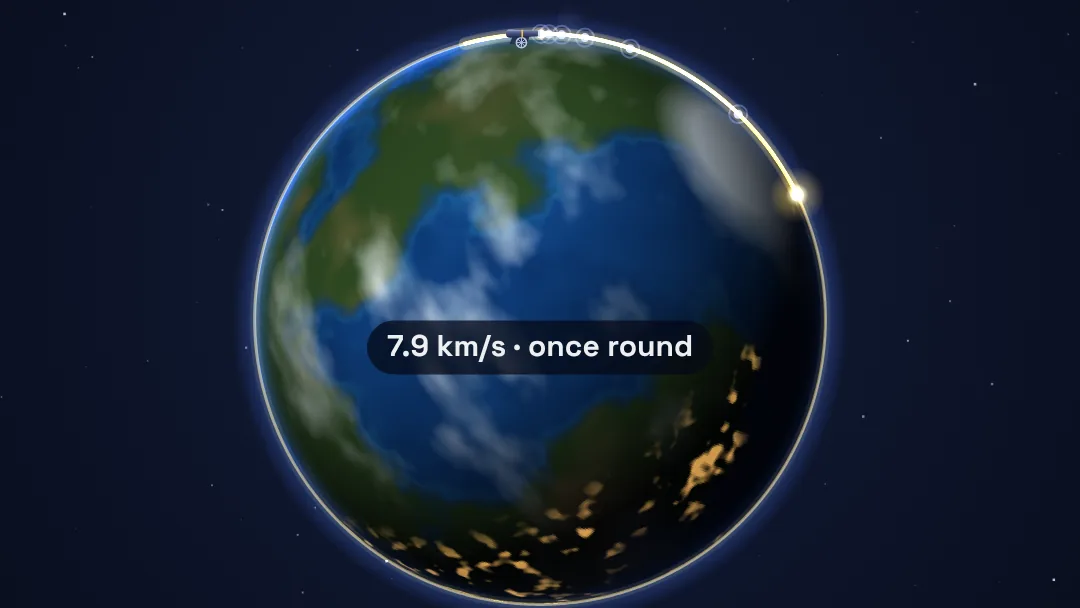
So fire at 7.9 km/s from the mountain top. In one second, the ball falls 4.9 meters, and the ground curves away 4.9 meters beneath it. The ball is no closer to the ground than when it started. It keeps falling and keeps missing. That is an orbit. In the model, the ball comes back round to the mountain every 84.5 minutes.
Fire faster, and the ground curves away more than the ball falls. The ball climbs, slows and falls back around Earth in a stretched loop, an ellipse. Faster still, and the path opens up and never closes. Gravity keeps slowing the ball, but never enough to pull it back. From the mountain top, that escape speed is about 11.2 km/s. Wikipedia: Escape velocity.
Why does the Space Station circle Earth 15.5 times a day?
Higher up, gravity is a little weaker, so a circular orbit needs a little less speed. At 420 km, the Space Station needs 7.66 km/s. That is about 27,600 km/h, or roughly 17,000 mph. OpenStax: Satellite Orbits and Energy.
Its circle is bigger, too. One lap takes 92.8 minutes in our model, so the station goes around about 15.5 times a day. NASA rounds this to 16 orbits, and 16 sunrises, every 24 hours. NASA: Space Station Facts and Figures.
A real cannonball leaves the barrel at about 0.5 km/s. That is about fifteen times too slow.
What does the model leave out?
Newton's Cannon and our film compute Newton's idea cleanly: a round Earth with no air and no spin. Earth, the mountain and the paths are to scale. The cannon, ball and station icons are not, and the motion is a time-lapse. The model leaves out:
- Air. At these speeds, air would quickly slow and heat a real ball. No real mountain reaches above the air.
- Earth's spin. The turning Earth adds up to 0.46 km/s to a shot fired east.
- Earth's shape and neighbors. Earth is slightly flattened, and the Moon and Sun pull too.
Even 420 km up, a trace of air remains. It slowly drags a space station lower, so stations need a regular boost to stay up. Wikipedia: Orbital decay.
Can a falling cup stop leaking?
This experiment comes from a NASA teacher's guide, Suited for Spacewalking. These steps are a suggestion, so adapt them to the child beside you. Work outdoors or over a bucket. You need a paper or plastic cup, a pencil and some water.
Predict. Poke a small hole in the side of the cup, near the bottom. Cover it with a thumb, and fill the cup with water. Ask your child what will happen if you drop the cup. Will water still pour out of the hole as it falls?
Try. First lift your thumb and watch the stream. Then cover the hole, refill the cup, hold it up high and let go. Watch the hole on the way down. A slow-motion phone video helps.
Explain. While the cup falls, the stream stops. Cup and water fall together, so the water no longer presses out through the hole. Gravity has not switched off. That is the Space Station in a cup: the crew floats for the same reason the water stays in. NASA: Suited for Spacewalking.
Back in Newton's Cannon, turn the mountain up toward 2,000 km. Predict first: will an orbit up there need more speed, or less? Then turn up the launch speed until the ball stops landing, and compare.
Newton's Cannon is an ExplainerTools Original. Its concept comes from Isaac Newton's cannonball thought experiment.

Sources & further reading
- Wikipedia, Newton's cannonball
- The Physics Classroom, Satellite Motion
- NASA, What Is Microgravity? (Grades 5-8)
- NASA, International Space Station Facts and Figures
- Wikipedia, Escape velocity
- OpenStax, University Physics Volume 1: 13.4 Satellite Orbits and Energy
- Wikipedia, Orbital decay
- NASA (1994), Suited for Spacewalking: Teacher's Guide with Activities (EG-101), Activity 1: A Coffee Cup Demonstrates Microgravity
Make the next question an experiment.
Browse independent creators who make big ideas visible.
Find an explainer