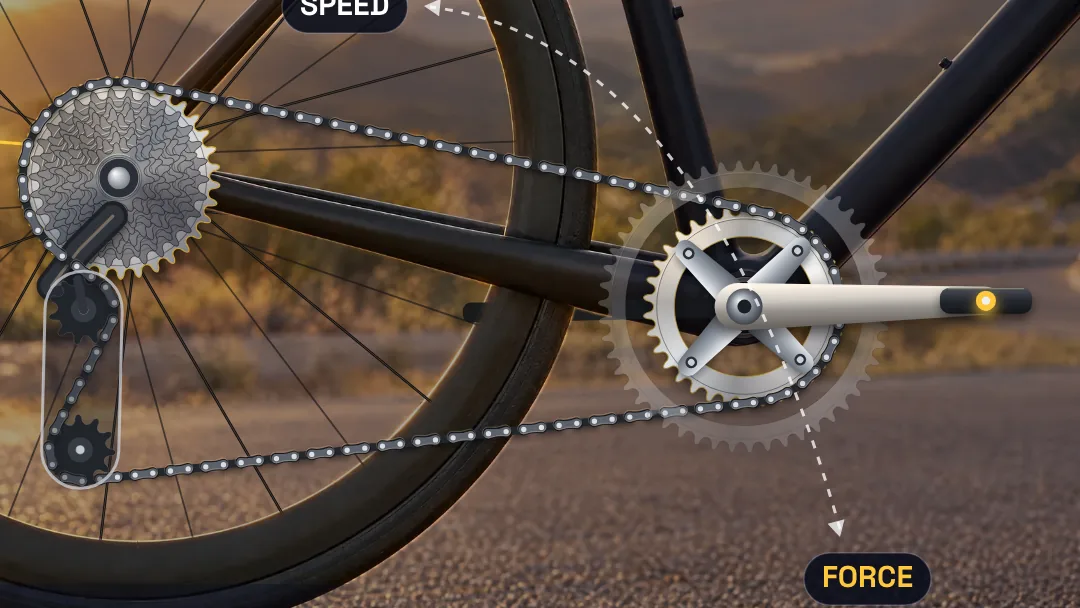
A low bicycle gear turns a climb into many light pedal pushes. A high gear sends the wheel farther with every pedal turn, but asks your foot for more force.
Try it yourself: choose a front chainring, rear cog and cadence, then watch the force and speed trade.
What does the ratio mean?
Wheel turns per pedal turn equal front teeth divided by rear teeth. The lowest preset is 34 ÷ 34 = 1.00. The top preset is 50 ÷ 11 = 4.545, so one pedal turn spins the wheel about 4.55 times.
With the same wheel and force at the road, pedal force is proportional to that ratio. The 50/11 gear therefore needs 4.545 times the pedal force of 34/34. That is why a rider shifts the other way on a hill.
What does the model leave out?
This is an ideal chain drive. It holds wheel size, crank length, slope and road force fixed and leaves out losses, chain angle, tire deformation, rider power, air resistance, acceleration and terrain. It explains mechanical advantage, not race performance.
The bicycle and climbing scene are AI-generated illustrations. Every tooth, chain link, arrow and number comes from the model.
Sources: Sheldon Brown, Gain Ratios; Bicycle gearing; Shimano, General Operations dealer manual.

Sources & further reading
Make the next question an experiment.
Browse independent creators who make big ideas visible.
Find an explainer