Machines · interactive
Why is a low gear easier on a hill?
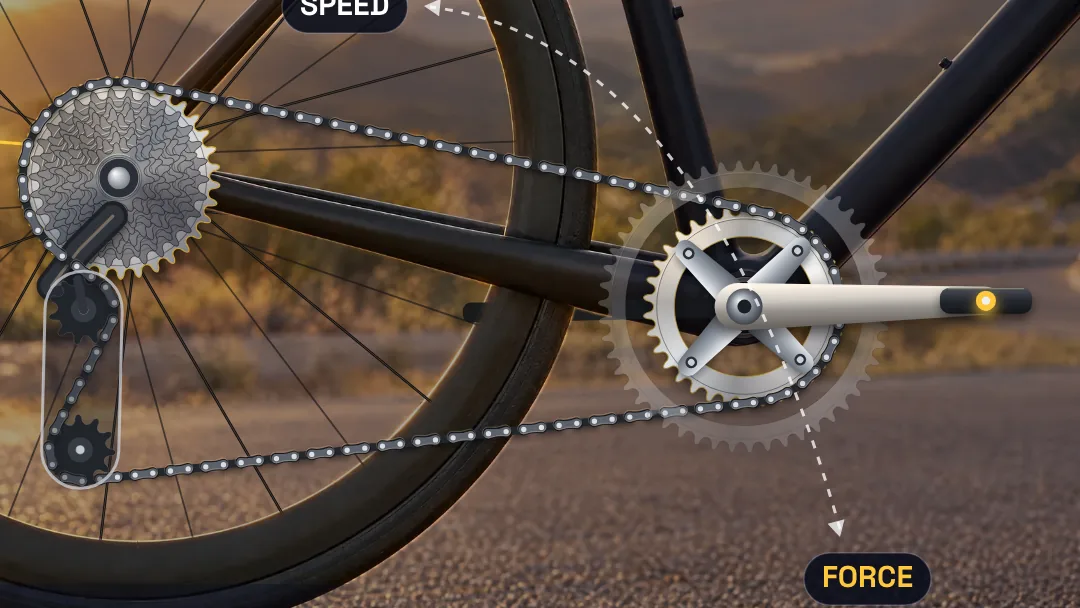
The teeth, chain, crank and readouts are drawn from the gear ratio. Drag the pedal or change the chainring, cog and cadence.
1 See
A 34-tooth chainring driving a 34-tooth cog turns the wheel once per pedal turn. A 50-tooth ring driving 11 teeth turns it 4.55 times.
2 Change
3 Understand
Model notes and sources
Model. An ideal derailleur drivetrain with no friction or flex. Wheel turns per pedal turn are front teeth ÷ rear teeth. The lowest preset is 34 ÷ 34 = 1.00; the top preset is 50 ÷ 11 = 4.545. With a 2.10 m wheel circumference, speed is cadence × ratio × circumference. At 80 rpm those gears give 10.1 km/h and 45.8 km/h.
Force trade. For the same force at the road and the same wheel, pedal force is proportional to the gear ratio. The 50/11 gear therefore needs 4.545 times the pedal force of 34/34. The comparison holds crank length, wheel size, slope and road force fixed. It is a mechanical-advantage comparison, not a rider-power or performance prediction.
Not modeled. Chain losses, changing chain angle, tire deformation, air resistance, rider power and cadence limits, terrain, acceleration and the bicycle's mass. The bicycle and climbing scene are AI-generated illustrations; every tooth, chain link, arrow and number comes from the model.
Sources: Sheldon Brown, Gain Ratios; Bicycle gearing; Shimano, General Operations dealer manual.
An ExplainerTools Original.